
I have an incredibly specific, some would say niche taste in survival-craft games. Nothing makes my dopamine spike like a game that challenges me to build a huge base, gather food, supplies, and weapons, and then (and this is the niche part) see how long I can defend said base from waves of attacking foes, deadset on killing me and tearing all my hard work down in the process. While many games do the former, with base-building being the defining aspect of the genre, none do the latter quite like 7 Days to Die does.
Some of you may be surprised to see a review of 7 Days to Die in 2024. For many people out there, 7 Days to Die is old news, a somewhat niche but otherwise well-known survival game that lots of players have gotten their hands on and already put a few hundred hours into. You may be surprised to learn that 7 Days to Die was just released this week (as of the time of writing).
The reason that’s surprising is because 7 Days to Die has spent a whopping 11 years in Early Access, originally hitting the Steam store in December 2013. While the game has been playable for what I disturbingly realize now is just more than half of my lifetime, it has never been considered finished. That is until the game officially launched into its 1.0 on the 26th of July, 2024.
So how did 7 Days to Die maintain a continuous player base in what many could very easily call developmental hell? You could very easily say that the game’s unique premise is what kept it afloat.

7 Days to Die is a zombie-apocalypse survival craft that challenges you to tough out the apocalypse with a special caveat: Every seven days, as the title suggests, a blood moon will occur, and during the night of said blood moon, your base will be under attack by a wave of zombies, purposefully spawned outside of the homes of every player in the server and hellbent on killing you.
This process continues every seven days ad infinitum, with the waves becoming progressively harder as time goes on—the size of the zombie horde and the strength of each individual zombie increase.
This gives 7 Days to Die an incredibly unique combination of survival-craft mechanics and tower defense. You are tasked with your usual survival needs of maintaining health and hunger, upgrading your loot, and exploring new areas, all with the knowledge that your precious base is not only potentially vulnerable to player attacks (if you’re playing on multiplayer) but that a devastating zombie horde will invade it. There are no ifs or buts; it’s simply a matter of how long you have until it happens.

There are many things about 7 Days to Die that feel incredibly dated or poorly designed. There are aspects that I frankly don’t like. Yet I’ve consistently played the game through its development cycle because the fundamental concept is so much fun and one that other games haven’t really emulated yet.
For many of you, that was enough to sell you on 7 Days to Die, and if the concept intrigues you, I highly recommend it. As I said, however, there are other aspects of the game I like, have mixed feelings about, or outright dislike, and many of you are going to feel the same about many of them.
When it comes to the survival mechanics, you will either love or hate them. 7 Days to Die heavily emphasizes realism (despite all the zombies) and tasks you with managing hunger, health, temperature, and illness. The constant hunger and thirst drain isn’t too much of a burden until your stamina (needed to perform basic actions like attacking or mining) starts to run low or recharge slowly because of your hunger or thirst, which can adversely affect your ability to restore either, especially since you can’t carry empty containers for water or drink from environmental water sources.

Injuries add a good amount of tension to the game, but again, they can be frustrating to deal with. Nowhere is this truer than breaking a leg, which slows you down to a crawl until you can splint the injury. Trying to run makes the hour-long heal timer take even longer.
Looting is entirely percentage-based, with the quality and quantity of times you find rolled based on your Lucky Looter perk. This can then become frustrating when necessary means for progressing the game, such as crafting workbenches, are blueprints locked behind the looting RNG. You can theoretically become blocked from progressing past a basic point for hours because the game just won’t drop the goods you need.
The variation of zombies in the game is really interesting, and fighting is more or less interesting. I don’t, however, love how certain weapon types are locked behind different perks, with endurance affecting your critical rate with shotguns. It’s a strange choice. I also don’t love the decision the developers made of making bloated zombies audibly shit their pants when you approach and have visible skid marks in their character model.
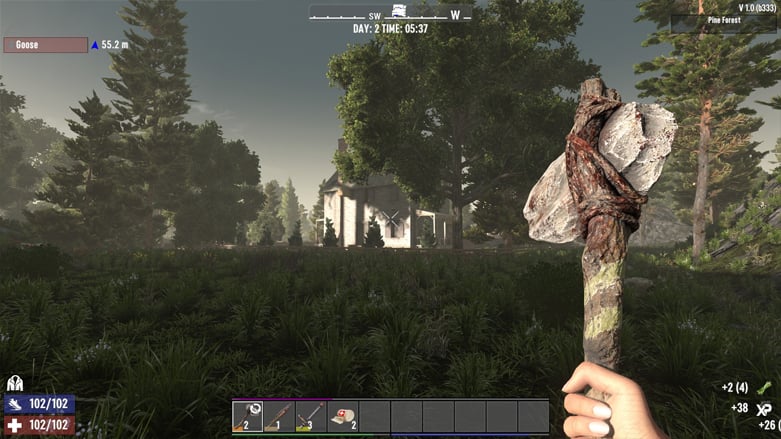
7 Days to Die looks dated, and that’s something that will keep a lot of players from giving the game a chance. That being said, the game looks as good as it can, considering its age, with the developers doing everything short of completely redoing the game’s models to beautify it for launch. While the Minecraft-style block construction of the world can look weird at times, the lighting is phenomenal, and the game is certainly passing, especially since graphics aren’t the selling point to begin with.
7 Days to Die, in my opinion, is dated in a lot of ways. Some of the mechanics feel unnecessarily tedious, the game doesn’t look incredible, and the engine is undoubtedly on its last legs. In other ways, however, the game is revolutionary, featuring a core mechanic loop that I am shocked no other games have replicated and a surprising amount of player freedom in its gameplay. If nothing else, 7 Days to Die will quickly become the next Stardew Valley or Rogue, inspiring a variety of new games and becoming the forefather of its own genre.
The Final Word
7 Days to Die is an incredibly unique title with a core gameplay loop that is unbelievably addicting. While there are certainly dated aspects of the game, 7 Days to Die is fun and worth giving a try, and should surely inspire a genre of its own.
Try Hard Guides received a PC review code for this game. Find more detailed looks at popular and upcoming titles on our Game Reviews page! 7 Days to Die is available on Steam, Xbox and PlayStation.

Comments