Becastled is a strange game.
It poses an interesting premise: what if a They Are Billions-style “city-builder-wave-survival” game met the 4X genre? It’s a neat idea, and one that Becastled presents by making the aforementioned city builder with wave mechanics tied to a grid system. You can only build on hexagons you control, and you must gather resources to expand to other hexagons and claim their resources.
As you do, you must balance expansion with defense, knowing that every few nights your city will be attacked by ever-increasing waves of foes. In theory, Becastled presents a unique strategy game where the rewards of 4X expansion are not so easily gained and therefore not so easily snowballed. Expanding too quickly can leave you exposed to attack, so you must think strategically and prepare on both the front and back foot—be both an expansive ruler and a defensive one.
In theory. In actual practice, Becastled becomes a very boring game of wait-and-see, where you aren’t rewarded nor are you encouraged to expand very far, and the threat of invasion is never a promising one.

If I could venture a guess as to why this is, based on my own time playing the game, I would say that it all ties to the game’s pacing, with the invasion clock moving so slowly that it is never worth worrying about, and yet providing you so much value for the resources you do obtain that expansion never feels like much of a priority. Your own internal threats are never pressing enough to warrant serious consideration either, making for a game that drags on for too long and doesn’t have the depth to justify it.
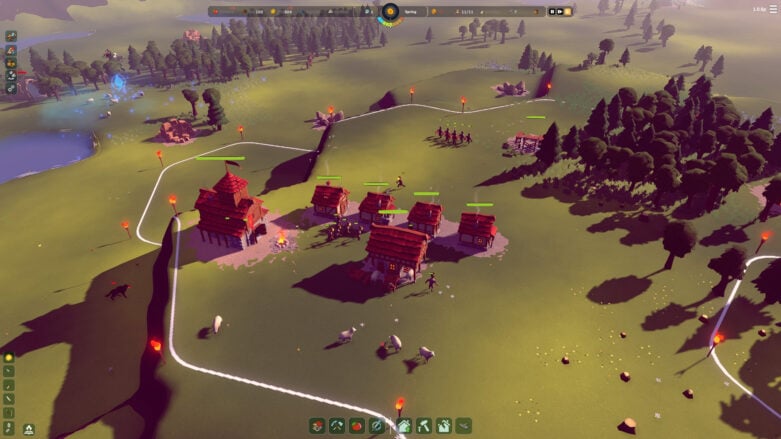
To explain, I’ll basically run you through a match of Becastled, which begins with you setting up a small town and gathering resources as a clock slowly ticks away at an upcoming invasion.
And I do mean slowly—it took me maybe 30 or so minutes in my first playthrough for an enemy wave to spawn. In similar titles, such as They Are Billions, which arguably popularized this genre, this time is vital for setting up; that first wave can kill an unprepared player, and as your buildings are built, you’re given a mechanic to pass the time, which is exploring the covered map.
Not only is the entire map already explored in Becastled, removing that vital time-waster used between building and turtling for the next invasion, but you certainly don’t need that much time to prepare. The first raids in Becastled are pitiful and continue to be pitiful throughout if you progress at the generous rate the game gives you.
As you build your base, you quickly realize that needs such as happiness are easily ignored. Your army has no rush to be expanded, fortifications don’t really need to be built, and you can even ignore feeding your population for essentially the entire game. While waves do eventually get bigger, they won’t do so in a way that feels like they catch you off guard.

As you expand, moving through the shallow tech tree and building soldiers, you realize that most of the game is waiting for the next wave to happen, with everything else being a bit of a chore you can choose to engage in if you wish. Otherwise, you’re placing houses, wood gatherers, and again, waiting.
During a match, you’re told that you can destroy four lunar towers across the map to summon the last wave. This communicates to the player as the victory goal. And thus, you might imagine destroying the towers themselves would be a tough task to accomplish. I was able to do so with 20 of the basic units (not many more than my starting amount) while they were starving from a lack of food.

The wave that spawned, of course, destroyed me. It was then that I realized this is not a mechanic to win the game, but rather a way to force the game to pick up the pace a bit. It’s confusing; it reads to the player as something you should aim to do, and to do it you should have the resources needed to reasonably fight the final wave to destroy all four towers to begin with. Instead, it’s a strangely convoluted difficulty setting that, again, makes you waste a lot of time.
Becastled strikes me as a child’s introduction to games like They Are Billions. It’s incredibly forgiving, giving you an abundance of time to prepare for each wave and making its management mechanics trivial and easily ignored. Even its graphics sort of mirror this idea, being a very generic low-poly fantasy game with no real style of its own or variation to its troops, buildings, or landscapes, with the greatest amount of variety ironically going to the enemies.

The game also has a surprising lack of depth for something that has been in Early Access for four years, with an abysmally small selection of troops and buildings, and a tech tree that mostly provides little buffs to your, again, ignorable management mechanics rather than anything really interesting.
With that in mind, I wouldn’t call it a terrible title. I think it has an audience, perhaps with younger players and those who are very new to this genre and the genres that inspired it, such as city builders and tower defense games. However, the fanbase that followed this game for so many years is not a bunch of children, and I can only imagine those who waited this long being disappointed in what the release version of Becastled has to offer.
The Final Word
Becastled is a game that plays slow, punishes those who want to speed things up a bit, and is far too forgiving with its management mechanics. It also has a surprising lack of depth considering how long it was in development, leading to a title that feels designed for children or players who have never played the genre. Most of the experience is waiting around for something to happen, only to realize that you’re usually vastly overprepared for what does, and it only provides a fair and engaging challenge if you’re willing to wait around for it for a good long while.
Try Hard Guides was provided a Steam code for this PC review of Becastled. Find more detailed looks at popular and upcoming titles on our Game Reviews page! Becastled is available on Steam and Nintendo Switch.

Comments