Of the games I have recently had the pleasure of reviewing, Death Howl is definitely something special.
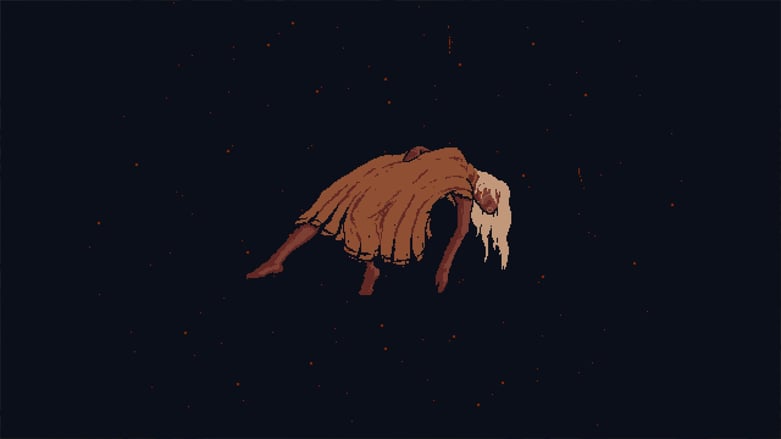
This is partially due to the game’s setting and story. Set in Neolithic Scandinavia, Death Howl follows our protagonist, Ro, a grieving mother who has just lost her son. Rather than accept his death, she uses strange, dark magic to pass over into the spirit realm, where she chases the spirit of her son, hoping to catch him before he crosses over into the realm of death. In order to do so, she must collect the titular death howls of the hostile spirits around her and confront the elder spirits who rule the realm, all the while being pursued by death itself.
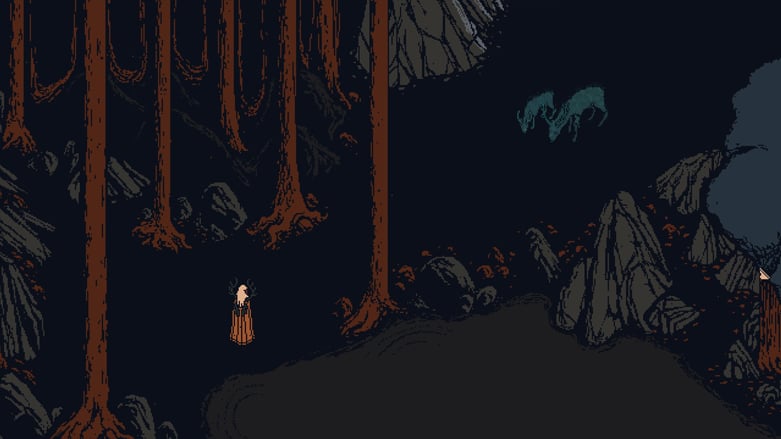
If you ask me, which you kind of did since you are here reading my review of the game, this is an incredibly strong premise. The story is made all the stronger by how confidently the game tells it. Death Howl does not feel the need to overexplain its concepts or premise, and immediately hooks you from the start with a quick opening that allows the tension and tragedy of the scenario to do all of the talking. Death Howl maintains its dark, grim tone throughout, hardly ever giving the player a chance to recover from the heart wrenching reality of this fantastical tale. The tension is constantly high and you want Ro to succeed, but the game is not afraid of making you question whether she is doing the right thing.
The game’s art does an incredible job of conveying the story’s dark and tragic tones with complementary visuals. The simplistic pixel art not only leaves room for your imagination to fill in some of the blanks in the game’s environments and monster designs, but also allows for the use of color to really shine and do some storytelling of its own. Often this translates into the particular theme of the area you are in, such as conveying sickness and plague with off greens and yellows and danger with red, but you get some subtle storytelling with Ro, her son, and the game’s primary antagonist as well. I will not go too deep into it here because I personally felt as though I got a lot of the story conveyed through the game’s art, but assuming I am not just grasping at straws, I can say that Death Howl’s visual storytelling is as fantastic as its writing, if not even more impressive.
Beyond the storytelling, both traditional and visual, Death Howl is special for the actual game part of being a game. Specifically, it uniquely combines the deckbuilding genre with the soulslike genre to make a formula I have not quite seen elsewhere.
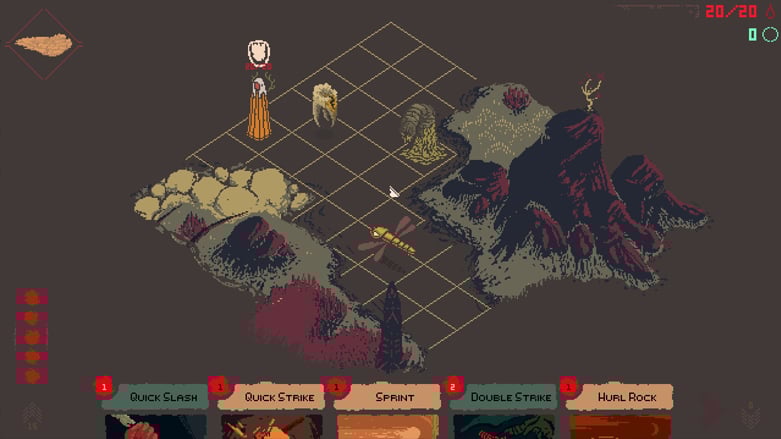
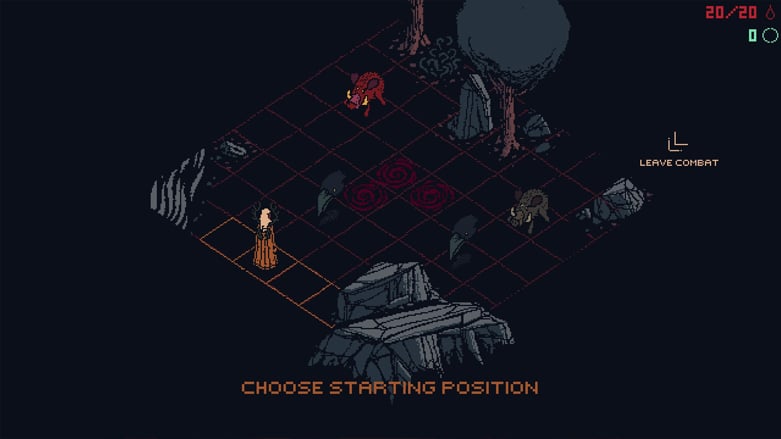
The way this works is pretty interesting. The map is semi-open, like you would find in a soulslike game, with turn-based encounters blocking your path at certain areas. These encounters play like a grid-based deckbuilding turn-based combat system, where you use action points to move and use cards with positional effects. Defeating enemies in these encounters rewards you with resources and death howls which are your main currency to level up and craft new cards. These are dropped on death and are used at what are essentially bonfires, where you are healed, and enemies reset.
What I find particularly interesting is how Death Howl translates one of the most important elements of a soulslike game, which is learning enemy attack patterns. Instead of attack patterns, each enemy has positional advantages and specific movement in the turn-based encounters that are vital to understand in order to defeat them. Knowing, for example, that a raven needs to be two spaces away from you in a line to attack or that a wurm fires in an L-shaped pattern makes the difference between success or repeated death in an encounter that cannot be skipped.
As interesting as the formula is, I think there are ways in which the combination does not work so well, particularly in progression.
I have said in the past that the reason the soulslike formula works so well is your ability to directly improve your character’s statistics in whatever way you want. Grinding out an area for souls is always rewarding when you can directly increase your health or damage or stamina to give you an edge over the opponents you face.
The leveling up equivalent in Death Howl does not proportionately increase your statistical strength, however, but instead gives you points to invest in skills that, while helpful, do not directly make combat easier in quite the same way. This is especially true when skills often require multiple points of investment before they activate and the fact that each area in the game has its own skill tree and even cards, which outright disables the skills you earned in another zone and penalizes the cards.
The fact that your level-up currency is also what you need to unlock new cards or to create new copies of existing cards further spreads your resources thin and overall contributes to leveling up in the game not feeling as exciting or rewarding as other titles in the soulslike genre. This can make the game feel almost stagnant in its difficulty until you have a very significant investment in skills and card combinations, and in the meantime, makes pursuing the level-up feel perhaps necessary, but not really fun to do, thanks to the lack of an immediate perceivable difference.
Regardless, Death Howl is still a unique, fun-to-play, albeit difficult title with a lot to offer. Between its original mechanics and incredible art and storytelling, I have very little doubt that the game is going to be very successful, even if I do not personally feel like it pulls off the souls like half of its formula all too well.
The Final Word
Though I felt the game’s progression system was somewhat flawed, Death Howl still managed to impress me thoroughly with its incredible storytelling, art, and unique blend of genres, creating something utterly unique and highly memorable.
Try Hard Guides was provided a Steam code for this PC review of Death Howl. Find more detailed looks at popular and upcoming titles on our Game Reviews page! Death Howl is available on Steam, GoG, and Xbox.

Comments