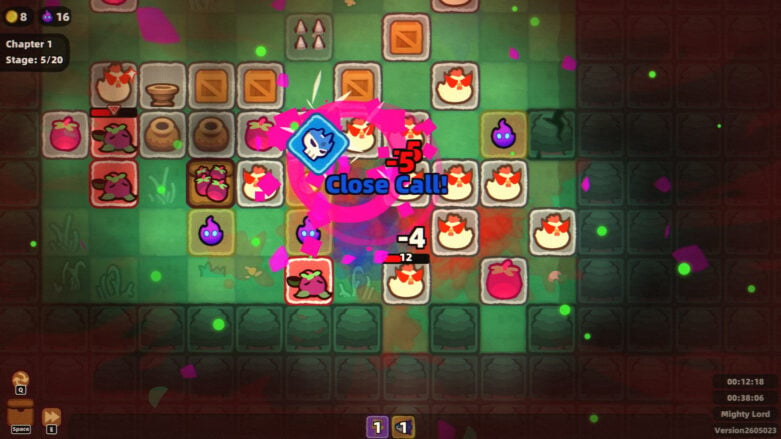
No titles challenge conformity quite like indie games, as indie creators are capable of making some of the most unique games you will see on the market right now. It doesn’t take much to create a game that feels unique among its peers; it could be as simple as tweaking a familiar mechanic to make a title that truly stands out and is utterly memorable for its gameplay.
Enter Demon Lord: Just a Block, an indie title that is just that, and manages to win me over very quickly and with little effort, delivering a super unique experience built around just one small change to the familiar.
Demon Lord: Just a Block is a turn-based roguelike game where players take on the role of a fallen Demon Lord (a character trope of anime fame) and fight to take back their kingdom from the hero that defeated them… sort of.
All of the roguelike properties of what I just described are there. The game follows the formula of the genre very closely, with procedurally generated levels, persistent upgrades, procedurally selected rewards, the whole shebang. The “sort of” comes in when describing the game’s turn-based combat, which is the small change that makes a major difference in how it plays.
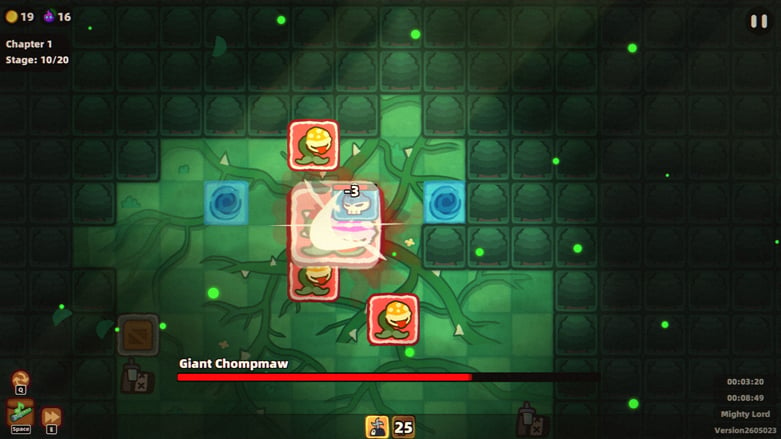
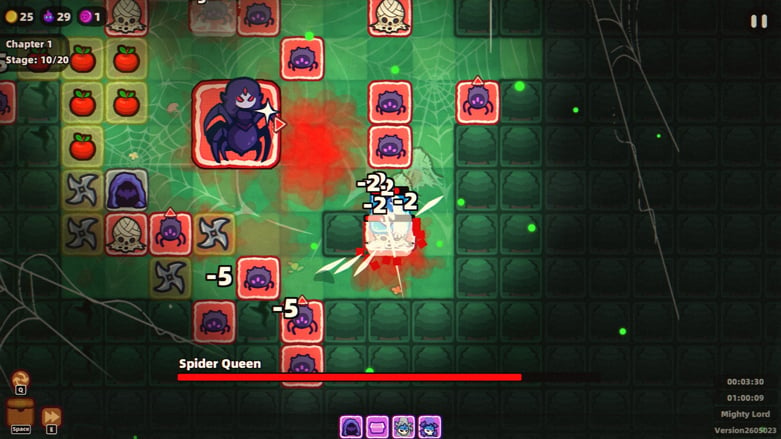
Demon Lord: Just a Block is, technically, turn-based; the player and enemies both act in turns, and when not acting, nothing happens. The difference is that the game is played on a tile, and each movement made by the player is what constitutes a turn. If you stand still, nothing happens, but if you use any of the movement keys to go left, right, up, or down, that counts as a turn, and the enemies around you will act as well. You can just move freely and everything will play like a normal game, but each command is technically triggering turns, making it a turn-based game where turns move as quickly as you want them to.
I just used the word “turn” a lot, but I hope you get the picture.
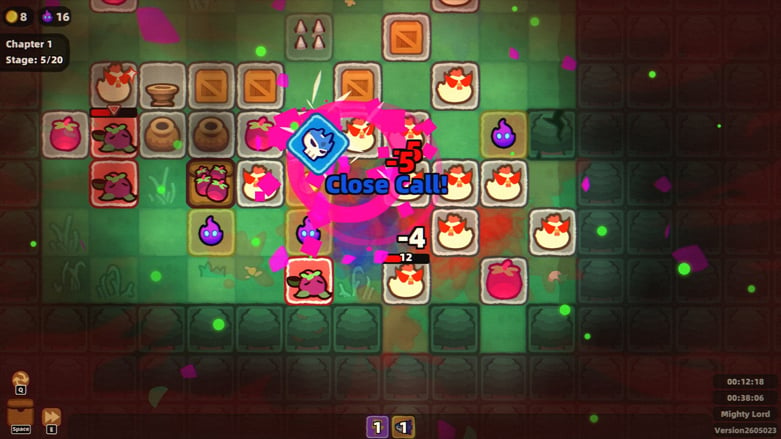
Demon Lord: Just a Block uses this unique take on the turn-based formula to create a game that is simultaneously a turn-based tactics RPG and a grid-based positional strategy game. Since each movement is a turn, and turns don’t fire when you don’t move, you get to see the direction enemies will attack before they happen. Every action in the game is played based on how you move on the grid, with even attacking enemies done by moving towards them, so the game becomes a strategic game of planning your moves so you’re not on a dangerous tile when an enemy attacks, while also throwing yourself into them and using your various collected powerups and weapons to kill them.
The game is fun to play, using a simple mechanical loop that is pretty hard to get tired of. It doesn’t offer a whole lot of complexity, but its simple twist on turn-based tactics makes for a unique kind of game and one that doesn’t need a whole lot of complexity to shine.
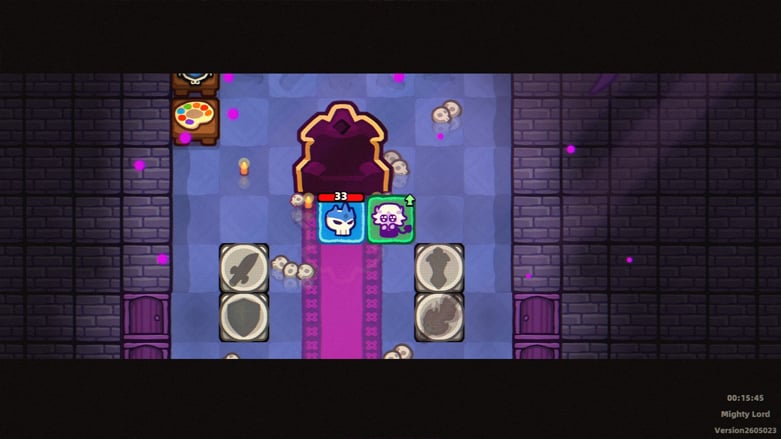
If I were to point out any glaring flaws in the title, it would be that the game itself isn’t, and doesn’t try to be, too wide in its scope. The game won’t take you very long to get through, offering a fair, if modest, playthrough without a whole lot of incentive to go back and play again. Many of the power-ups and builds you will discover are less than halfway through the game, and they can vary from really clever and unique to kind of boring. My personal favorite was the soldier spamming build, and I will say that when these powers were fun, they were really fun, going into areas that other roguelikes are afraid to go for balance purposes.
Another issue with the game stems from localization. Developed by a solo developer based in China, the game’s dialogue and text can be a bit hard to decipher or awkward to read. If you’re just here for the gameplay, this isn’t as much of a problem, but I found myself invested in some of the characters (particularly Lulu), and the awkward dialogue made it hard at times to fully engage with the storytelling.
Finally, it’s worth pointing out that the developer has admitted to using AI assistance in making the game’s music. While they insist that the rest of the game is developed by hand, the developer’s admitted use of AI is not disclosed on the Steam page, which also clearly uses an AI-generated description. If, like me, you have moral objections to the use of AI in creative spaces, this could be very important information and something you’d be disappointed to learn is not disclosed on the store page. It is also worth mentioning that failing to point this out on your game’s page is a violation of the Steam terms of service, and that failure to disclose important information gives me, as a consumer, some pretty bad vibes.
Overall, Demon Lord: Just a Block is a fine title. The gameplay loop is simple, lacking in scope but using a clever twist on the turn-based formula to deliver fun gameplay that is amplified by the inherent replayability of the roguelike genre. The art is simple and cute, and the characters are appealing, even if the localization can make it hard to fully understand them. It’s a good, short game, without too much going on, and not a bad way to spend $13.
The Final Word
Demon Lord: Just a Block is a fun, small-scale roguelike with some cute art and a clever twist on turn-based strategy gameplay. It makes good use of the roguelike formula, with the gameplay being simple and yet weirdly addicting, albeit lacking in much longevity beyond that inherently provided by the roguelike formula. All in all, it is not a bad way to spend $13.
Try Hard Guides was provided a Steam code for this PC review of Demon Lord: Just a Block. Find more detailed looks at popular and upcoming titles on our Game Reviews page! Demon Lord: Just a Block is available on Steam.

Comments