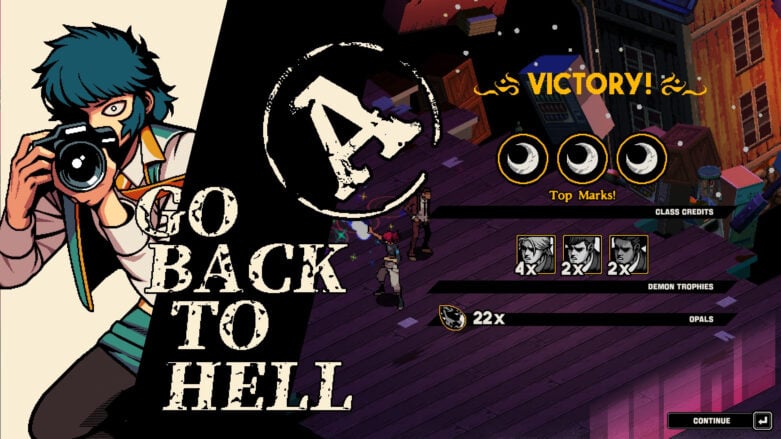
Demonschool first caught my eye a few months ago, with a bit of promotional material popping up on Steam that immediately convinced me it was going to be my kind of game. After all, what’s not to love in the promise of a highly stylized, character-driven, school-life-style RPG about demon hunting? The premise was promising, but the aesthetics of the game alone were enough to make me want to give it a try.
And those aesthetics did not disappoint. Demonschool is a hand-drawn game that blends large 2D character portraits with pixelated graphics, depicting a cast of characters and a world I would call 2000s academic goth. The character designs, looks, and feel of the world remind me of being a gothy punk back in early high school, invoking vibes of skateboarding, Hot Topic, Kingdom Hearts, Persona, and other things you might sketch in your lined-paper notebook during class. It’s a very specific style and one that pulls a lot from Japanese media, and I’m all here for it.
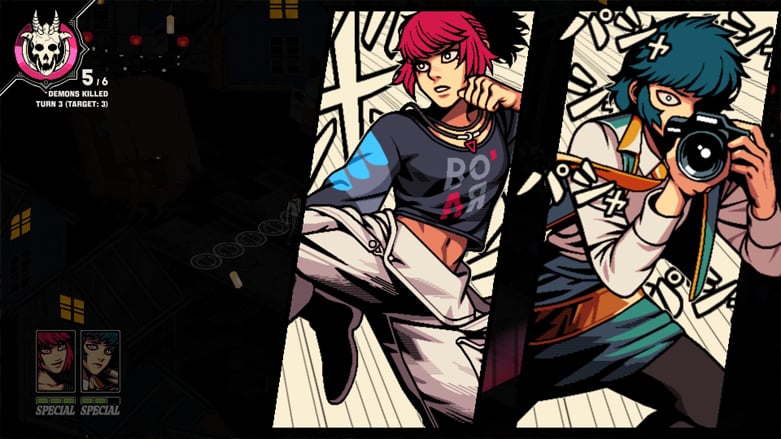
The same reasons I enjoy the game’s art are why I found myself liking the characters, too. They’re all depicted in a very cool and very relatable style, with character designs that appealed to me. While each character had their own personality, I often felt like the dynamics between them were played up for a laugh and were hard to follow, which is an issue I would use to describe a lot of the game’s writing.
Another thing of interest in Demonschool is the combat mechanics. Demonschool takes a unique approach to turn-based combat by giving you a sort of game of push and pull, using movement and momentum to damage enemies. Essentially, working on a square grid, your task in Demonschool is to use your limited action points and party to line up enemies and shove them into each other, or into your teammates, and create huge combos of what are essentially demon-yakuza-dominoes toppling over one another. Each combat encounter requires you to clear a certain number of enemies to finish, and after doing so, you have to end a turn with a character on a specific tile to end the encounter before you are overwhelmed by constantly spawning enemies.

The combat is very interesting and plays more like a puzzle game than traditional turn-based RPG combat. I can see this system being a favorite for some players and an admittedly jarring, if unique, mechanic for others who might otherwise prefer more traditional combat.
Demonschool is not just a series of puzzly combat encounters, however. It is a character-driven, narrative RPG with a story to tell. Unfortunately, it’s in this aspect that I found my biggest problems with the game.
Describing the problem with Demonschool’s writing is… complicated, and I kind of feel like you have to experience it yourself to fully understand what it’s like. To put it best I can, the story in Demonschool is poorly paced, happens at breakneck speeds, often makes no sense, and poorly writes its characters.
The best way I can describe it is that it feels like the whole thing is a disjointed mess with attention problems. Nothing builds up in Demonschool. Things just happen, with the characters never paying any mind to the absurdity of why or how. Things in the story seem to fall into place for our characters by happenstance, without them working for it, and then take a sudden left turn into a new direction. I can safely say that you won’t often be able to predict where the story goes in Demonschool.
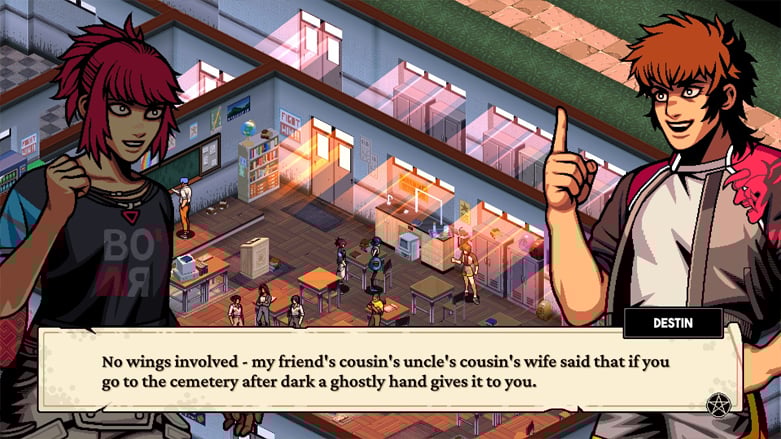
Character dialogue is often short, a little confusing, and played for laughs at the expense of creating cohesive and consistent character personalities. It is so bad that in several cases, the secret information a character needs to move forward is revealed to us as a joke, such as a minion blurting it out at the player party, and often it feels like this is done because the writers don’t know how to continue the story.
I think the game’s introduction does a fantastic job of conveying how hectic and disjointed the story is and does so without me having to spoil later elements for you in case you’re still curious about giving the game a try yourself.

Demonschool begins with our main character, Faye, trying to make friends on a boat heading to an island college. She walks up to one of her fellow students and immediately starts blurting out that demons are real and are going to be present at the school, which understandably makes her new friend uncomfortable. When they get to the school, they find out that this friend, Namako, is going to be kicked out of school, so she and Faye fight a group of gangsters who, for some reason we don’t know yet, are in charge of admission. After winning, the gangsters let them inside the school, at which point Faye reveals to Namako that she knows who she is and that they are both part of a prophecy about demons returning to earth.
With no indication that this is a paranormal school, something we’re supposed to piece together by a series of weird events, but is dropped on us all at once at the start, Faye and Namako attend their first class, where the teacher immediately tells them that they specifically have to go find a tape that kills anyone who watches it. Faye and Namako then bounce around from location to location, randomly skipping time and going on a series of seemingly unrelated tasks as they solve this mystery, with each dialogue segment being short and confusing and sending them on what feels like a wild goose chase without our characters questioning it.
If that explanation of the early game feels like a confusing and jarring mess to read, I can promise you that it’s far worse in-game. Things never quite make sense in Demonschool; the story never progresses in a way that feels believable or satisfying, and it feels like you’re ping-ponging between a series of random, short, comedic dialogue segments because the author didn’t know how to get you from point A to point B and made it up as they went.
The Final Word
Demonschool is an interesting title with a unique, puzzley approach to turn-based combat and phenomenal art direction and aesthetics. The story in this story-driven game, however, is all over the place and fails to feel cohesive or satisfying, while also playing more into laughs than solid characterization. If the game has caught your eye, I still suggest trying it out, but beware that you may also find the writing disjointed, confusing, and whacky in a not-so-intentional-feeling way. But maybe you’ll find more fun in the randomness than I did.
Try Hard Guides was provided a Steam code for this PC review of Demonschool. Find more detailed looks at popular and upcoming titles on our Game Reviews page! Demonschool is available on Steam, Nintendo Switch, Xbox, and PlayStation.

Comments