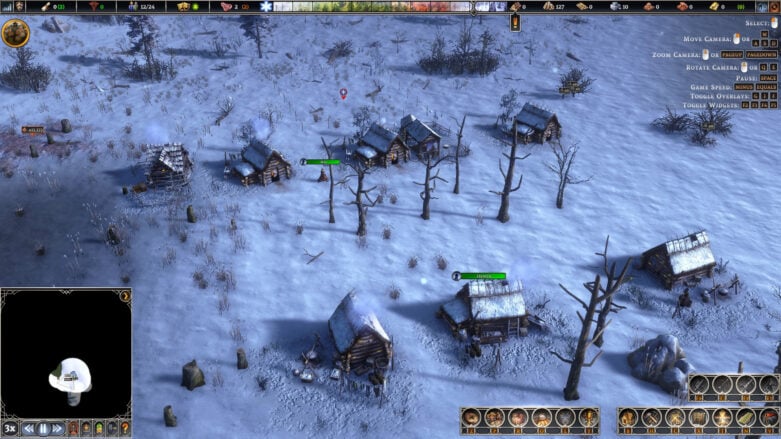
Farthest Frontier is a deeply invested city builder with RTS mechanics and one that took me quite a bit of time to really form an opinion on.
Firstly, playing Farthest Frontier made me realize just how spoiled I’ve been by Manor Lords. The latter’s free-form building system—revolutionary in its genre—really makes for some immersive and gorgeous cities and has made it hard to go back to grid-based city builders.
While Farthest Frontier’s building is grid-based, I have to commend the creators on just how good they’ve managed to make everything look. A healthy variety of alternative models for buildings, mixed with textures that blend together well and lots of attention to detail, have made for a city builder that looks absolutely incredible, if still quite grid-like.

That is, of course, one of the more important aspects of a city-building game, as I’ve mentioned in the past. You don’t invest time into this genre to build a city that looks bad; something appeals to that inner architect inside all of us when we put together our own gorgeous-looking city. Farthest Frontier succeeds on this front splendidly.
The second, arguably equally if not more important aspect of a city-building title, is how well it simulates its economy. I’ll go ahead and spoil it for you: Farthest Frontier succeeds on this account as well, if with a few hang-ups I’ll touch on shortly.
One of the biggest reasons Farthest Frontier succeeds on both fronts is because of the absolutely massive variety of buildings, and therefore production chains, it features. Your city will be vast and gorgeous, with a nicely complex economy as you populate it with an absolutely ridiculous amount of occupations and associated unique buildings to go with them. From mining iron to harvesting soap, there is a lot to do to build a city and keep it running in this title.

It can, at first, feel as though a lot of the economy is easy to master. On my first playthrough, I quickly found my village overstocked with food and with a pretty decent rate of immigration and a good birth rate.
However, you learn that the balance of the game is based around resource distribution—more specifically, the presence, or utter lack thereof, of certain resources across the game’s randomly generated maps. Added to the game’s balance is the threat of raids, which can be utterly devastating, especially if you’re struggling to produce an economy that can support a military.
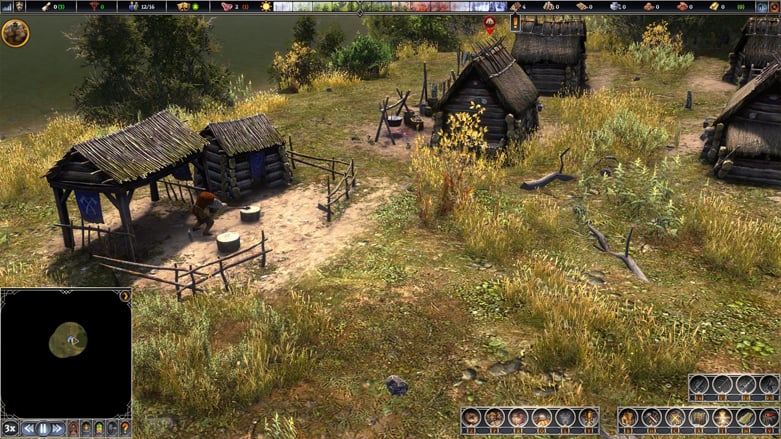
Over time, Farthest Frontier reveals itself to be a city builder of considerable depth—so much so that you can only really learn how deep it goes by playing the game yourself. It’s for these reasons that it’s easily become one of my new favorite, if not my current most favorite, city builders, scratching an itch the genre hasn’t scratched for me for a while. This is, of course, despite some issues I have with the game.
There are small problems with the game, such as the fact that empty households incorrectly show that they provide you gold income, or roads not connecting automatically when placed next to each other, or that markets incorrectly display that they can extort more tax money out of the same houses taxed by other markets in the build menu. These issues and others are ones I imagine the developers will patch out of the game one day, though they’re not game-breaking per se as they exist now.
While it certainly adds a bit of depth to the gameplay, Farthest Frontier’s research tree is, unfortunately, mostly just a series of mathematical improvements to the rate at which certain chores are done or the stats your troops fight with. AKA, a number-based progression system—something I complain about in most places I see it implemented in the place of something more exciting or engaging. While, sure, it’s helpful to produce shoes 12% faster, it’s not nearly as exciting as unlocking something tangible, like a new ability or feature. It makes research and the knowledge points required for it feel like something of an afterthought—a bonus currency to spend to make the game a little faster or easier and nothing all too exciting to focus on.

The game’s policy system is much the same. These are city-wide buffs that you can apply at the cost of some kind of debuff to counteract the strength. While they have a depth of strategy in their use, again, it’s just numbers, and I found that a little bit disappointing.
Where the tech tree does unlock meaningful changes are new buildings, which are sort of bottlenecked behind tech points and can at times feel like an arbitrary gate that’s kept. At the same time, however, I feel like unlocking these structures with tech points sort of plays into the game’s pacing well, although I honestly would have just preferred it not be there at all.
The biggest problem with Farthest Frontier has got to be the game’s UI and lack of tooltips. The HUD is, frankly, not the best, and doesn’t convey vital information to you at a glance, such as how many civilians you have that are unemployed. Various areas in the game take some trial and error to understand as well, which isn’t terrible but could have easily been explained through better tooltips, which could have easily been implemented.
For those with a mind for efficiency, there is unfortunately very little that can be done to improve transportation and logistics in your city, and what there is is poorly explained (to the point where I still don’t totally understand it myself).
Finally, the load times in Farthest Frontier are pretty bad. I’m not sure what goes into the map generation, but for reference, I was able to write about half of this review while waiting for my new game on the large map size to load. While, again, I don’t know what’s going on under the hood with this game, I’m sure whatever makes these maps load so long can be easily optimized.
The Final Word
Farthest Frontier has its issues but still manages to be one of my new favorite city builders thanks to the sheer amount of depth in its economy and attention paid to gorgeous, expansive city building. Though it lacks some options in the logistics department and the UI is hard to look at, fans of the genre should find a title worth investing in with this deep colony builder.
Try Hard Guides was provided a Steam code for this PC review of Farthest Frontier. Find more detailed looks at popular and upcoming titles on our Game Reviews page! Farthest Frontier is available on Steam.

Comments