Tim Burton and those he has created his iconic films with (shout out to the criminally underappreciated Henry Selick) have always been one of my greatest inspirations. As a child, I would watch The Nightmare Before Christmas over and over again on repeat, and Corpse Bride remains to this day one of my all-time favorite love stories. From Beetlejuice and Edward Scissorhands to Frankenweenie, it’s easy to see why this artist and his timeless aesthetic captured the imaginations of so many all over the world. It is also easy to see why I, and many others, would be thrilled at the concept of a game based around Burton’s macabre art and storytelling styles; enter Gloomy Eyes, a title that now competes with Little Nightmares for the position of my favorite narrative puzzle-adventure game.
Gloomy Eyes tells the story of a world where the sun has up and left. That’s no exaggeration, as the narrator puts it, the sun got tired of humanity’s bickering and decided to leave one day. The sudden loss of sunlight brought about the zombie apocalypse, with the dead rising from the earth and humanity retreating into the safety of their cities. You play as the titular Gloomy, a zombie child who simply wants to make a friend (despite his violent outbursts and bad reputation), and Nena, the human daughter of a zombie-hunting fanatic, as they come together to form an unlikely friendship and bring the sun back, just in time for the Halloween season.

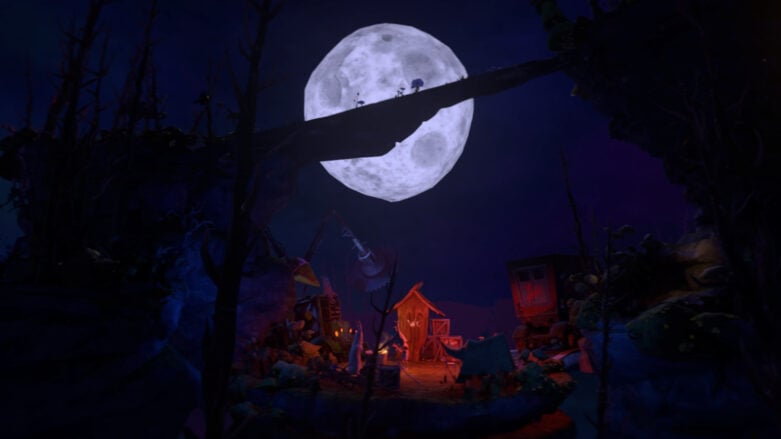
I shouldn’t have to explain this bit, but the absolute strongest element of Gloomy Eyes is the art style. As I previously mentioned, the game takes big inspiration from the art and films of Tim Burton, with a noticeably claymation style that pays homage to The Nightmare Before Christmas, Frankenweenie, and Corpse Bride. The entire world is displayed like you’re on the set of a claymation film mid-shoot, with each level being a highly detailed and macabre diorama cleverly put together for players to find their way through while also being in awe of the gorgeous scenery.
The game was clearly designed as an art piece first and video game second, which is not an insult in the slightest. I absolutely admire everything the developers did to make the game as gorgeous as it is, and all done without bloated file sizes or the very modern and very pointless pursuit of hyper-realistic lighting and graphics. It’s a game built around a very specific style, and it pays homage to its inspirations while also being a stand-alone piece of art worth studying and admiring alongside them.

This focus on art and detail-packed level design can be a little tricky for the eyes of a player looking to progress, however. Maybe my eyes are just getting worse with age, but there were certainly points in every level where I found myself confused as to where to go to move forward. Thankfully, the developers included a clever tool to help with this problem. You can, at any time, zoom out and view the entire level as a diorama, rotating it and seeing where you need to go next to progress or solve a tricky puzzle.
Said puzzles are, admittedly, tricky. Again, I found myself stumped on every level, and more than a few times had to rely on the provided hints in order to solve a problem I was stuck on. For the puzzle-loving gamer, I would say this is actually a big plus. I’ve played far too many puzzle games lately that fail to be puzzling, and while they aren’t my favorite genre, I can appreciate why someone would want a brain teaser to actually tease them.

The game’s mechanics are built around the somewhat familiar genre trope of a co-op puzzle game, using two characters with opposing abilities to collectively clear paths that neither one could approach alone. Gloomy is a zombie with the ability to fling objects or drag things to interact with the environment, but light is his bane. Nena is a frail human with the ability to traverse brightly lit areas, but not past any hungry zombies that might make her a snack. The game does a great job of incorporating both characters’ strengths and weaknesses to create, again, some of the more outright difficult puzzles I’ve played recently. Again, this isn’t my genre, so that they may be a piece of cake for some of you more deft puzzle gamers, but I certainly found the answers to be not-so-obvious quite often.

Gloomy Eyes is a sweet, adorably macabre little game that plays into its harrowing haunted themes well without overdoing it or becoming an outright horror game. The levels also don’t have a problem overstaying their welcome. While a difficult puzzle might stump you in place for a bit, the levels themselves are generally short, playing around in one little delightfully built diorama before moving you on to the next. The storytelling is short, to the point, and highly reminiscent of classic Halloween tales, sure to entertain audiences of any age, especially those who fell in love with the Burton brand of weirdness growing up. Even without its incredible set dressing, Gloomy Eyes also manages to just be a generally good puzzle game, one which I’m sure fans of titles such as Little Nightmares will get a big kick out of.
The Final Word
Gloomy Eyes feels like a playable Burton short film with enough challenge and heart to stand tall as a great little puzzle-adventure game. It’s not perfect; some puzzles drag, and navigation can sometimes get muddled, but the art style, storytelling, and atmosphere make it a standout experience that’s hard not to fall in love with, especially for anyone with a love of the weird, the charmingly creepy, and the delightfully dark.
Try Hard Guides was provided a Steam code for this PC review of Gloomy Eyes. Find more detailed looks at popular and upcoming titles on our Game Reviews page! Gloomy Eyes is available on Steam, Xbox, PlayStation, and Nintendo Switch.

Comments