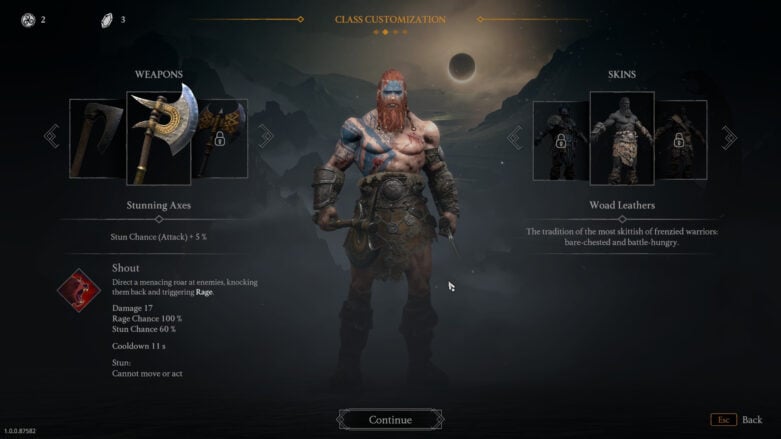
Jotunnslayer: Hordes of Hel is a bullet-hell survivors-like game that I reviewed back in the pre-release of its Early Access playtest. While I had my criticisms then, the game I previewed at the time is nothing like the 1.0 release we’re getting now, almost a full year later. Jotunnslayer: Hordes of Hel has certainly come a long way, improving on almost every aspect from before, and while a few minor criticisms still remain, it has overall become one of my favorite titles in its genre.
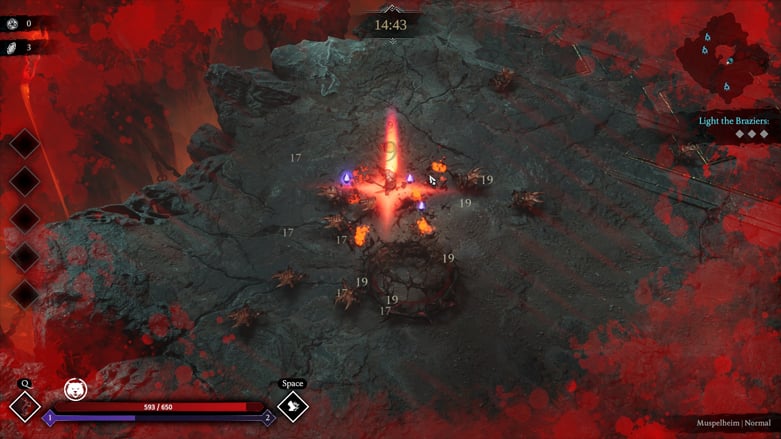
Like other titles in the survivors-like genre, a match of Jotunnslayer: Hordes of Hel challenges the player to survive ever-stronger waves of enemies across an open map. Attacks are automated, with the player only really needing to account for movement while their character fights on their behalf. With each enemy slain, XP orbs are dropped to level you up, and upon a level up, you get to choose from a series of procedurally selected abilities to set up your build, making every run different as you can never be sure of which options you’re going to get.
Jotunnslayer: Hordes of Hel mixes the traditional formula up in a few ways. The introduction of quests keeps the gameplay fresh by giving the player something new to do in the middle of a run—little side objectives that can greatly mutate the environment (often introducing new enemies altogether) and provides the player with some extra rewards for doing so, including multipliers that increase the amount of gold (your permanent upgrade resource) you leave the match with.

A match of Jotunnslayer: Hordes of Hel ends if players can survive the down-ticking clock, with enemy waves getting progressively stronger and larger as it goes down, and eventually defeating the map’s boss. These bosses are where I feel the game really shines, providing unique encounters with their own dedicated mechanics and feeling like a sufficiently challenging gate to pass to unlock new levels. The number of levels has also been greatly increased since the Early Access version of the game, and I find that the amount available is more than generous.
Since Early Access, the game’s roster has also expanded with two new heroes. Where I originally thought the game’s cast was a little boring, these two new additions do a lot to mix things up, and I found myself appreciating the characters available a lot more in my return to the game.

My main criticisms of the game in Early Access were some performance issues, a lack of enemy variety, and abilities that didn’t feel good to use. While I expected the performance issues to be addressed before the game’s full launch (and they were), I was surprised to see the other two issues fixed as well.
Where once the game had rather generic-looking Viking-themed enemies, Jotunnslayer: Hordes of Hel now hosts a very diverse cast of incredibly interesting foes. Most intriguing to me is the fact that these foes are different on each map, of which there are a good many to play through, keeping things feeling fresh from map to map and game to game and making replaying the experience all the more enticing.
I criticized the Early Access version of the game for failing to deliver abilities that felt good to use, something that I think you really need to master in a game like this. To be honest, the abilities that really took the “boring to use” cake in the Early Access version of the game still feel rather lackluster and uninteresting in the 1.0 release. Many of the game’s abilities feel lackluster, and a great deal of them are invisible, passive buffs rather than something tangible and visual for players to enjoy. That being said, the game has since expanded its roster of available abilities, and the variety helps in some way to make up for these problems.

Even so, I still feel as though many of the choices for abilities in the game are poor, simply not feeling as good as they could for players to use. While these abilities often have cool visual effects, it’s a matter of their actual effects, or lack thereof, on enemies that make them feel weak or dissatisfying to use. Many of the game’s abilities, even when fully maxed out, have small or long and thin impact radii and give very little feedback when interacting with enemies. The simple addition of more visual stimuli when an ability hits an enemy could help the power-ups in this game feel all the more impactful.
I’m on record as saying that the Viking aesthetic feels overdone, but Jotunnslayer: Hordes of Hel does it incredibly well, adding a sort of grimdark fantasy style that reminds me of the Diablo series and paying special attention to Norse mythology to really bring the whole thing to life.
Visually, the game is gorgeous, and the developers have only added even more incredible landscapes and visuals since the Early Access launch. Namely, the game’s lighting and textures really shine through, creating gorgeous battlefields and effects that are striking without being blinding or obnoxious.
Jotunnslayer: Hordes of Hel has come far from the Early Access version I played at the start of the year. While there are still aspects of the game I personally would have changed, the game overall has grown into a solid entry into its genre, one which I feel will have broad appeal to fans of bullet-hell titles and Norse mythology alike.
The Final Word
While its mechanical satisfaction and feeling of power could use some work, Jotunnslayer: Hordes of Hel still serves as a solid entry into the survivors-like genre, being especially visually excellent and showing remarkable growth from its Early Access run.
Try Hard Guides was provided a Steam code for this PC review of Jotunnslayer: Hordes of Hel. Find more detailed looks at popular and upcoming titles on our Game Reviews page! Jotunnslayer: Hordes of Hel is available on Steam, Xbox, and PlayStation.

Comments