Metal Bringer is a mech-building action roguelike developed by the same team behind Samurai Bringer. With striking visuals, surprisingly enjoyable characters, and a shockingly satisfying gameplay loop of building mechs, gathering loot, and fighting bosses, Metal Bringer surprised me. While the game can have some clarity issues, it has easily become one of my favorite new mecha titles, competing even with the Armored Core franchise with its exciting mecha action.
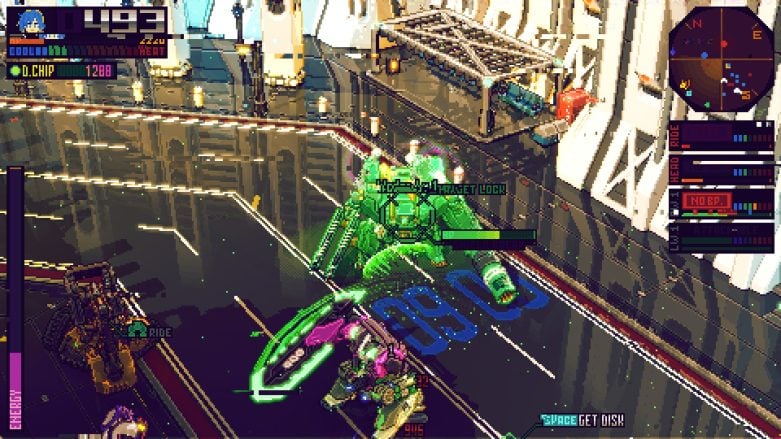
No conversation about Metal Bringer can begin without first acknowledging the game’s incredibly unique art style. Somewhere between pixel art and 3D, the game absolutely looks incredible and gives an undeniable retro vibe. The already bright and exciting art style is made even flashier with the inclusion of flashing neon rainbow text signaling item pickups or level-ups and gives the game an undeniably good look that might be a little overwhelming at times, simply because of all of the stuff on screen at once, but I’ll touch on that more later.
Metal Bringer tells the story of a dystopian future where AI has imprisoned all of mankind, preserving them in cryosleep against their will, as if hoping to prevent a mass extinction by sticking the whole species in the freezer. Our protagonist, a young girl named Suria, wakes up in an off-grid laboratory to find out that she has been in cryosleep for 1000 years and is the last human awake and outside of the hostile AI’s grasp. With the lab at her disposal, she uses the same machines that were used to imprison humanity to free them, which is a classic kind of mecha anime plot and one that instantly gets you engaged in the story.

Mechanically, Metal Bringer is an action roguelike that revolves around building two types of weapons to defeat the endless hordes of AI: Labor and Arms. The so-called Labor are artificially intelligent androids, most of which serve the hostile AI, with a singular remote-controlled version being your access to the outside. Alongside the Labor are Arms, essentially mecha which are piloted by the Labor and are your most powerful weapon for freeing humanity.
The core gameplay loop in Metal Bringer essentially revolves around you heading out into procedurally generated levels, defeating huge hordes of hostile Labor (some of which are armed with Arms), and collecting blueprints and upgrades along the way which are then used to build your Labor and Arms for future runs. You enter each run with your personally customized Labor and the Arms they are piloting, and along the way can freely hop out to pilot other Arms or steal the components from the Arms you’ve defeated., allowing for on-the-fly customization that becomes remarkably handy as individual pieces of your machine are destroyed.

Being able to essentially build your character and your mech with the same component-based customization system gives you a ton to collect and a lot of freedom to personalize your play style. While you won’t have a whole lot of muscle to start the game off with, the ability to hop into defeated mechs and steal their parts gives you a lot of freedom in how you play the game even before you have anything unlocked.
The wealth of variety in Metal Bringer’s customization is downright astounding, with everything from individualized parts to passive upgrades available for your build. The game is not only concerned with giving you a mighty arsenal of tools to save humanity but wants to make sure they match your chosen aesthetic and fit into that ever-so-important cool factor. I found myself a die-hard fan of the mantis-like arm blade, which seemed to shred through hordes of enemies and bosses right up until it exploded, presumably under the weight of how awesome it was (and not the barrage of missiles shot my way.)

The game also doesn’t overly concern itself with player-sided balance. As you unlock more blueprints, your mecha build can vary from the basic to the downright ridiculous, with hardly a limit on how crazy things get on your end.
Like any great mecha anime, Metal Bringer features a host of unique rival pilots with their specially crafted and named Arms to defeat. These minibosses are a unique challenge and often preclude fighting a giant, more traditional boss fight after the fact. Both are procedurally selected for each run and getting to know your rivals through multiple high-stakes battles is a pretty exciting way to introduce these characters.

While the game can initially feel maybe a little bit too easy, especially once you start getting your favorite mech pieces unlocked, it can get hard pretty fast, which I personally appreciated because it made each level feel unique and progressively more challenging.
However, the sheer wealth of information and color constantly on the screen caused by the massive hordes of enemies, the handful of health and resource bars you have to keep track of, and the borderline bullet-hell level of projectiles being sent towards you at once, can make tracking and clarity kind of an issue. Target lock is a bit finicky, often locking you onto a random enemy in the horde instead of a boss with no way to switch targets but to unlock and lock again, something that can make the clarity problems worse.
When paired with the game’s less-than-stellar English localization, there can be mechanics that, even several hours into the game, I still have trouble fully understanding. Clarity may be the biggest unintentional difficulty spike in Metal Bringer, with just a lack of understanding making the game a bit harder than it should be.
The Final Word
Metal Bringer has become one of my favorite new mecha games, with a highly replayable roguelike loop and incredible mech customization systems. Though poor localization and some overwhelming VFX and UI elements can make clarity an issue, Metal Bringer is fun enough that you likely won’t find yourself caring.
Metal Bringer was reviewed on PC. Find more detailed looks at popular and upcoming titles on our Game Reviews page! Metal Bringer is available on Steam.

Comments