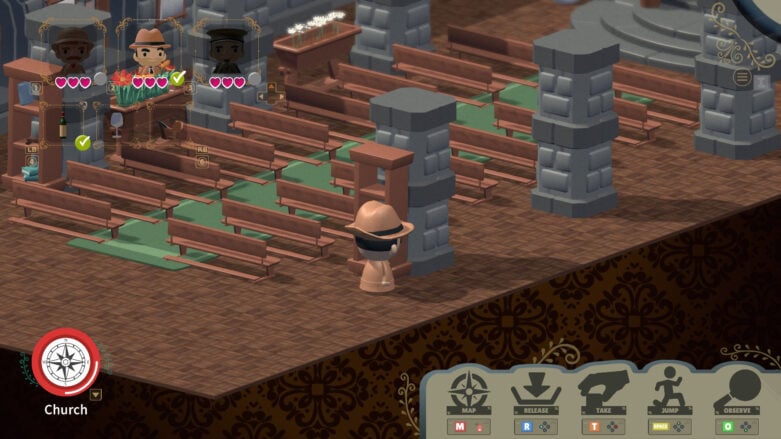
Clue: Murder by Death seeks to offer players an engaging detective experience that challenges the brain to solve an insidious mystery. For some, the title will certainly succeed in this, offering a pretty challenging mystery to solve with very few handicaps to help you do it. However, others may find themselves put off by the rougher edges of the game, especially when it comes to its pacing issues and unintuitive gameplay.
The premise is short, simple, and instantly recognizable. As a detective in 1930s England, you’re called to the site of the in-house murder of a wealthy socialite. You have just two hours to solve the case before Scotland Yard arrives, which puts tension on our player detectives to deduce the mystery as quickly as possible.
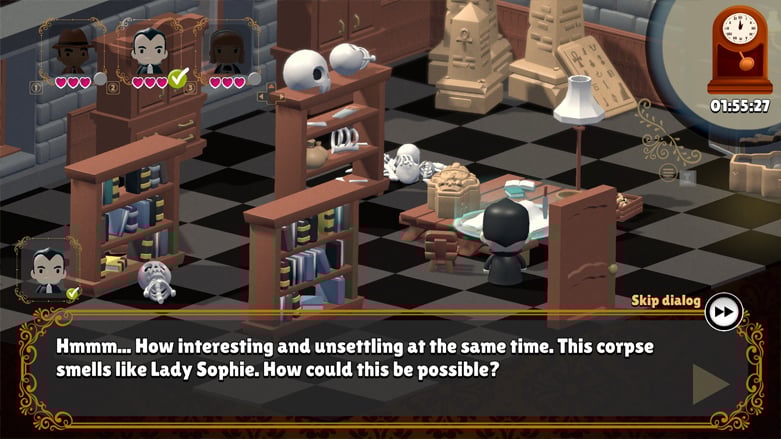
This isn’t imaginary tension, either, as the game is actually played on a real, 120-minute timer that is constantly ticking away while you search the lavish and large mansion for clues and first-hand accounts. This process is made a little bit easier with the ability to switch between three different characters, allowing you to essentially be in multiple places at once as you gather clues. Each character also has their own traits and perspectives, allowing them to gather unique insights and information during your investigation that you wouldn’t be able to get as just one detective.
The ticking clock is definitely the most interesting of the mechanics in Clue: Murder by Death, and it changes the way many of us probably play detective games. Namely, it forces you to be selective with the information you look into, because you can’t explore every possibility, listen to every story, or identify every clue in your case. Knowing that every character in the mansion has their own version of events and their own motives to lie, you have to use the power of deduction to rule out impossibilities and work with incomplete information, as connecting all the dots is essentially impossible in the time you’re given.
As interesting as this time limit makes the investigation, the mechanics of the game can actively fight against it and make a player inadvertently waste precious time. Your characters move slowly through the gigantic mansion and will often get hung up on furniture or even in conversations, whether or not you’ve had them already. The latter happens because approaching a character triggers a conversation automatically, which locks you in place as their text box appears, rather than simply giving you the option to interact with them with the press of a button.
This would be less noticeable if your time wasn’t precious, but also if the game wasn’t full of these unnecessary loading sequences. Triggering a conversation locks you in place and plays a short, but noticeable, loading sequence before the text actually appears, which also happens when entering any room. You will be doing this often, as there are no connected hallways, with each small segment of the mansion being split into its own instance. What’s more, you’re prevented from returning to a room for about ten to fifteen seconds after you enter one, with a spinning hourglass preventing you from going back once you realize you entered the wrong room. None of these load times are longer than ten seconds, but they add up with how frequently you have to transition to a new room or how many conversations you have to have throughout the investigation.
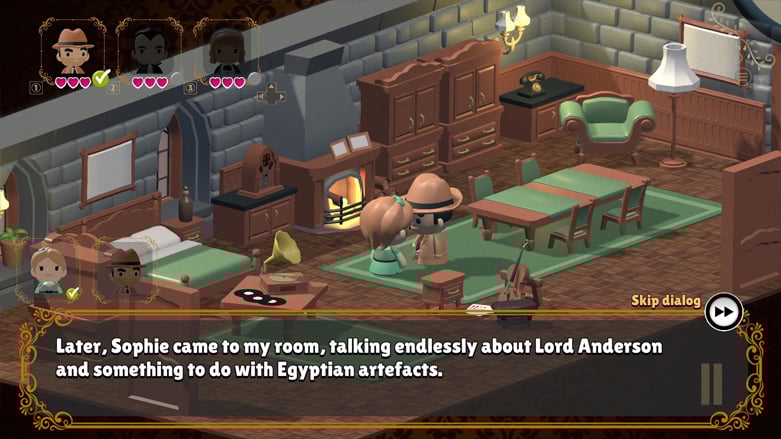
When you pair the minimal and rough mechanics of the game with its long, drawn-out dialogue segments and its excessive amount of loading screens, you get an experience that, frankly, just made me tired and bored pretty quickly. The game demands a lot of backtracking and a lot of conversation, and it really makes you commit to a two-hour investigation with much of the information coming only after a lengthy early game. For someone with ADHD like me, the early stages of the game can be especially torturous, and I simply didn’t find myself invested in the mystery or characters enough to overcome how dull and tedious the game often felt.
For a lot of players, I see these problems being a deal-breaker. The game is simply not engaging enough mechanically to keep their attention, especially when paired with the odd, tiring design choices. For some, though, especially hardcore mystery lovers, you may find yourself able to withstand the pacing issues and mechanical flaws of the game to reach the end of the mystery.
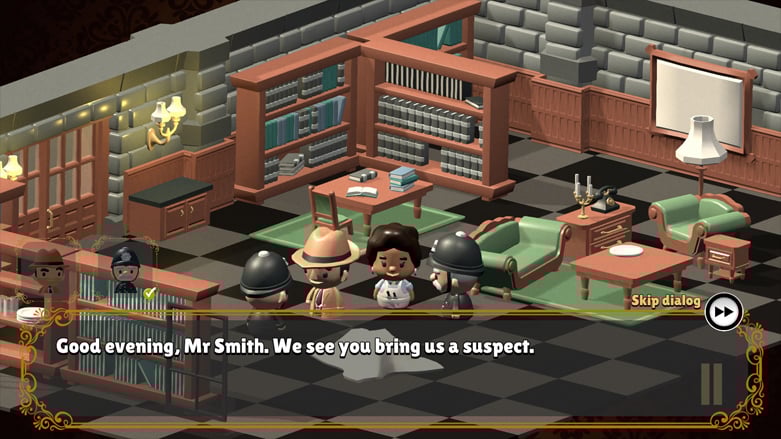
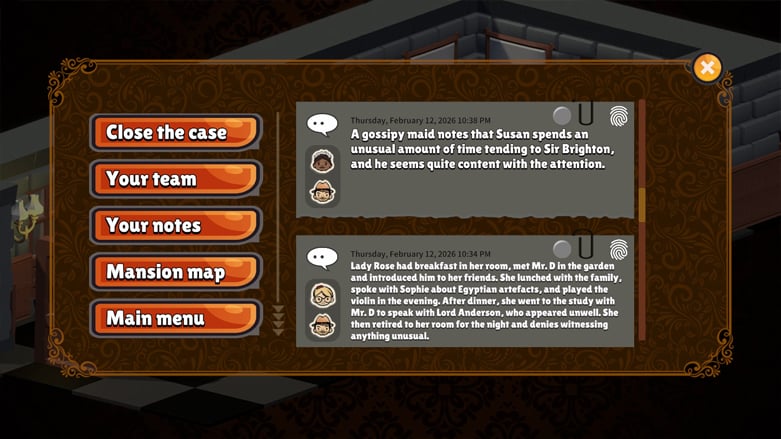
These very same players may find themselves excited to know that Clue: Murder by Death does very little to hold your hand during your investigation. There are, essentially, no mechanics to help point you towards the killer or connect the dots in the information you’ve discovered. All you get is a series of notes describing the conversations you’ve had or the information you’ve found, and the ability to color-code them. Everything else is up to you to deduce, and the veteran detectives will likely enjoy this lack of handicaps to their investigation.
At the end of my playthrough, I was left with something of a mixed impression of Clue: Murder by Death. The game really didn’t appeal to me, as it failed to keep my interest with intentionally slow pacing, unintentionally distracting load times, and an art style and mechanical choices that simply didn’t appeal to me as a player. However, some of the things that didn’t appeal to me are likely to enthrall players who love solving a difficult mystery, such as a by-design reliance on your own deductive skills with very few handicaps to help you, as well as a mystery that requires both prolonged commitment and strategic haste to solve.
I see the game appealing to a niche audience, and it feels like the developers had that exact audience in mind when they made it. For a more general player base, however, I don’t see Clue: Murder by Death being all that appealing. If it’s caught your interest, and what I’ve said in this review hasn’t changed that, I don’t see any harm in giving the game a try.
The Final Word
Clue: Murder by Death seems perfect for a niche audience, as it offers a mystery that requires player commitment and meaningful deduction skills to solve, with very few tools to make it easier. For a general audience, however, the game is likely to feel slow, awkward to play, and full of distracting load times, which come together to make a game that’s hard to engage with.
Try Hard Guides was provided a Steam code for this PC review of Clue: Murder by Death. Find more detailed looks at popular and upcoming titles on our Game Reviews page! Clue: Murder by Death is available on Steam, Xbox, PlayStation, and the Nintendo Switch.

Comments