
Ah, KATAMARI, the silly little game you are.
I can already tell that this review is going to be rather difficult to stretch into a thousand words. Chances are, if you’re reading my review looking for a recommendation on whether or not you should purchase Once Upon A KATAMARI, you are probably not already a KATAMARI fan. If you were, you likely would have already purchased it. Otherwise, you’re a fan of KATAMARI who is probably wondering if this game does anything particularly different from the other games in the franchise, if it’s any better or worse than the others, and if it’s as worth your money as the last KATAMARI title was, though I am fairly certain this group is going to be much smaller.
For the unfamiliar, KATAMARI is a long-running and beloved Bandai Namco series that originated on the PlayStation 2 in 2004. If the game can be called anything, it’s unique: its incredibly flamboyant characters, the King of Space and the Prince (that’s you), are iconic and colorful mascots as original as the game’s mechanical loop. The gameplay has you pushing around a sticky ball, called a Katamari, and collecting various objects throughout a level by rolling over them. Absurd and very Japanese humor persists throughout as you grow your Katamari bigger by collecting objects, eventually allowing you to roll over and collect larger items. These games feature multiple levels that mix up your objective, which can be anything from simply growing your Katamari as large as you can within a time limit to more nuanced goals, like only collecting objects worth a certain amount of money.

The colorful characters, stages, and unique gameplay that persist throughout the franchise are always accompanied by excellent soundtracks, often using very upbeat Japanese pop to match the high-energy and vibrant feel of the setting.
For returning fans, I can say that Once Upon A KATAMARI is more of the same.
The game’s levels are well-designed, this time taking on a time-traveling theme as you move through stages across different time periods, such as the Jurassic Age or Feudal Japan. Each stage has multiple levels with different objectives and its own themed set of items to pick up, and of course, the King of Space comments on your progress throughout.

The level design, soundtrack, and gameplay loop are as solid as any KATAMARI game. When I said the game was more of the same, I meant that quite literally. There is nothing in Once Upon A KATAMARI that is particularly different, reinventive, or exciting beyond what every other KATAMARI game has already offered.
If you’re a returning fan who loves the formula, this isn’t necessarily a bad thing. You’re in for more KATAMARI fun with this latest and freshest installment of the series. Given there are very few KATAMARI games available on the PC, this should be especially exciting for PC fans looking to play more of the franchise. If, however, you happen to be a returning fan who, for whatever reason, is totally burnt out on the KATAMARI formula, I can’t say this game is going to change that.

For entirely new players, I would absolutely recommend giving Once Upon A KATAMARI a try if you enjoy puzzle games and time challenges, especially if the unique gameplay loop appeals to you. There have been many KATAMARI titles, yet this latest game does not show signs of sequel degradation or that the developers have forgotten the formula. Once Upon A KATAMARI is as full of colorful and iconic energy as the others, and the gameplay remains consistently fun.
However, if you plan to play the game on PC, I highly recommend using a controller.
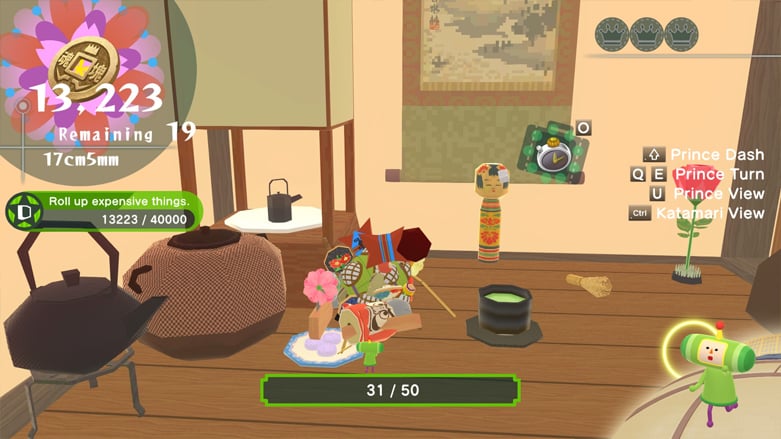
Once Upon A KATAMARI‘s PC controls, to put it bluntly, suck. Even when using the so-called simplistic version, you still need your hands on both the WASD and IJKL keys while occasionally moving them to several other positions on the keyboard, which feels incredibly awkward in terms of hand placement.
With some key remapping, I was able to make this a little better, but the fact that you need to use keys to change your character’s direction (essentially tank controls) remains an underlying issue that harms the PC control experience. It is unfortunate because this could have been resolved by allowing players to change direction by moving the mouse, which would make controlling your Katamari significantly easier and remove much of the awkwardness of the current setup. For whatever reason, though, the developers did not account for this, and there is no way to implement it yourself, leaving a somewhat uncomfortable experience for PC players. Again, if you have a controller, you’re far better off using it.
The Final Word
Once Upon A KATAMARI remains as iconic, colorful, and fun as the rest of the franchise, once again using its signature formula to create an entertaining and unique puzzle game. While the title does not do anything different or reinventive for the franchise, it does not necessarily need to, providing another delightful helping of the series for fans and new players alike. PC players will be pleased to have another KATAMARI title on the platform, though they are better off avoiding the awkward keyboard controls and using a dedicated controller.
Try Hard Guides was provided a Steam code for this PC review of Once Upon A KATAMARI. Find more detailed looks at popular and upcoming titles on our Game Reviews page! Once Upon A KATAMARI is available on Steam, Xbox, PlayStation, and Nintendo Switch.

Comments