
The Fortress is an intriguing entry into the roguelike genre. This isn’t just because of its absolutely incredible art and dark fantasy aesthetic, which presents something that feels like the fever-induced nightmare of an ’80s child the night after playing Dungeons & Dragons first edition and watching The Dark Crystal, but because the game also takes a very unique approach to the mechanical side of the roguelike genre that I haven’t seen before and which I think works incredibly well. It perhaps works too well, however, as I found myself unintentionally exploiting the game’s mechanics and potentially cheapening the overall experience. When paired with a few serious bugs, albeit ones the developers seem to be on top of fixing, it ended up being hard for me to give this game what would have been an otherwise perfect score.
But I’m getting a bit ahead of myself. The Fortress is a roguelike that takes you through five distinct dungeons with one mission: to defeat the lich, an evil undead demigod that has devastated the land, and his loyal minions along the way. Each section of the game is visually unique and has its own narrative, which, in one way or another, revolves around the unique final boss of that area.
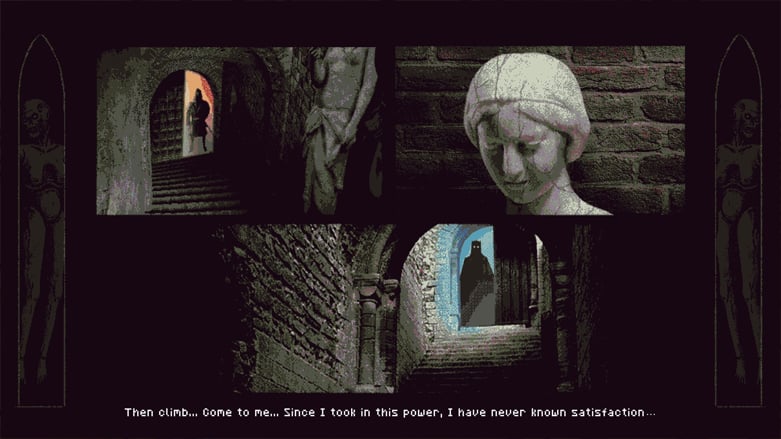
The game’s lore is incredibly rich and interesting, even when it’s only told through a couple of sentences at a time at the beginning and end of each segment. It tells a contained story that gives you just enough information to be satisfied while leaving room in your mind to imagine the finer details and the greater world around it. Because of this manner of storytelling, as well as the game’s rich aesthetic, I would definitely compare The Fortress to the dark fantasy epics of the ’70s and ’80s, minus the more kid-friendly elements.
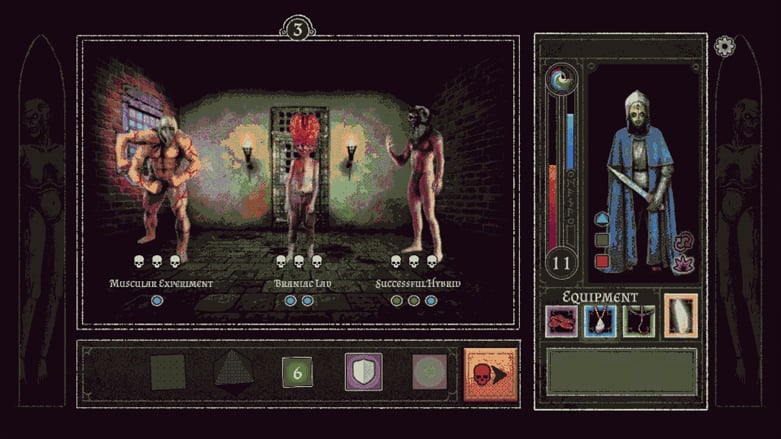
Kid-friendly, The Fortress certainly is not. The game is unapologetically brutal in its macabre fantasy. Some of the enemies you’ll encounter are the dog-headed experiments of the cruel lich, man-eating fiends, and fellow prisoners driven insane in the depths of the tower.
If I had to compare the title to other games that fans might be interested in, I would say that The Fortress bears the most resemblance to Slay the Spire, Fear & Hunger, and Darkest Dungeon.
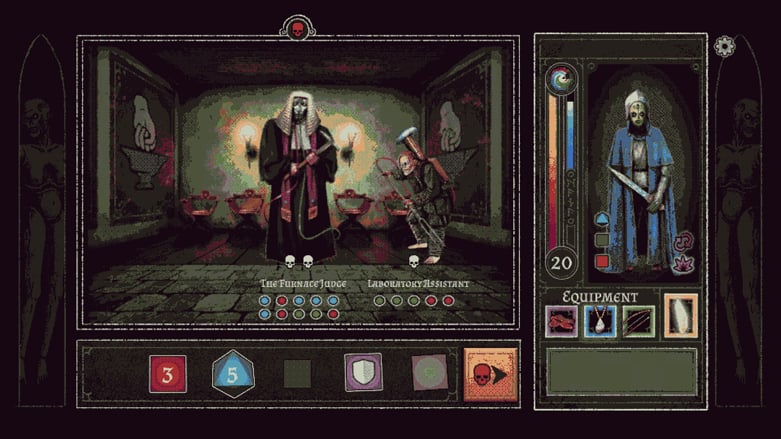
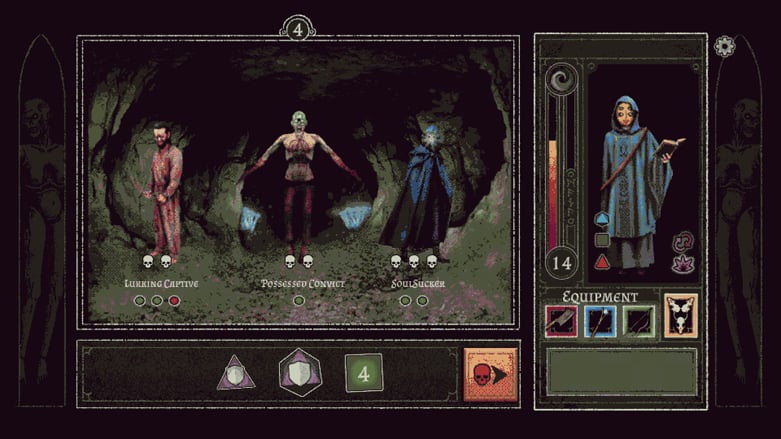
The latter is an especially interesting comparison because of the unique way The Fortress handles its combat. The turn-based roguelike doesn’t use deckbuilding as its main mechanic like so many others, but instead makes use of a series of dice. Three, to be precise: a red die representing strength, a blue die representing mana, and a green die representing agility.
Enemies you face in the dungeon spawn with a health total spread across these three types of dice. On each turn, you roll your dice, getting a number of attacks based on the result of each die. These attacks only affect the corresponding health type, and unused dice charge a special meter that deals ten flat damage split across all enemies when used.
This mechanic is deceptively simple and creates a unique type of strategy based on some RNG, where you want to carefully use your rolls each turn, knowing that you might not get useful rolls on the next. The game is balanced around this RNG element, offering you some decent health-regain opportunities and boosts to the numbers you roll on each die.
Unfortunately, the game might be a little too balanced, as I quickly found myself tearing through the game with the right build. It got to the point where I was able to clear whole encounters, including bosses, in my first turn. The final boss took two turns, but that was only because he came with a second form.
As much fun as I had with the game’s mechanics, the balance really needs to be addressed, as I seriously don’t think the developers intended for the game to be completed in just over an hour. I beat the game and unlocked the credits far before I came even close to unlocking all of the relics or classes, though, to be totally honest, I didn’t see a whole lot of difference in the classes themselves. It seemed each class was split between being dodge- or crit-focused, with unlockable classes simply having better and better values in these areas.
Balance wasn’t the only issue I had with the game, either. Occasionally, I would have a run prematurely terminated by a rather frustrating bug, one where entering a new zone would trigger multiple cutscenes, only to put me into an encounter with a blank screen, unable to take any actions and with no enemies present. This only happened once during my runs, but it seemed to persist when using the “continue” feature from the main menu to load a save.
The developers recently postponed the release of the game because of an unforeseen bug, so I have to imagine that this was it. Chances are, by the time the game is out and you’re reading this, this bug no longer exists. However, since it was present in the version of the game I played, I have to contribute it to the score.
Overall, The Fortress is great. Aside from game-breaking bugs that probably won’t even be present by the time you read this, the game impressed me with its incredible art, great narrative, and deceptively simple dice mechanics. That being said, the game’s balance needs to be addressed, as right now it’s a little too easy to totally cheapen your experience with an incredibly overpowered build.
The Final Word
Despite bugs that likely won’t be present in the game by the time it releases, I had an incredible amount of fun with The Fortress, as I was sucked in by the game’s great storytelling and art, and engaged by its unique approach to roguelike gameplay. However, the game’s poor balancing can unintentionally cheapen the experience, making the game’s brutal and unforgiving world a bit too easy to navigate
Try Hard Guides was provided a Steam code for this PC review of The Fortress. Find more detailed looks at popular and upcoming titles on our Game Reviews page! The Fortress is available on Steam.

Comments