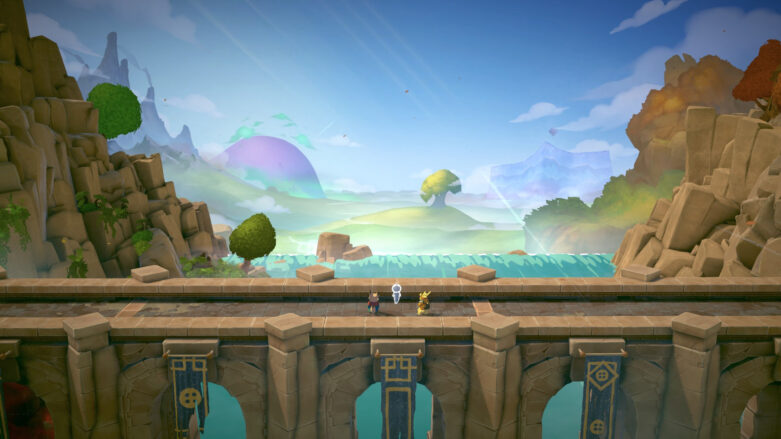
Ah, The Lonesome Guild… as the last game I reviewed before a short vacation, I can admit that I was feeling a little burnt out when I got my hands on this title. However, after giving it a chance, the game turned out to be a surprisingly fun and very sweet sendoff before a four-day break, full of likable characters, a charming story and world, and competent beat-’em-up mechanics that kept me charmed throughout my playthrough.
The game didn’t catch me right away, though. It took me about an hour and a half of playing before The Lonesome Guild started to get its hooks in my brain, as the core mechanics and cast began to open up more and show me everything the game had to offer.
That being said, the charm was apparent from the start. The Lonesome Guild is an ARPG set in a world of cute little animal people, built around the themes of friendship and loneliness—friendship being explored as a small group of six ragtag strays are brought together thanks to Ghost, a faceless stand-in for the player character.
The way the game uses the theme of friendship and togetherness is actually rather interesting. Beyond simply being an element of the story and a theme present in the writing, friendship literally drives the game’s mechanics and progression.

The more blatantly obvious way this shows itself is in leveling up; characters progress through the acquisition of relationship points, which are earned over the course of the game by continuing the story but also (and mainly) by taking the time to sit down and talk to your companions. This is done at rest stops and is an interesting way of encouraging the player to build a relationship with the characters in their party—something you have to do to, you know, be friends. Grow a stronger bond by getting to know everyone, and it will benefit both of you in the long run.
The less obvious way that togetherness ties into the gameplay is through the game’s main combat mechanics.
See, your party of characters is totally capable of fighting on their own. The AI is actually pretty good, and I’ve yet to see an AI companion miss a dodge roll when faced against a boss’s AOE ability or attacks.
For you to actually control a character, you must do what the game refers to as “bonding” with the character Ghost. Ghost jumps into the body of a party member, giving the player control of them until they switch to someone else. This is described in the canon as a strangely personal experience, where the characters themselves are not possessed or taken over by Ghost, but rather feel joined together as one.

Bonding with a character with Ghost is more than just playing your favorite party member. You are encouraged to jump between each party member as alerted to do so in combat, which “enflames” said party member, giving them a combat bonus and more quickly building up Ghost’s ability, which is essentially your ultimate.
The game’s entire combat system is a more subtle and poetic way of saying, Hey, we’re stronger together, and through a bond of trust (you have to be pretty trusting to let a Ghost inside your body) we can accomplish even more than we could on our own.
Said combat system is a solid, if pretty straightforward, beat-’em-up masher where basic attacks are mixed in with charged abilities, with each character in the game having their own unique strengths, weaknesses, and abilities. It’s a well-built-together system, and I didn’t face any problems of balance or bugs engaging with it, though I will say the simplicity can get rather tiresome. It is, thankfully, counteracted a bit by switching between party members, but overall it can be kind of simple to a fault, and it can get pretty repetitive in back-to-back combat encounters.

I wasn’t a huge fan of the game’s puzzles, which mainly involved character placement challenges where you, say, have one character go somewhere, pull a lever, and move another to pull another lever until the characters eventually meet up again. A lot, though not all, of these puzzles felt less like brainteasers and more like tedious time-wasters—but your enjoyment with them may vary.
Overall, the biggest draw to the game, of course, is the story and characters, of which I can say I was rather fond of both. The characters especially are fun, featuring a wide breadth of personalities that are fun to see interact with each other. Though I wasn’t a big fan of them at first, Davinci surprised me by becoming my favorite member of the cast. I simply love their little mechanical wings and infectiously positive attitude.

Something that will be rather polarizing about the writing, however, is the inclusion of internet speak and general cuteness-overload-y vibes. The game is very sweet through and through, and at times it can give you a bit of a stomachache. If something about a character speaking to you using only an emoji gets you unreasonably mad, you might want to sit this title out.
The Final Word
The Lonesome Guild is a heartfelt title built on the themes of friendship and togetherness, which are baked into the game’s core mechanics as well as its story. The combat mechanics may be a bit repetitive, and not every puzzle is a hit, but overall this wholesome adventure should appeal to many, though its cuteness and meme-y dialogue might polarize a few. For those who love it, though, The Lonesome Guild will leave you in a better place than when you started it.
Try Hard Guides was provided a Steam code for this PC review of The Lonesome Guild. Find more detailed looks at popular and upcoming titles on our Game Reviews page! The Lonesome Guild is available on Steam, Xbox, and PlayStation.

Comments