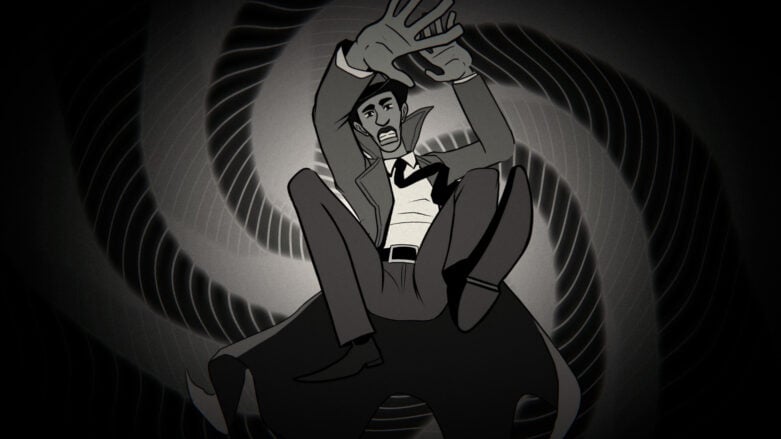
Imagine you’re a detective in the late 1930s. It’s been a long time since you’ve had any real work, and the bills are starting to catch up to you. Then, as if out of nowhere, you suddenly receive a case, and an unusual one at that: you’re tasked with investigating the murder of one of the wealthiest socialites in the country, and the task comes from the deceased himself, in the form of a letter sent to you before his death. As if this wasn’t strange enough as it was, you quickly find that you’re stuck in a time loop, repeating the same twelve hours over and over until you can find whoever killed your client.
This is the plot of The Posthumous Investigation, a game that is something between a parody of the genre and one of the more interesting detective titles I’ve played yet.
As one Steam reviewer aptly put it, it’s refreshing to see detective fiction that isn’t directly based on Sherlock Holmes. It’s also refreshing to see a detective story set somewhere besides London, New York, or an impossibly large manor somewhere on the outskirts of either city. Set in 1939 Brazil, The Posthumous Investigation and the book it’s based upon already win some points from me for originality, because I think if I had to play one more generic Clue-based detective game, I might become a suspect in a crime myself.
This unique setting isn’t coincidental, as The Posthumous Investigation is actually an adaptation of the works of Brazilian author Machado de Assis. More specifically, the game adapts several of the writer’s stories, but is mostly based on his novel The Posthumous Memoirs of Brás Cubas. The adaptation feels true to the writer’s style, especially in its use of irony, humor, and critique of society and social issues.
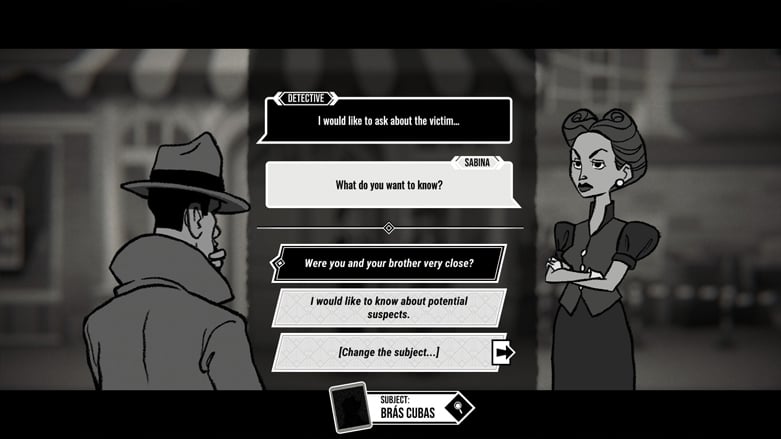
Mechanically speaking, The Posthumous Investigation isn’t too complex or removed from other detective games you’ve likely seen before. It’s a simple point-and-click game set in a 2D environment, where you move around and interact with suspects or hidden items to gather clues. Discovering information from other suspects or finding clues unlocks new dialogue with suspects, who then reveal even more information for your investigation. Time constantly moves forward, with different events happening throughout the day and everything resetting when the clock strikes twelve, meaning that you have to play through multiple time loops to gather enough evidence to solve the mystery.
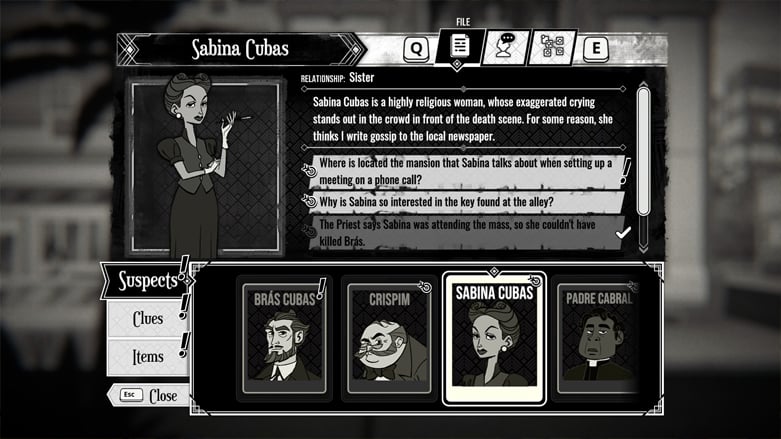
The time loop mechanic is definitely an interesting take on the detective genre, but I feel like it sort of cheapens the mystery a bit. Not only is it disappointing to know that there is no way to solve the mystery without the time loop mechanic, as it is simply impossible to collect all of the right evidence before the day ends, but the end of each loop presents us with clues and outright answers from the ghost of the victim himself that make the mystery a lot easier to solve. The narrative storytelling device is interesting, but determined detective players might feel a little cheated by the experience.
While the gameplay in The Posthumous Investigation might not be the most amazing, what truly stands out is the writing and art.
Again, being adapted from a fantastic writer known for his satirical and ironic writing, the game is packed with some clever and humorous moments. What especially stood out to me was the cast of characters, who run the gamut from the mundane to the absurd, each of them being parodies of the social structure of Rio de Janeiro. The game doesn’t take itself too seriously, and while it actively parodies the detective genre, it isn’t afraid to tell a compelling story and mystery either.
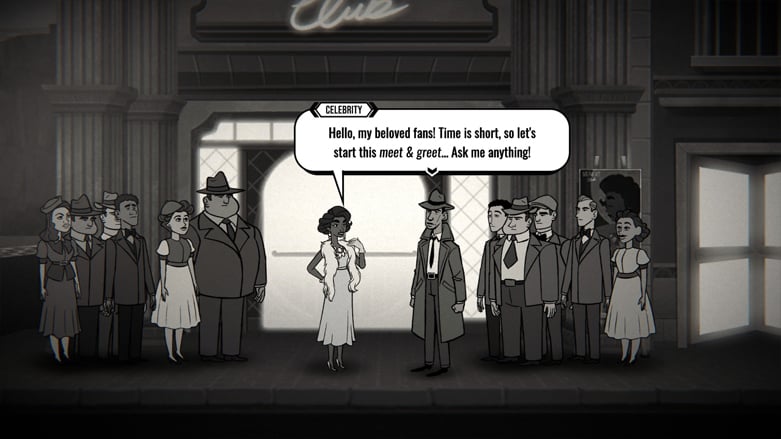
The game’s art style is comical and fun, with cartoonish designs that, again, run the gamut from normal to more wacky and mimic the style of cartoonists of the time. The game is certainly pleasant to look at, and you’re likely to find yourself invested in the story and characters effortlessly as you work to solve the mystery of who killed your patron.
There’s a lot to love about The Posthumous Investigation, but the title is lacking a few quality-of-life features that could really improve the experience overall.
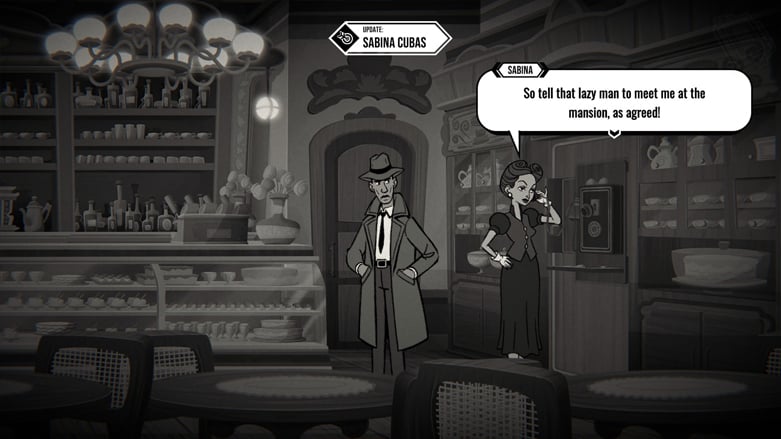
Namely, each loop you experience while trying to solve the murder mystery will have you rereading old dialogue, specifically in any case where an action must be repeated to obtain an item or gain access to an area. Because of this, a skip dialogue feature would be very, very helpful, as you’re bound to find yourself repeating many long and mundane conversations as you play the same day over and over again. Having to talk to the police about cheese bread several times was so annoying that it actually started to get a bit under my skin.
Hardcore detective fans should also ignore the game’s Steam page, particularly when it says that the game has zero hand-holding in its mystery-solving process. As I hinted at earlier, the game does, in fact, give you a lot of hints, some of which you don’t even ask for, while others outright tell you how to proceed in your mystery. This isn’t a problem for some, but those who really like solving a mystery without help are bound to be disappointed by this.
The Final Word
The Posthumous Investigation is an interesting title, one that adapts incredible works of fiction into an interactive experience. While the mechanics aren’t the most inventive or interesting, and certain quality-of-life features would make the game far more enjoyable to play, you’re bound to find yourself wrapped up in the game’s fun writing and characters, fantastic art, and exciting mystery.
Try Hard Guides was provided a Steam code for this PC review of The Posthumous Investigation. Find more detailed looks at popular and upcoming titles on our Game Reviews page! The Posthumous Investigation is available on Steam.

Comments