If I were to summarize my opinion of Tides of Tomorrow in one phrase, it would be “missed potential.”
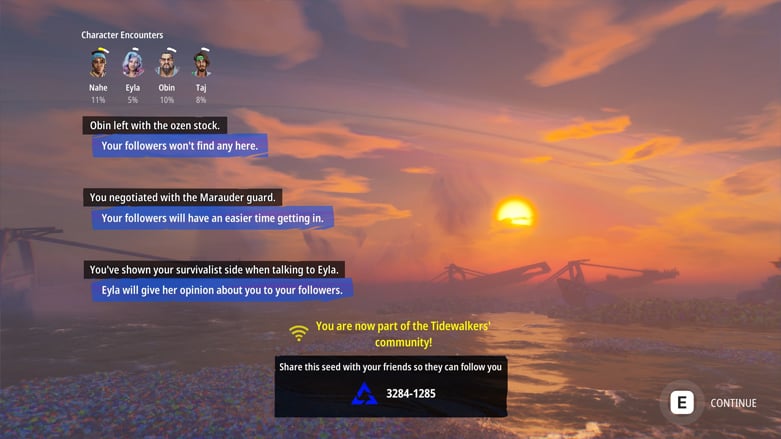
The game is built on an incredibly strong premise: as a so-called Tidewalker, players follow the footsteps of a chosen player’s playthrough, with the world before them shaped by the decisions of the real-life player who came before. Throughout the story, you’re faced with points where you’re tasked with making a decision, and doing so changes the narrative for the next player to experience it. Since you’re also playing in the footsteps of someone else’s choices, this essentially creates a potentially endless loop of echoed choice, creating a game that uniquely captures consequence and weaponizes player choice in a way I haven’t seen done before.
This alone is enough reason to check out Tides of Tomorrow, and I’m not going to act like it’s not incredibly cool, especially when you experience it for the first time around. The flaws I found with the game aside, it’s an incredibly cool mechanical concept that inherently gives the game a sense of mystique and captures player interest in ways other titles just won’t.
Every pop-up letting you know that something you’ve done will affect the player who comes after you makes you feel like there is a genuine weight to the world and the story around you, and it affects the choices you make in the story. One early decision that has you choose between taking life-saving medicine and saving it for the next player immediately hits you with the weight of that choice, and it was here that I was initially hooked on the game.
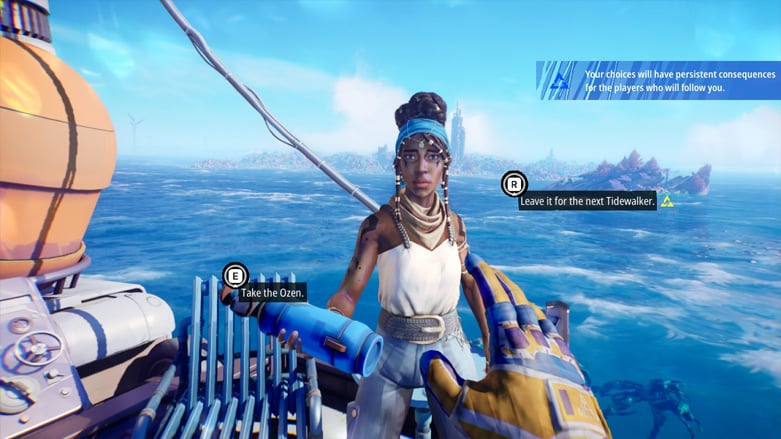
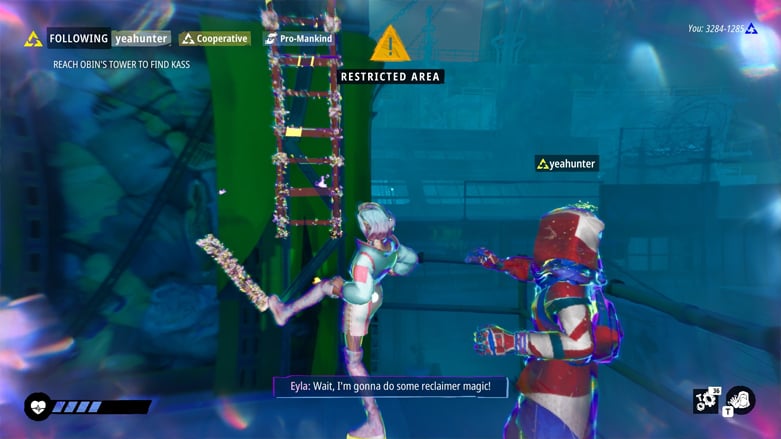
The concept of following in the footsteps of the past also allows you to view the actions of the player that came before you, which can be used as a convenient way to solve environmental puzzles by literally seeing how someone before you solved a problem, or as a means of making sure you do not follow in the footsteps of the player that came before you. The game also keeps track of the decisions you make and the dialogue you choose to tell the world what kind of player you are, whether you fight for the people or if you’re something of a selfish nihilist.
These are all great concepts, and they’re fun to engage with the first time around, but the game really falters when it comes to creating actual gameplay to fit in the empty space between these decisions.
Tides of Tomorrow would have worked incredibly well as a story-driven RPG where your choices are many and provide tangible changes to the story. Instead, the game plays more like a dark ride at your favorite amusement park, railroading you from one area to the next with very little room to breathe. Yes, the events you get to witness do change based on the actions of the player who came before you, and yet it still feels like an adventure you’re actively not in control of. You are pushed from point A to point B unceremoniously, and when given the choice of a game-changing option, it’s usually something that the next player will see rather than a meaningful change to the story in front of you.
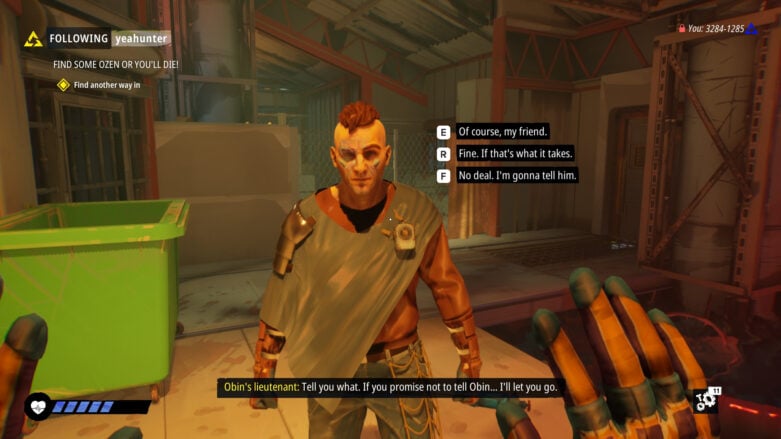
This amusement-park-ride feeling extends to the dialogue and story pacing as well, with the narrative ping-ponging incredibly fast between characters who instantly love or hate you and rope you into their story without your say. It really does feel like a condensed story that you’re forced into, with little to no explanation as to why you want to help these people, no chance for you to refuse to help them, and character bonds that are rushed and so do not feel earned or even worth paying attention to. The breakneck pace of the narrative gives me the impression that Tides of Tomorrow wanted to rush players through its story as fast as possible, afraid that if they did not, players would not finish the game and thus give nothing for the next Tidewalker to experience.
The super rushed feeling of everything also means that actual gameplay is incredibly limited, with each level feeling like a Telltale-style visual novel with the most basic of interactive elements thrown in to keep you from getting too bored. Again, level design is as straight-ahead and constricting as the narrative, pushing you along short, narrow paths to story beats that do not feel earned as the game takes you through a roller-coaster ride with occasional decision-making that affects the ride for the next person.
The game’s dialogue not only follows the awkward pacing of the narrative but is also filled with really lame humor that tries to make light of the darker, more interesting concepts the game presents, without ever giving these concepts time to breathe and develop. It makes everything obnoxiously quirky, undermining stakes that are already hard to take seriously because everything just happens so fast with no time or reason for us to be personally invested in them.
The game forces you into its narrative with this vague description of a chosen-one trope and the need to find a life-saving medication, and then expects you to be sold on the problems of people you have just barely met and exchanged two paragraphs of dialogue with, with said dialogue excluding any real meaning or reason to connect.
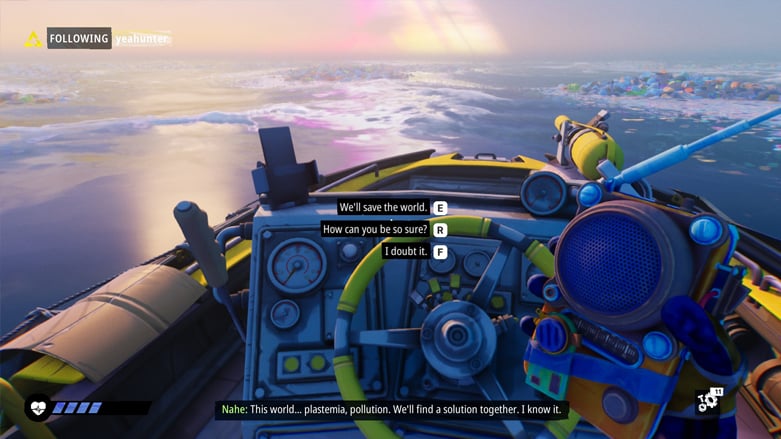
Tides of Tomorrow has a really cool premise, and honestly, I would recommend checking it out for the premise alone. However, chances are you’re like me, and you will be burnt out on this premise incredibly quickly as you struggle to enjoy the game’s breakneck pacing, awkward dialogue, and underwhelming gameplay. Overall, the game feels like a rushed-to-market amusement park ride made to show off a very cool indirect multiplayer feature, but this mechanic only carries the game so far and would have been a lot more interesting in a different kind of game.
Tides of Tomorrow has potential. Perhaps with some better pacing and more player choice both in and out of dialogue, I would have enjoyed it a lot more. However, the breakneck narrative, blatant railroading, and awkward dialogue, paired with very straight-ahead, not-much-to-do gameplay, personally left me very disappointed.
The Final Word
Tides of Tomorrow features an incredibly interesting mechanic and a unique setting, but both are undercut by poorly paced storytelling and a lack of deeper, engaging gameplay. While I would still recommend the game for its unique, indirect multiplayer mechanic, you might find yourself in the same position I was: burnt out on the gimmick early into the game.
Try Hard Guides was provided a Steam code for this PC review of Tides of Tomorrow. Find more detailed looks at popular and upcoming titles on our Game Reviews page! Tides of Tomorrow is available on Steam, GoG, Xbox, and PlayStation.

Comments