Towa and the Guardians of the Sacred Tree is a Hades-like roguelike officially published by Bandai Namco. Where the game succeeds the most is in features that would probably make for an excellent visual novel: great characters, long cutscenes filled with extensive character interactions, and an exceptionally interesting non-combat minigame. Unfortunately, the core roguelike portion doesn’t quite meet the genre’s standards, leaving Towa and the Guardians of the Sacred Tree feeling like an ambitious, well-drawn title with an unfortunate identity crisis.
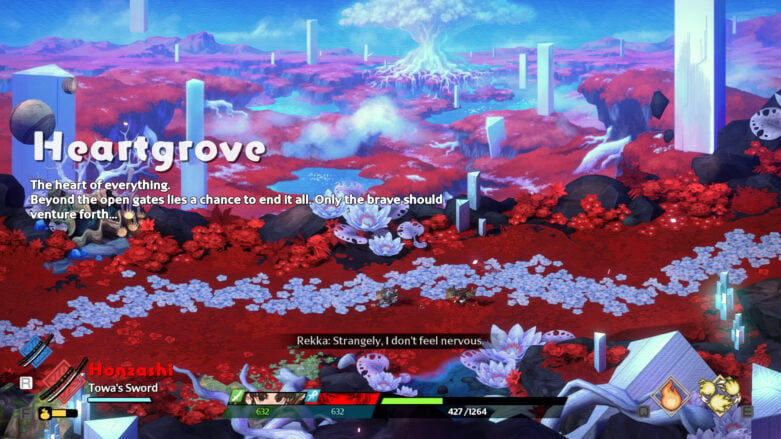
Topping the list of what I like about Towa and the Guardians of the Sacred Tree, of course, is the art. The whole game looks very much like a modern take on some classic JRPG styles, and the characters are not only incredibly well drawn and well designed (with some great expressions, I might add), but the world and backgrounds look incredible. This can’t quite be said about all of the effects in the game, with some definitely feeling lackluster, but in general you aren’t going to find an ugly scene in Towa and the Guardians of the Sacred Tree.
Speaking of characters, that is probably the biggest actual draw of the game. The game stars the Prayer Children, a group of eight adventurers with their own personalities, backstories, and motivations. If you find yourself interested in these characters, you’re in luck, because the game is absolutely jam-packed with writing and interactions for all of them. Since each run has you selecting two characters to play as, you can essentially pick your favorites and see how they interact with each other through various personalized cutscenes. It is definitely a game that wants you to keep replaying areas with different pairs, if for no other reason than to see how they interact with each other.

Like many JRPGs, you can expect these cutscenes and dialogue segments to be long. While most of the time I was fine with this, there were definitely segments, such as tutorials, that dragged on a bit too long because of the character interaction.
Another particularly interesting part of the game is blacksmithing. You can physically create the swords your party uses on each run. It’s a fairly expansive system, better in customization than I’ve seen in many games, allowing you to manually alter the shape of each individual part of the blade to create either a fantastical or grounded weapon. You are then taken into a multi-step minigame based on the art of Japanese sword making.

For those who are unaware, the lack of iron deposits in Japan historically called for a unique method of blacksmithing, one which (as far as I’m aware) the game depicts well. I found this especially interesting, not just because each step of the process determines the stats of the finished weapon, but because not many blacksmithing games (or any that I’ve seen, really) capture this incredibly unique process. This potentially makes Towa and the Guardians of the Sacred Tree the first of its kind.

For all the good of those features, however, the main game is unfortunately disappointing.
Outside of cutscenes and side content, Towa and the Guardians of the Sacred Tree is a roguelike where you select two characters to run through procedurally generated dungeons with. It’s actually more like one and a half characters, though, as you are essentially picking one playable character and one support character that hangs back and occasionally casts spells on your behalf.
The combat in Towa and the Guardians of the Sacred Tree isn’t a problem simply because it’s uninteresting, with each character having two moves that are lackluster and often clunky or stiff to use, but because your partner character is more of a liability than a helper. While they provide you with two more aimed abilities, they are also a target; your max health bar is the combination of both characters’ health, and if your secondary character loses it all (meaning you drop below 50% HP), you do much less damage. This would be less of a problem if their AI were better, if you had more control of them, or if they didn’t lock in place when using abilities.
The game’s multiplayer, unfortunately, does not solve this problem, as the second player is essentially relegated to the position of autoturret with no actual control of movement, forced to just spam attack abilities as they come off cooldown.

Progression, both in-run and outside of it, simply isn’t that interesting either. The power-ups you collect in-game don’t alter your two basic moves in a way that would make them feel better if they already aren’t fun to use, and most meta-progression is just basic stat boosts. Honestly, the most fun I had with progression was building new swords and seeing how strong I could make them.
Towa and the Guardians of the Sacred Tree is a beautiful game with excellent characters and one of the most unique blacksmithing minigames I’ve ever played. But for a roguelike, it’s missing the most important thing: fun, satisfying combat and progression. Instead, it leans too hard on its cutscenes and side systems to carry an experience that should have been elevated by the gameplay loop itself.
The Final Word
Towa and the Guardians of the Sacred Tree is gorgeous and creative, but ultimately held back by its core mechanics. Fun characters, great art, and a unique minigame fail to elevate this title beyond its stiff and below-average-for-the-genre gameplay.
Try Hard Guides was provided a Steam code for this PC review of Towa and the Guardians of the Sacred Tree. Find more detailed looks at popular and upcoming titles on our Game Reviews page! Towa and the Guardians of the Sacred Tree is available on Steam, PlayStation, and Nintendo Switch.

Comments