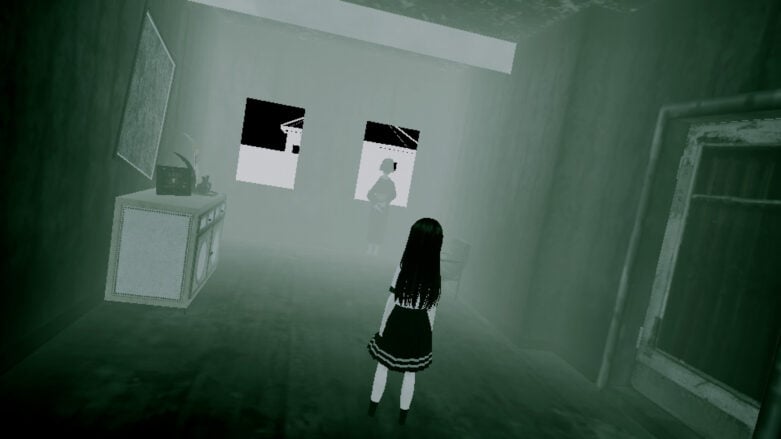
I often find myself disappointed by games. While I try to avoid having high expectations for titles, I occasionally can’t help but look into something ahead of time, and it is just a mathematical fact that, with the sheer number of games I find myself reviewing, some aren’t going to live up to my own hype. It is rare, however, and I would even say unheard of, that I find myself not only disappointed in a game, but that I find the game itself distasteful. I have a pretty thick skin, and it takes quite a lot to outright offend me.
While I wouldn’t say I was offended by Welcome to Doll Town, an indie horror game I’ve been looking forward to since January, I would say that the disappointing and distasteful descriptions still apply.
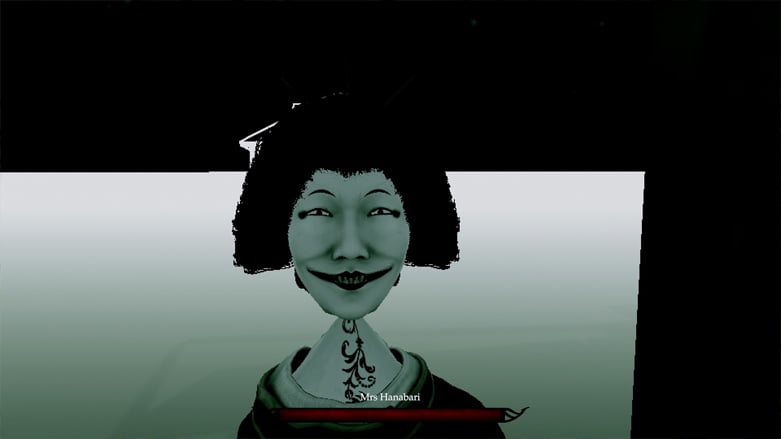
Welcome to Doll Town is an indie horror game that takes us into an abandoned town once made famous by a local factory’s production of life-sized, realistic dolls. I love Japanese horror, and I love the use of dolls in horror media, so Welcome to Doll Town already had plenty to catch my attention. I was sold on the promise of an indie horror game that combined some of my favorite horror elements into a likely Silent Hill-like experience, but what I actually got was a disappointing mess that left a bad taste in my mouth.
If we’re going to get into it, we should get into the worst first. The reason Welcome to Doll Town leaves such a distaste in my mouth is the game’s seemingly tone-deaf approach to some serious subject matter.
The horror of the game stems from its narrative, a frankly difficult-to-follow story that was certainly lost in translation, literally, as the poor localization mixed with just bad pacing makes the entire thing feel like a railroaded experience. Where a stranger trauma-dumps her backstory on the protagonist, who has no feasible reason for following her from place to place and dealing with the tragic and dangerous events thrust upon her. She just kind of shows up, is told to do something by someone she’s never met, and continues to do so until the story just kind of ends. I do wonder how much of this confusing narrative would have been cleared up if the translation quality was just a little bit better.
That aside, what the story clearly focuses heavily on is suicide, self-harm, and tragedy. The death of children or young women is a consistent theme, and it often happens in tragic acts of murder, fatal accidents, or, again, straight-up suicide. At first, I was hooked on the game’s use of dark and tear-jerking themes, and I thought it would continue through with this vibe to give me one of those narratives that you love to let hurt you. If it had followed through on the vibe it gave me when I first watched a teen get locked in a freezer, I would have been much more impressed.

Instead, the game mixes its awkward, poorly paced storytelling with outright lame humor. This humor is not just an optional break from the serious nature of the game, but a tone-deaf forced presence that destroys all of the game’s tension and makes a mockery of its serious themes. It doesn’t just show up in dialogue, but visually interrupts tense moments. I audibly sighed when I faced the first boss, died, and then watched her literally hit the Gangnam Style dance on my corpse. This was mere minutes after we were told about the suicide of a child that happened as a result of the denizens of this town.
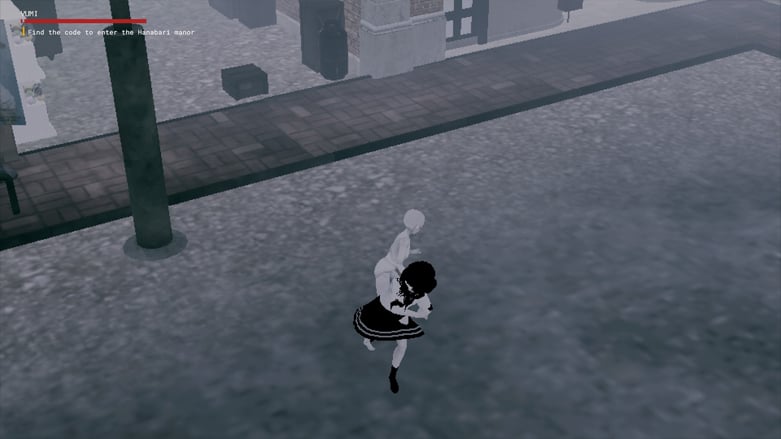
This tone-deaf “comedy” continues when the game has you engage with combat, having you button-mash and fist-fight “haunted” dolls who go down with little to no effort. Stun-locking a boss into a corner is one thing, but then executing an enemy with a wrestling move that plays loud crowd applause just straight-up kills the idea that this game has anything to do with the horror genre it insists it belongs to.
Maybe you can ignore how jarringly tone-deaf the game is. Maybe its irreverent humor, which frankly I found stupid, combines with the dark themes to make something uniquely enjoyable. I could see how that could be the case, and while I don’t think Welcome to Doll Town executed on that at all, I could see it being tolerable for others.
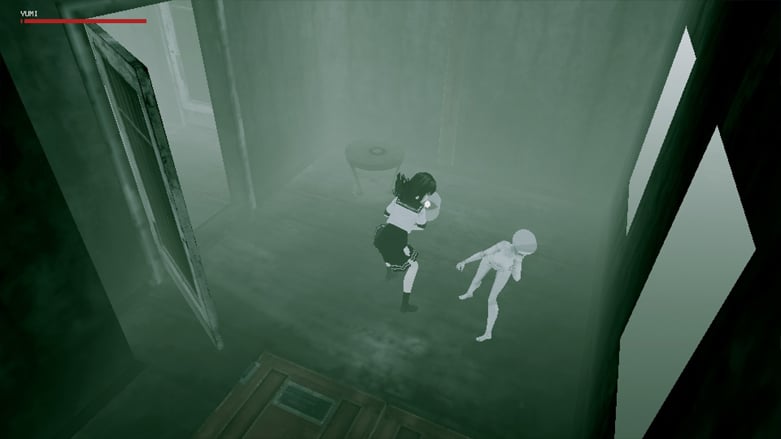
What you’re left with is still a game that is disappointingly short and lacking in content. The game’s only real mechanic is its combat, which is featured so rarely that you could almost forget it exists. The puzzles are somewhat aimlessly thrown together, expecting you to kind of just wander around until you find the answer at the worst, and being so easy to solve at the best that you can hardly call them puzzles. The controls are awkward and can’t be changed, and the game itself, on top of everything, runs just short of 80 minutes, making the $12 price tag kind of steep.
I want to say there are redeeming virtues present in Welcome to Doll Town. I was really excited for the game and hoped it would be, if nothing else, a unique indie horror experience combining some of my favorite types of horror storytelling. Unique it certainly is, but for all of the wrong reasons: the game feels almost like it has a complete cognitive dissonance from its own themes, putting out awkward sound effects and cringe dance moves paired with straight-up discussion of suicide and teen death. The gameplay itself does not redeem the tone-deaf design, as the game is way too short and lacks any real interesting mechanics, and it even fails to capture the most basic of horror game design principles present in a hundred different indie horror games.
I don’t want to sound like I’m bullying the developers. I know that making a game is hard, and clearly a lot of hard work went into this title, especially when it came to the character models and designs, which, despite everything I said in this review, were still great and impressed me. However, the biggest flaws of the game come not from elements outside of their control, but from strange choices deliberately made during writing and game design. While there might be an audience for this game somewhere, it’s not for me, and I was frankly disappointed and put off by the experience I got playing it.
The Final Word
Welcome to Doll Town is short, awkward to play, full of translation errors, and, most importantly, features a strange cognitive dissonance between its heavy subject matter and its awkward, forced use of cringeworthy humor. While the game might find its audience, it failed to charm me and left me disappointed and outright confused by what it had to offer.
Welcome to Doll Town was reviewed on the PC. Find more detailed looks at popular and upcoming titles on our Game Reviews page! Welcome to Doll Town is available on Steam.

Comments