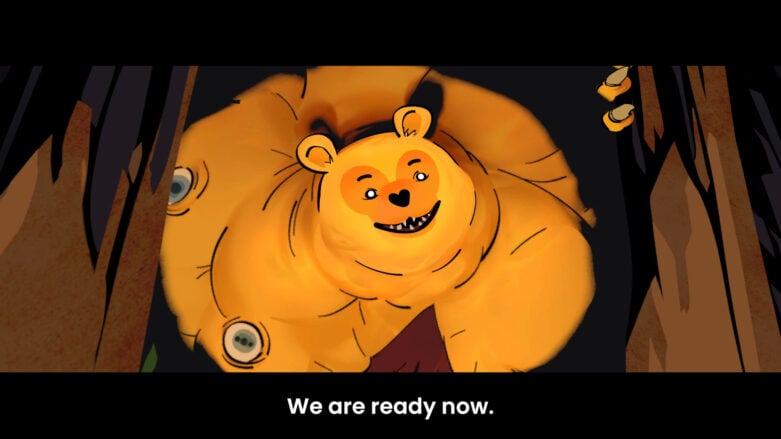
We live in an incredibly special time. Many of us, at least those of the same generation as me, have the unique privilege of watching beloved children’s media we grew up with enter the public domain, only to immediately be used to create horror media. Winnie the Pooh is one such beloved childhood icon that has received special attention since entering the public domain, with the horror movie Winnie the Pooh: Blood and Honey spawning an entire spinoff extended film universe smartly titled the “Pooniverse.”
Continuing this trend of Winnie the Pooh-themed horror iconography is the very deliberately named Winnie’s Hole, a body horror experience starring everyone’s favorite, lovingly obese Pooh Bear.
Winnie’s Hole combines a smorgasbord of elements to create a game that I can truly call unique. The familiar children’s tale meets body horror, deckbuilding roguelikes, and tetromino-style block placement in a way that, shockingly, works incredibly well.
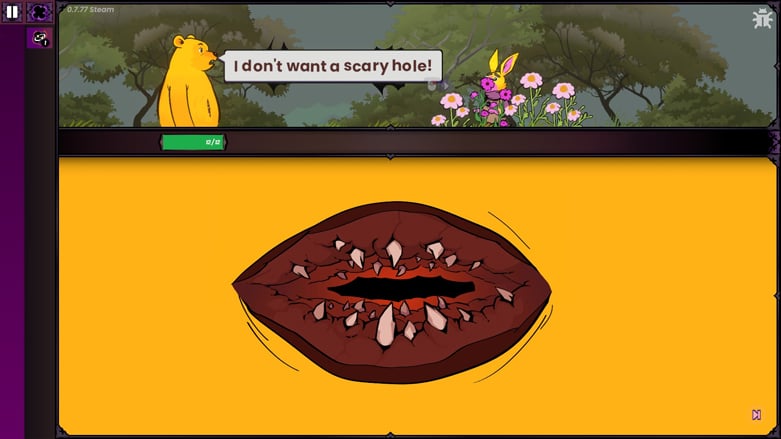
The game’s roguelike gameplay loop is split into two sections: combat and exploration, with both making use of the aforementioned tetromino blocks in their own way. During combat, your typical deckbuilding mechanics are enhanced by the use of multiple, uniquely shaped blocks, which trigger all of the effects (or your “cards” for those familiar with the genre) that they touch. For example, you can deal damage, heal, and shield Winnie from damage all in the same turn by using the right-shaped block to cover all of the spaces needed.
Similarly, exploration has you using randomly selected pieces to navigate a small space, rewarding you with all the resources you can pick up in that area. You’re given a limited amount of pieces before you have to move on to the next stage, and touching the side or going “out of bounds” with your pieces deals damage, hurting your run. This makes for a clever sort of mini-puzzle between combats that makes use of the block-placing mechanic in a similar but still unique way than the combat does.
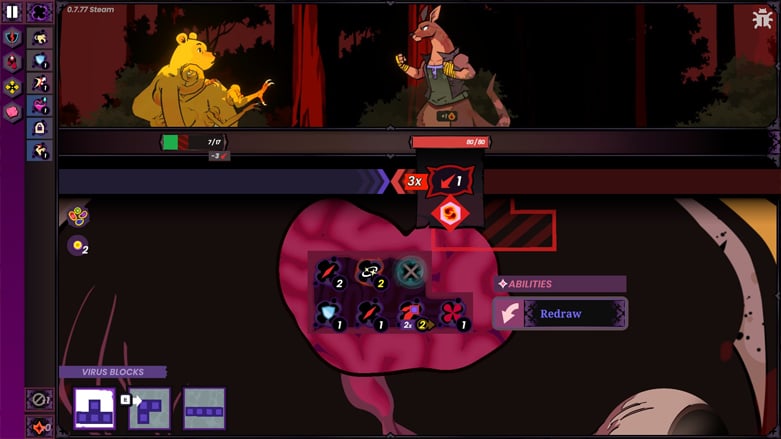
Something I really appreciated about the game’s upgrade tree is how liberal it is with “card” mutations, or the ability to add extra effects to the abilities you play each turn. These effects are generously effective, such as copying the card onto another enemy, using its effect twice, or allowing the card to be instantly used upon draw, and can be applied to essentially anything in your deck, making for some crazy combos.
Just like how Winnie’s Hole combines a lot of different elements to create one cohesive game, the game is all about forcing poor Winnie to grow accustomed to a series of mish-mashed growths appearing all over the bear’s body.
See, the actual plot of Winnie’s Hole is about a terrifying virus growing within the bear’s body. As it spreads, the virus begins to mutate, giving the player access to more cards and special perks to use in combat, and adding a delightfully terrible new addition to Winnie’s body.
Yes, what is by far my favorite part of the game is the use of what can only be called procedurally generated body horror; each new mutation that you acquire during your run corresponds to a different, horrendous growth appearing on Winnie’s body. When you select these mutations, Winnie’s body actually grows, and the new mutation appears procedurally somewhere on the bear’s grotesque mass. Watch as eyeballs, centipede legs, and crab claws appear in places they definitely should not be, alongside other equally creepy changes as the one friendly bear becomes a terrible mound of horror, feasting on his forest friends in the process.
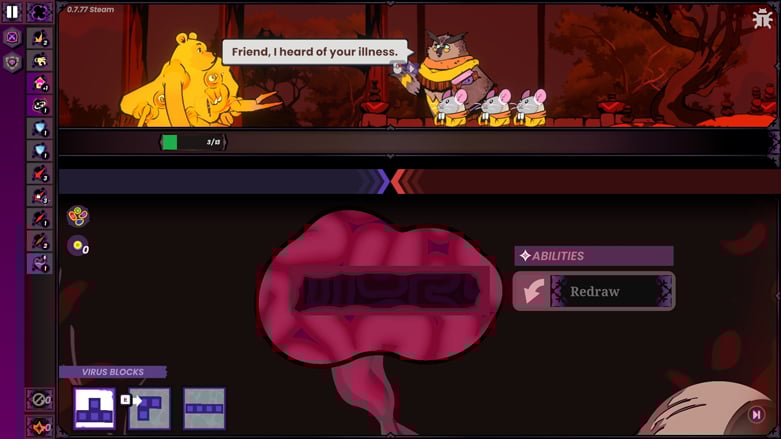
All of this is delivered in a unique art style and with original character designs based on the familiar characters you love and will come to dread. One criticism I have here, and it’s a subjective one, is that I wish the art style was closer to something we’ve actually seen from the property before, which I think would add to the creepiness and the sort of twisted nostalgia factor the game is going for.
There really isn’t too much more I have to say about Winnie’s Hole. For a game in Early Access, I found everything to be in a surprisingly solid state: the gameplay loop is well defined, the mechanics are fun, there’s a lot of playtime there for the player to enjoy, and the overall theme is very solid and well executed. It’s a great roguelike, a solid parody, and a fun piece of horror media, so there is already a lot here for players to enjoy.
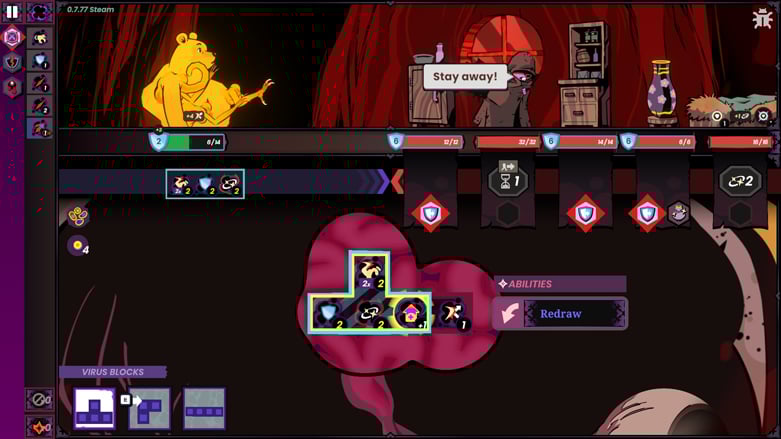
If there was something I had to criticize, it would be that the game’s animation and hit effects are a little lackluster. So much effort was put into turning Winnie into an animated, shambling mound, with horrifying appendages growing from every which way, but similar effort isn’t present in the game’s combat. Powerful attacks are just represented with a quick and lackluster PNG over an enemy, leaving a little too much to the imagination. Defeated enemies also just fade away and turn into floating DNA pellets for you to collect; I’d like to see a lot more grotesque effort put into these animations and effects, so it really feels like I’m playing the terrifying monster I’m meant to be.
Winnie’s Hole is not just horror-slop designed to capitalize on your nostalgia for a familiar, now public domain property. It’s a genuinely clever take on the deckbuilding roguelike genre, with mechanics that stand out from others before it. It’s also a uniquely fun, grotesque piece of body horror, which doesn’t take itself too seriously but also doesn’t shy away from terrifying mutations and morbid execution on its premise. It’s great, even for something in Early Access, and I’m looking forward to seeing where the developers take it next.
Pros:
- A solid twist on the mechanics of the deckbuilding roguelike genre
- A genuinely great piece of horror media
- A fun parody on a familiar franchise, which doesn’t take itself too seriously
Cons:
- A disappointing lack of animations or effects that could take the horror content to the next level
TryHardGuides was provided a Steam code for this PC Early Access Review of Winnie’s Hole. Find more detailed looks at popular and upcoming titles on our Game Reviews page!

Comments