
There are quite a few similarities and repeating themes in farming and crafting games, particularly those in the genre defined by trendsetters like Harvest Moon and Stardew Valley.
Oftentimes, these games follow a familiar story: something has driven you, the player character, from the hustle and bustle of city life into the countryside. Usually, this is the death of a family member or some lucky break that has led to the inheritance of a small rural property, conveniently located not far from a friendly, if not thriving, community that will often welcome you in with open arms. These games will often sprinkle in very real and very heavy topics, often involving the quiet tragedies of life, like natural loss or falling out with a friend, and usually revolve around the themes of being self-sustainable and helping your small community thrive with the sweat of your brow. These stories are often environmentalist, fit snugly into the “cottagecore” category, and can usually be a little too optimistically toned for my taste.
Winter Burrow is also a lot of these things. It’s an environmentalist tale about escaping the city and returning to a home in the woods, long forgotten from your childhood. Many familiar tropes in the genre are touched on by Winter Burrow — and touched on well. These types of games know what they want to be, and they know what their audiences want.

Winter Burrow does, however, set itself apart from other titles in the genre quite a bit, even while hitting on a lot of the same notes.
The game’s setting and protagonist — the much smaller world of a tiny field mouse — already make for an interesting change from the formula. Being an animal, albeit one that lives a surprisingly human life à la The Secret of NIMH, does a lot to change the perspective of the story. If a writer really pays attention, this perspective can also dramatically change the story’s tone; thankfully, in Winter Burrow, it does.
Working in the city slowly killed the parents of our protagonist. Hard labor in the mines sent them to an early grave before they could ever afford to return back to the countryside. As our protagonist returns home to the cottage stump of his youth, he finds himself with far more freedom outside of the city, but with freedom, of course, comes danger and responsibility.
See, the life of a field mouse is not easy. Even people who settle out on scarcely touched frontiers face famine, exposure, and dangers in the woods; as a mouse, you are much smaller and face far more natural predators that can make survival even more challenging. Winter Burrow understands this, and it’s a huge theme in its writing.
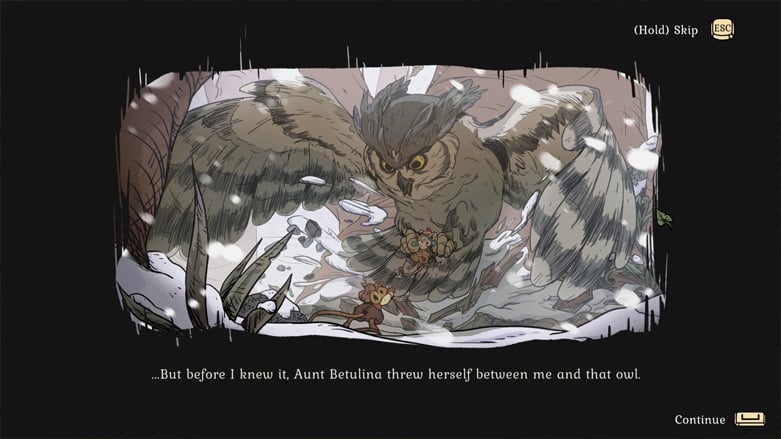
What I’m saying is that there is a hard edge to the narrative in Winter Burrow that separates it from other titles in its genre. It’s not gratuitous, particularly violent, or gruesome, but it honestly takes a look at the harsh nature of — well — nature. Beetles will attack you in the woods, the snow will freeze you in place if you don’t stay warm, food is scarce, and the threat of owls, snakes, and even big bugs is constantly present for a tiny mouse.
The game’s writing is also rather solemn and hangs heavily on the problems the characters are facing. Rather than peeks behind the curtain of a seemingly perfect life, the struggles of our characters are presented plainly and are often big motivators for their actions. The themes of togetherness and being a good neighbor still make it in, but they’re used more as a subversion to the grimness of the setting rather than as the highlighted theme.

For as unique as I found the story and setting of Winter Burrow, I can’t say I was as impressed by the gameplay itself.
If you’ve played Stardew Valley, you’ve played Winter Burrow, which is mechanically familiar to many other titles in its genre, if lacking a bit itself. You can gather supplies, craft furniture or advanced building materials, and restore your home and its small farm over time. It is solid in its gameplay mechanics, if a bit basic and uninspired, and even lacking a bit in content compared to other similar titles.
The game is not likely to challenge you, with resources being pretty abundant and the roadblocks to progress being fairly simple. This is especially true since most of the game’s literal roadblocks, such as better resources and actual blocked zones, are unlocked through the game’s linear story.
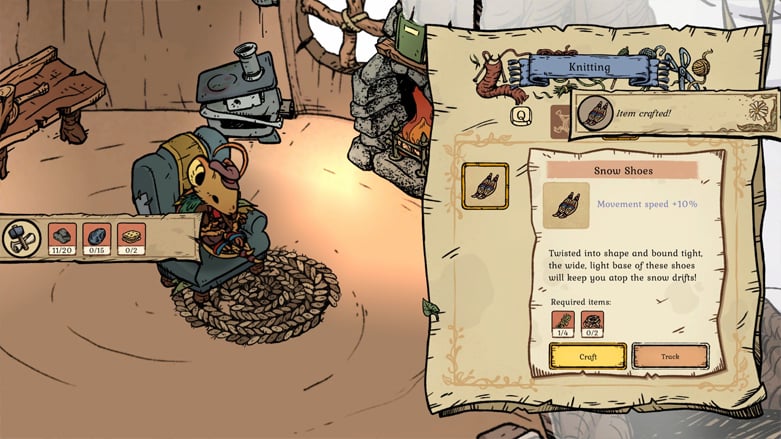
The biggest issue behind the gameplay is that Winter Burrow is a rather linear experience. Nearly every recipe and resource you find is fed to you at just the right time as you continue through the game’s story, without a lot of room to be open-world or give the player a lot of sandbox options for their farm. You essentially are always completing a mission, not trying to earn a lot of money by growing the crops of your choice or exploring the map as you see fit, because progress is intrinsically tied to whatever quest you’re currently doing.
The Final Word
Winter Burrow really stands out for its unique setting and the bold way it chooses to approach its narrative and character writing. Mechanically, it’s less bold, being a solid game to play, even if it’s a little overly similar to others in the genre and too linear for my personal taste. It is definitely a cozy take on its genre, one that can be played at your own pace without worry of a big difficulty curve or trouble, while unironically having a more solemn story than a lot of its peers.
Try Hard Guides was provided a Steam code for this PC review of Winter Burrow. Find more detailed looks at popular and upcoming titles on our Game Reviews page! Winter Burrow is available on Steam, Xbox, and Nintendo Switch.

Comments