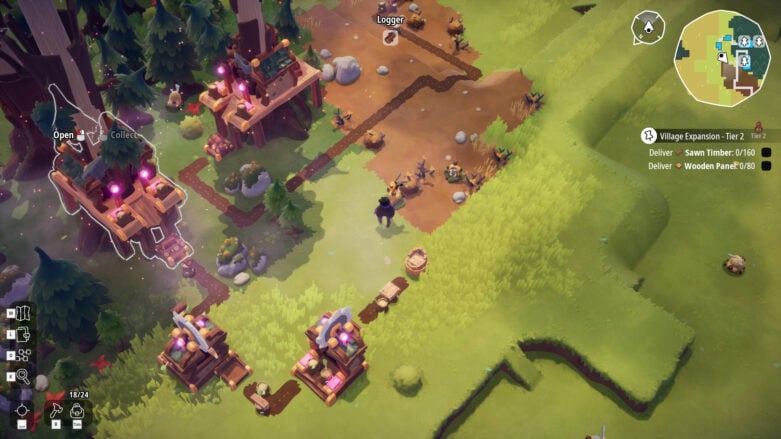
In Oddsparks: An Automation Adventure, you discover an ancient and lost ability—Automated industry! Using the power of a mysterious artifact fallen from the sky, you construct an army of automaton workers and bring property to your tiny village with the help of the cutest little labor force you’ll ever meet.
Getting right into the game, I first found myself making a character, which seems to be a semi-optional step that can be accessed at any time and isn’t immediately required to play.
Character customization is simple and sweet. There aren’t a ton of options for tops, accessories, or hairstyles (at least not at the moment), but there are still a good handful of options in most categories. Some things are locked behind in-game achievements, which I don’t mind and actually sort of prefer. The accessories you do have are taken an extra mile with a color bar that lets you deeply customize the hues you take into the game.

One of the first things I came to appreciate about Oddsparks: An Automation Adventure is the game’s myriad unique models and animations. You see a taste of this right away in character creation, but it starts to shine as you get into the gameplay. Collecting all the different types of Sparks (which I’ll touch on more in a bit) is fun, and watching as they operate machines differently with their own little animations is a neat little piece of attention to detail the developers didn’t need to include, but I appreciate it.
Oddsparks: An Automation Adventure is all about automation. I mean, it’s in the name, so you probably should have been expecting that. Automation is achieved through the odd sparks, which are also in the game’s name. These are funny little automatons crafted through techno magic who obey your bidding to the best of their stupid little ability.
Sparks gather resources on your command. They attack living creatures when ordered. Best of all, though, these soulless little golems operate machinery and production lines without needing a lunch break or union benefits!
Not all Sparks are created equal, either. Some are better at operating machines, carrying goods, or chopping flesh. A big part of the game is figuring out which Sparks to put where and maximizing your efficiency with a diversified team of automatons.
Don’t tell the rest, but my favorite, by far, is the Stumpy Sparks.

Set your sparks to operate machinery. Then, draw paths from one machine to another, then to a storage device like a barrel. Your Sparks will follow the paths in an endless loop, collecting or depositing from machines whenever they encounter one on their right side.
It can be a little confusing to set up a working assembly line at first; The Sparks are, after all, stupid, so a lot of the thinking work has to be done by you. It took me maybe ten to fifteen minutes to fully figure out how to get a working conveyor line turning logs into sawed planks. Still, once I did, I reveled in the utter satisfaction of forcing tiny wooden men to saw their inanimate brothers into workable lumber.

Like your typical factory-style game, the gameplay loop revolves around unlocking new materials by exploiting your environment and progressing down a tree of sorts of engineering. Chop down wood to make logs, put logs into a sawyer to make planks, and turn those blanks into wooden panels. You continue down this tree for a while, with each new material giving you access to further advancements that require more and more refinement.
Generally, the formula for production seems to be 1 x 2 x 1, or one producer per refiner and two of said refiners to fuel the next tier. If we take the example of the wood production chain mentioned above, we would need one panel-producing machine to be fuelled by two plank producers, who would need one log cutter each to maximize efficiency.
Efficiency, of course, is the name of the game. You want to constantly upgrade your output supply, production speeds, and storage capacity, as well as discover how best to route your Sparks to create the ultimate self-sufficient work machine.

The game mixes this normal style of factory-game progression with a story-lite quest system. With the discovery of your automated workers, it is only natural that you would want to improve the lives of your village, and each craftsman of your hometown has their own ideas of how to use the Sparks. Progression and recipe unlocks are mainly locked behind your villager’s quests, with some needing to be completed before others, with the ultimate goal, of course, being to upgrade your village through your automaton automation.
My complaints about Oddsparks: An Automation Adventure are few and far between, mostly in the UI direction.
Quest tracking in Oddsparks: An Automation Adventure, frankly, sucks. Though you’ll ideally be taking on a bunch of quests all at once, you can only track one on-screen at a time. This sort of contradicts the nature of the game, which has you slowly completing each quest simultaneously (at least, that was the case for me.) Having to jump through the menus to find your journal (which, as far as I’m aware, has no hotkey?) to see the requirements for each quest your automaton workers are producing materials for can be a bit annoying.
I also found myself sitting around a lot of the time, waiting for things to get done, such as “cooking,” so to speak. Much of this review was actually written while I was waiting for stuff to finish crafting.
I’m willing to chalk this up to player error, though. The game encourages you to roam around, explore, and interact with your surroundings as your factories automate, but I found myself more or less planted by my Sparks, watching them as they went to work.
All in all, I’d say that Oddsparks: An Automation Adventure has been released into Early Access with more than a solid foundation, and if we have nothing but further improvements to make, expect that players have a title worth really getting excited for.
Pros:
- Great cartoony graphics and character designs
- Fun, well-fleshed-out factory-style gameplay
Cons:
- Slow at times, with a UI that desperately could use some better navigation tools

Comments