Sanatorium – A Mental Asylum Simulator is a game with an incredibly interesting premise. Stepping into the shoes of a 1920s mental-health doctor (sort of), you’re challenged with the day-by-day process of diagnosing and treating new patients, managing dwindling hospital supplies, and using your knowledge of outdated medicine to climb the hospital ranks, all while solving an internal mystery. While built on a strong premise, in execution, the game leaves something to be wanting, providing the veneer of a game that requires deduction and care for patients while really just being a simple deckbuilder with very few wrong answers. More of a puzzle game than an immersive asylum simulator, the game’s own internal logic for getting through the somewhat repetitive gameplay loop can be flawed as well, leading to a frustrating experience in an otherwise interesting critique of a dark age of mental healthcare.
For further context, Sanatorium – A Mental Asylum Simulator is a story-based deckbuilding game where you play as a reporter posing as a doctor in a 1920s-era asylum, where your aunt has been writing you strange letters hinting at abuse. The gameplay revolves around your day-to-day doctorly activities as you slowly collect evidence against the head doctor and expose what’s going on at the facility.

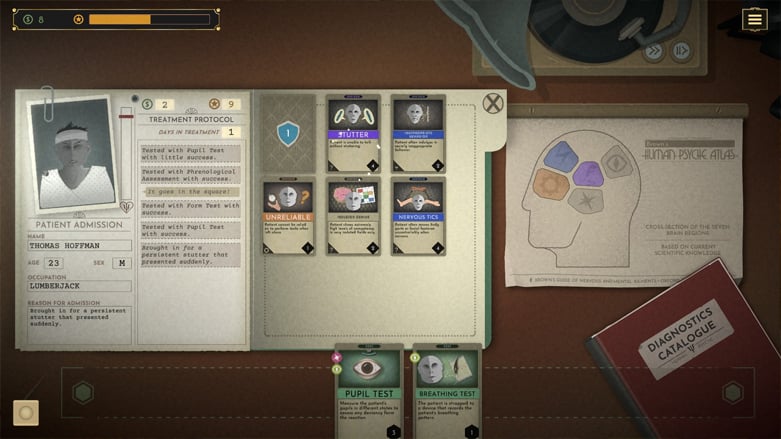
The gameplay loop is pretty straightforward. Each day, you spend your money on testing equipment and treatment methods, which are the game’s main form of deckbuilding or cards You then diagnose patients in your office, assigning unknown symptoms to different categories based on the outdated science of phrenology. You then treat each patient based on their symptoms and the treatments available.
Each category of phrenology is assigned a color or symbol, which corresponds to the different cards you purchased at the start of the day. Certain symptoms are diagnosed better by corresponding cards and can only be treated by corresponding cards. You can combine symptoms into a single, easier-to-treat diagnosis once you’ve discovered enough corresponding symptoms. Each patient requires a certain amount of treatment each day, with a reputation bar increasing or decreasing based on correct or incorrect diagnosis or treatments, or missing a treatment. You get a certain amount of money per day per patient, which is then carried over to the next day where the cycle begins. If you mess up too many times and your reputation drops to zero, you lose the game.

It’s an admittedly fun gameplay loop and one that I found myself getting sucked into really quickly. However, it’s not without its problems.
One such problem is that you can’t view your patient files at the start of the day and instead just get a vague estimate on which treatments you’re going to need that night. It makes it impossible to know exactly how many treatments, and of which kind, you’re going to need that night unless you have a great memory and are taking notes. It becomes even harder when you get new patients, but that level of unpredictability, I think, fits the gameplay loop well.

Another issue is how the game handles assigning each symptom to different categories in its phrenology analog. Put quite frankly, sometimes the categorization of things just does not make sense. A symptom talks about involuntary movements, but isn’t categorized with the area that specifically mentions involuntary movements. This is present for a lot of symptoms, especially those you unlock later, and can become frustrating when you receive severe reputation penalties for getting them wrong.
Another big issue I have with the game is that it simply boils down to a game of matching cards. The deep and seemingly well-researched flavor of mental illness and outdated science becomes a game of matching the blue symptoms with the blue treatments, etc. There is a mechanic to discuss with your patients the symptoms they have, but doing so and paying attention doesn’t actually help with diagnosis or treatment, nor do they actually have unique dialogue half the time. It feels like the game is sort of a shell of a complex asylum simulator, showing off a lot of surface-level complexity that ultimately amounts to just matching cards with each other.
Sanatorium – A Mental Asylum Simulator is not an unplayable game. The gameplay loop is fun, and the theming adds to the experience in a positive and immersive way. However, the asylum theme is just that: a theme, with very little additional depth to explore the fantasy beyond surface-level aesthetics and descriptions on cards. The gameplay loop, while fun, has its flaws and can quickly become flawed or face pacing issues depending on how many patients you have. It’s a fun card game, but not quite the immersive sanatorium simulator I expected it to be. As long as you know what you’re getting into, however, I can still recommend the game to you, especially on sale.
The Final Word
Sanatorium – A Mental Asylum Simulator provides a unique coat of paint over a deckbuilding-style puzzle loop. That coat of paint is about as deep as the theme goes; however, the game unfortunately lacks a lot of immersive features or mechanics beyond color-matching cards. If you know what you’re getting into, it’s not a bad game, but the promise feels like more than what the title actually delivers, which also feels a bit like it should still be in Early Access.
Try Hard Guides was provided a Steam code for this PC review of Sanatorium – A Mental Asylum Simulator. Find more detailed looks at popular and upcoming titles on our Game Reviews page! Sanatorium – A Mental Asylum Simulator is available on Steam.

Comments