
Imagine if, upon drifting off to sleep, you could find yourself in another world. A world of vicious monsters and cruel demons, wearing deceptively cute, almost mocking facades of small animals as they hunt you down. A sort of special hell only accessible by those in our world suffering the most from mental illness and trauma, who have no choice but to fight their way out to return to the waking world.
That is the rough premise of SealChain: Call of Blood, a roguelike deckbuilder that puts a unique spin on the familiar deckbuilding mechanics of the genre.
Believe it or not, this unique mechanic is actually advertised in the title of the game. SealChain actually kind of sums up how the game is played: each powerup you collect during the roguelike runs fills up a spot in your inventory and points in different directions on the hexagonal grid. By connecting these directional inputs, you create a chain of sorts that enhances and activates these powers, even more so if they have a resonating type. Behind this grid, you can play Seals, which activate a specific passive buff when you fill out the grid above in a specific pattern. Thus, seals and chains are your means to power in SealChain: Call of Blood.
If that explanation did not make a whole lot of sense, you can imagine it like a deckbuilding roguelike meets Resident Evil-style inventory management. It is not a perfect comparison, but I think you would get the picture.
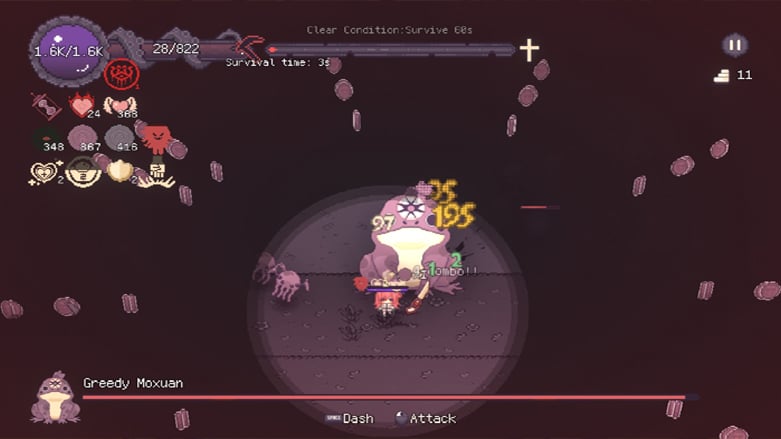
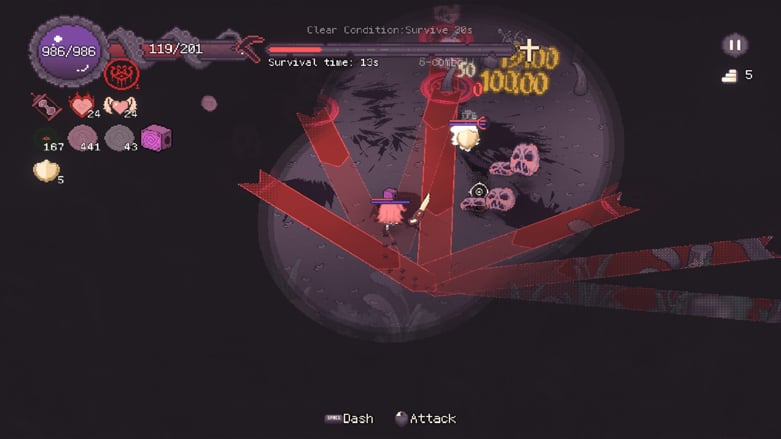
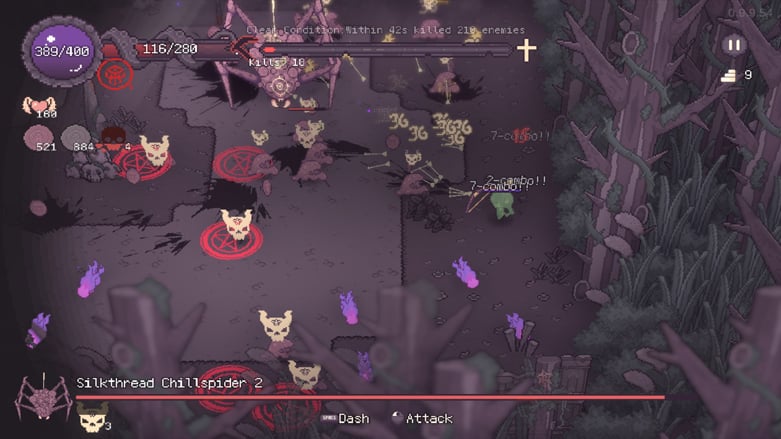
Outside of the powerup system, SealChain: Call of Blood plays as a sort of bullet hell with roguelike elements. Each level is procedurally generated along a path of nodes, with each one giving you a reward. Battle segments consist of you either surviving for a period of time or killing enough enemies to trigger a map wipe that ends the encounter, with elite or boss enemies thrown in along the way. Your weapon auto-locks onto nearby enemies, but you still have to make the input to attack them, and you have a short dash with invincibility frames to dodge the hail of projectiles that will be on your screen.
Interestingly enough, the battles in SealChain: Call of Blood do not appear quite as often as you might think. In a usual run, you might face one battle between two to four non-battle nodes, giving you a lot of rewards for not a lot of effort. This is not to say that the game is poorly balanced, as it is built around the fact that you will have lots of these rewards, and it gets progressively more difficult with every battle you do enter.
What this does mean is that a vast majority of your time in SealChain: Call of Blood is spent actually crafting your build as opposed to actually using it. You are given constant additions to your inventory management between the times you actually get to use it, so you will mainly be fiddling with how your inventory is laid out and trying to solve the puzzle of how to properly build your character, which can definitely be time and thought-consuming.
For some, this is all part of the fun. For others, I can see this being sort of a drag, especially with how short the actual battle segments are. A level in SealChain: Call of Blood will rarely take you longer than 60 seconds to pass or fail, either because the game wipes all the enemies out that quickly or because you were swarmed and killed.

The inventory system can be especially difficult to manipulate and master because the game does not do a very good job of explaining this rather complex mechanic to you. The only tutorial is a short, text-based one that briefly explains how to connect nodes in the grid element of the inventory. However, since the game has some overall poor localization in English, this written tutorial can be kind of hard to understand. I was personally left confused by how exactly to activate Seals throughout my playthrough, despite having plenty of opportunities to use them.
Something you no doubt have already noticed about SealChain: Call of Blood is the unique art style of the game. The game uses hand-drawn, 2D art for all of its backgrounds, enemies, and characters, and hones in on this rather unique design philosophy in portraying it all. Horrific demons and straitjacket-bound killers are portrayed as cute anime girls, and while the game has a rather dark and toned-down color palette, it makes heavy use of the red-to-pink-to-purple spectrum. It creates a really unique, gorgeous look that is a sort of toxically cute, goth-girly aesthetic that I really vibe with. It is without a doubt one of the biggest draws of the game, and I can see a lot of players enjoying it just for that.
SealChain: Call of Blood is overall a pretty good deck-building roguelike title. Its unique art and mechanics make it stand out from other titles in the genre. While some will love the game for its heavy build-making mechanics, others will find that the actual gameplay is a little lite, menu-heavy, and poorly explained by the tutorial. If that does not bother you, however, you should absolutely give SealChain: Call of Blood a try, as the experience will certainly be memorable if nothing else.
The Final Word
SealChain: Call of Blood stands out for its unique approach to deckbuilding and its phenomenal art and aesthetic. To some, the game may feel menu-heavy and action-lite, with the poor localization making its mechanics harder to understand. Those who can look past these issues and really engage with the character-building mechanics will likely fall in love with the complexity of the mechanics, the narrative, and the world and characters within.
SealChain: Call of Blood was reviewed on the PC. Find more detailed looks at popular and upcoming titles on our Game Reviews page! SealChain: Call of Blood is available on Steam.

Comments