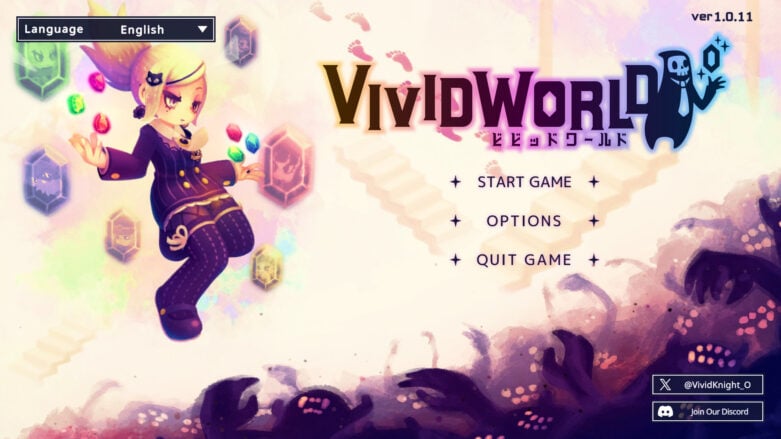
I don’t know what you call the visual aesthetic of this game—moe, kawaii, something like Hello Kitty meets the Grim Reaper—but I love it.
Vivid World is a unique title that combines roguelike dungeon crawling, deckbuilding, and autobattlers into one surprisingly cohesive package with, as I said, a really good and really cute visual identity all its own.
As a student who wakes up in the afterlife after a mysterious attack on her school, one she all but slept through, you battle through various dungeons using the power of summoned allies to free the souls of your deceased classmates from greedy demons and piece together what happened during your fateful nap.

Stepping into Vivid World’s somewhat lengthy hands-on tutorial can be a bit overwhelming. Combining three different genres and built around the fundamental idea of a party-building dungeon crawler, there is a lot of information to take in; even after learning how to play the game, there is quite a lot of text to read as it comes from item descriptions, hero powers, and most of all, keywords—the latter of which can be pretty hard to remember the effects of on the fly.
Essentially, Vivid World plays like this. You enter a dungeon, which has a series of randomized paths ending in a transition between each level, the final of which has that boss’s dungeon. Along the way, you collect several resources, a bit too many if you ask me, which can be used to buy gems. While there are other trinkets like jewelry to collect, gems are your main form of progression.
Gems make up both the autobattling and deckbuilding elements of the game. Heroes come from their own gems, each one having its own unique ability, stats, and traits, the latter of which can be activated by matching multiples in a party. Heroes are upgraded by collecting three of a kind, which improves their stats, or by gathering orbs, which give them a passive ability. They take damage as they battle or if you explore too long, and can be healed by using a unique currency meant exclusively for healing them. You can also use gold to collect more heroes or upgrade the size of your party from merchants.
The other side of gems are just called… well, gems. They are activated abilities that go into your hotbar to be used by the player either before or during battle. They can be found as level rewards or purchased using, once again, a unique currency exclusively meant for gems.
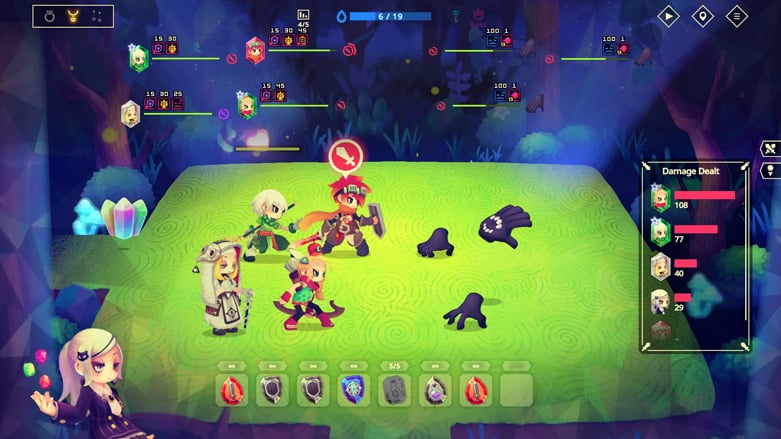
Combat in the game is played as a combination of turn-based actions and autobattling. Each turn, you can use one of your gem cards to deal damage to an enemy or buff an ally. Then your party and the enemy will fight each other, automatically casting their unique abilities every time their Technical Points reach a threshold. After everyone uses their basic attack or skill once, the turn resets, and it’s back to you to initiate the next by using a gem or skipping the action.

The goal of a dungeon is to collect and upgrade your ideal party through randomized rewards leading up to the final boss, beat him, and go home. Nothing you gather in the dungeon carries over, but instead you earn a permanent upgrade reward that can be used to mutate the dungeons themselves or buy yourself permanent buffs in the form of stickers.
Though Vivid World can feel overwhelming with its multiple currencies, abundance of items, heroes, and keywords to keep in mind, I did have a great time with it. The aesthetic is cute, and it’s fun not only to engage in the autobattling gameplay loop but to continuously unlock and try out new heroes in battle. It sort of has aspects of a creature collector in that sense, as you are constantly adding new heroes to discover as you play.

That contributes to one of the game’s bigger problems, though, which is loot-pool bloat. There are so many gems, heroes, and jewelry items to collect that the later stages of the game can feel bloated and difficult to manipulate through RNG. You have to embrace the roguelike chaos rather than holding on to rerolls to build your ideal build, like you can in other titles in the genre.
Another issue the game suffers from is a lack of readability. It is difficult to understand everything that is going on in a battle, especially when it involves enemies and Technical Points. When certain gemstones give your party 25 TP, it isn’t clear when you should use that, as I could never find an actual numerical indicator of how much TP my party had at any given time. Like other parts of the game, it felt less like I was making coordinated decisions and more like I was playing a guessing game.
Fusing gemstones together was a mechanic that suffered from a similar lack of direct information. For example, combining two Iron Shield gemstones created a level 2 Iron Shield, but combining that level 2 gemstone with a level 1 of the same type created a totally new gemstone with a different effect. Mutating your gemstones into new ones that don’t provide the same effects as before wasn’t a fun mechanic and again left me feeling confused half the time.
Despite the game’s bloated RNG and lack of clear, directed information, I had a lot of fun with it. The game’s aesthetic identity is great, and the unique gameplay loop, combining roguelikes, deckbuilding, and autobattling creature collectors, is fun and replayable. I highly recommend this title to anyone who can handle it without feeling overwhelmed by everything it tries to tell you.
The Final Word
Though its RNG inventory can be bloated and it doesn’t communicate information perfectly, Vivid World is a highly fun combination of several genres that stands out for its replayable, engaging gameplay loop and super unique identity.
Try Hard Guides was provided a Steam code for this PC review of Vivid World. Find more detailed looks at popular and upcoming titles on our Game Reviews page! Vivid World is available on Steam.

Comments