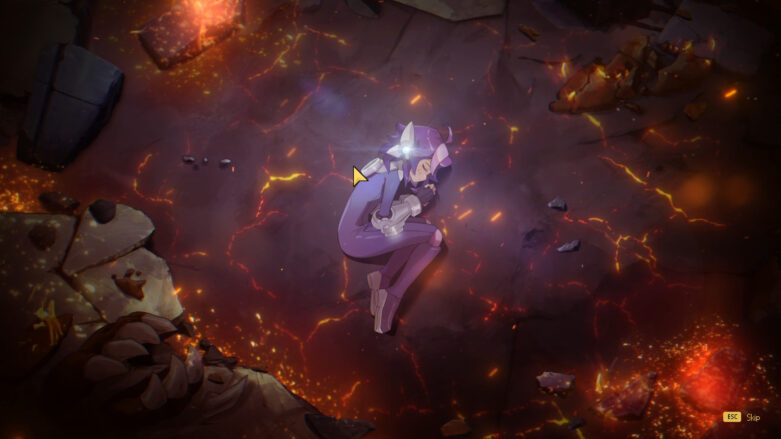
What would you do if you only had 30 seconds to save the world?
You’ll experience just that in Ascend to ZERO, a clever, highly stylized roguelike all about time travel and hopeful defiance in the face of overwhelming odds. Sent back in time moments before calamity and armed with the ability to stop the flow of time for everyone briefly but yourself, Ascend to ZERO challenges you to manipulate the last half-minute of everyone’s life to fight hundreds of foes, save your friends, and save the very world itself.
There are two key aspects to Ascend to ZERO‘s mechanical identity that make the game the unique experience that it is.
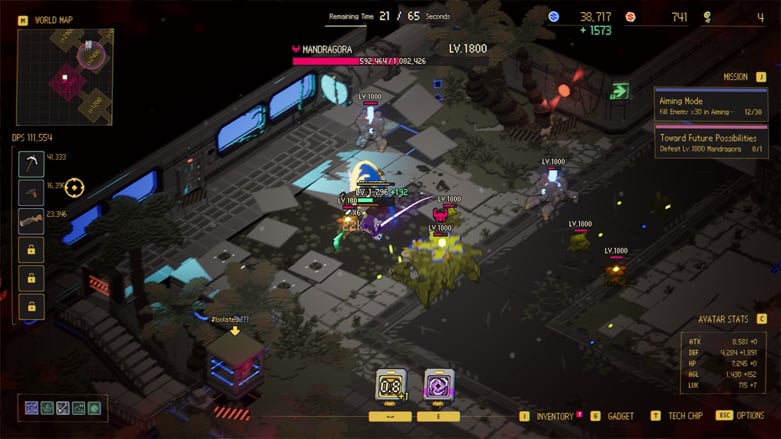
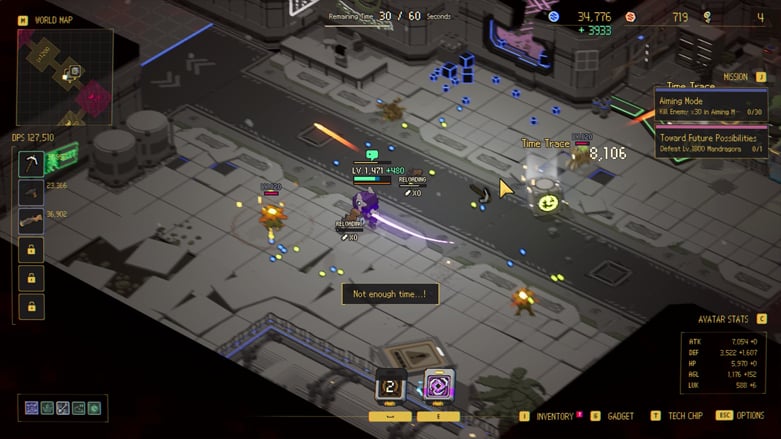
The first part of this two-part formula is that the game is played in thirty-second bursts. Sent back in time just before the end of the world, you must use the literal final moments of your time on Earth to make a difference. A thirty-second clock ticks down as you blast through the levels. You have the ability to stop time, but doing so prevents you from interacting with objects or using your weapons. It’s a tactical tool, not a free pass to victory, and the use cases are very strategic and clever. Being unable to hurt your enemies in the frozen-time state makes it more of a tool for setting yourself up for victory or cheating precious seconds, which is important because even one full second can be the difference between victory and your run ending.
Time can be extended either by earning permanent upgrades through runs or by being reset after defeating certain enemies, meaning the last 30 seconds can theoretically be extended indefinitely. While I don’t love the ability to extend the time limit, I can’t really think of another way the game could make itself playable without it. I suppose every boss enemy you defeat just delays the invading army’s ability to destroy the world by intervals of thirty seconds. Other options that slow or speed up the flow of time also play with this concept really well, creating risk-reward systems and safety nets where a precious second can last you longer.
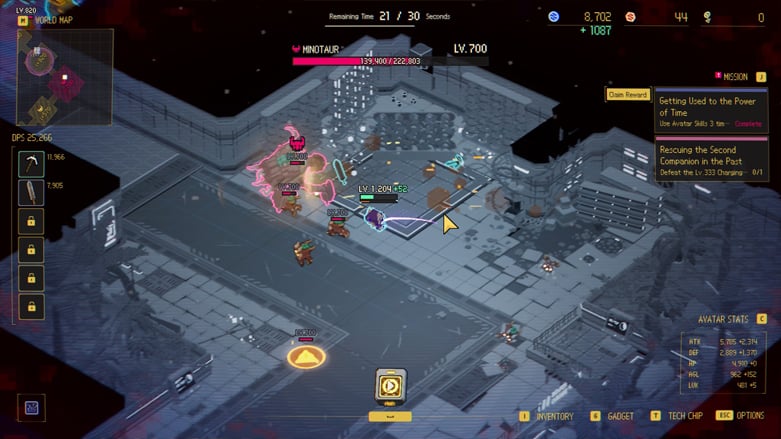
The second piece of the puzzle that is Ascend to ZERO is the clever way in which the game combines the roguelike structure with survivorslike combat. All combat is handled passively and automatically by the weapons you equip, sort of like the abilities you unlock in a Bullet Heaven game. This is also why you can’t hurt enemies in the frozen time state, because time has to be progressing for them to fire.
Paired with this is the unique way in which the game handles roguelike pathing. There are no doors or level transitions; instead, there are open areas separated only by monster difficulty. The game throws level-ups and difficulty curves at you in massive increments. The first room has level 1 enemies, the second level 25, the third level 70, and so on and so forth until you’re facing enemies with levels in the thousands. Each level you earn increases your own stats, and this creates probably the most interesting interaction with the game’s limited timer: Do you waste precious time sitting in an era you can handle, gathering experience points and levels, or do you rush ahead, risking being stalled or even outright killed by enemies you can’t handle?
Ascend to ZERO is an awesome game, one that pairs two very unique core gameplay identities into one to create an experience that is both fun and strategically engaging. The game just manages to tickle some part of my brain that is obsessed with big level-ups, fast-paced combat, and dashing, and discovering roguelike augments as I delve deeper into the levels. I was frankly surprised by how much I loved the gameplay and just how much it managed to stand out among other roguelikes out there.
Thankfully, the game not only plays great but also looks incredible. The unique chibi-PSX style pairs well with the game’s incredibly good-looking and satisfying-to-navigate user interface, and the cherry on top is the gorgeous soundtrack that pairs alongside it all.
For everything I enjoy about Ascend to ZERO, I can also see where the game has its issues.
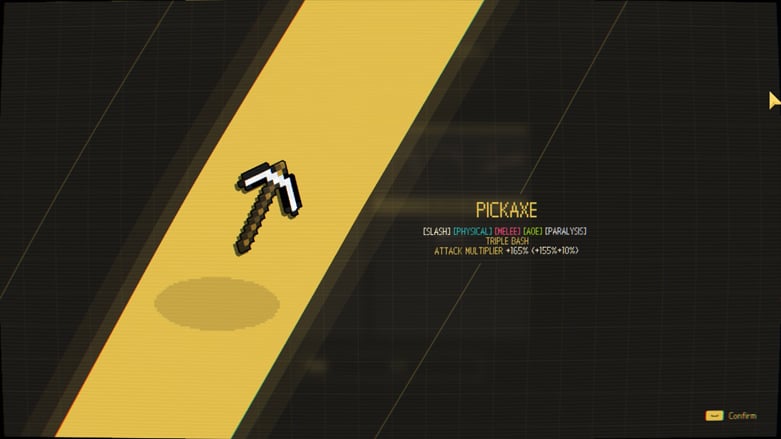
Namely, progression can feel significantly grindy. New weapons and items being locked behind a gacha-style system, accessed at the end of each run, is a less-than-ideal way to reward players for the time invested in the game. All upgrades share the same currency, which makes every run meaningful but also means you’ll spend a lot of time earning the money you need to upgrade your character across multiple areas. Later in the game, this feeling can only amplify as the difficulty curve scales sharply and demands a much greater time investment from the player to strengthen their statistics and face the challenge.
In addition, the less-than-perfect localization can make some areas awkward to read. Not impossible to understand, but a little confusing or tonally alien. This isn’t a huge problem, but I found it took me out of a lot of the dialogue and character interaction, which is something you really want to experience fully in a game with such an emphasis on its story.
The Final Word
Ascend to ZERO is a fantastic roguelike, one that combines its unique time-trial mechanics with a quick, dirty, and clever adaptation of survivors-like combat and satisfyingly intense level scaling. The game looks and plays great, but some poor localization and the grindy nature of its difficulty curve might prevent some players from fully appreciating it.
Try Hard Guides was provided with a Steam code for this PC review of Ascend to ZERO. Find more detailed looks at popular and upcoming titles on our Game Reviews page! Ascend to ZERO is available on Steam and Xbox.

Comments