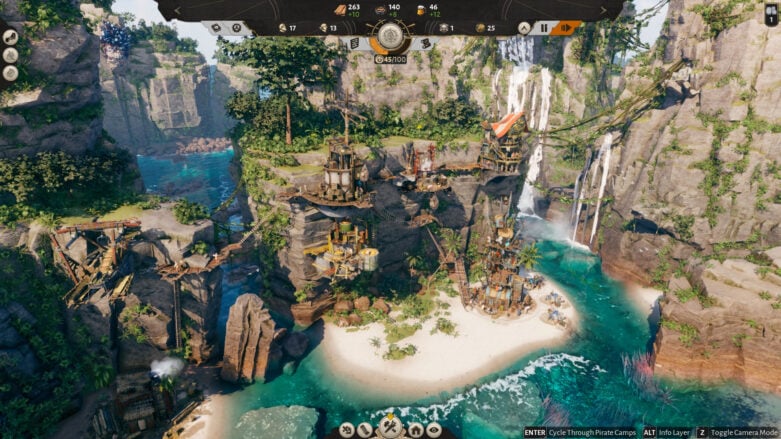
Corsair Cove ties with All Will Fall for the most interesting city-building games I’ve seen in a while, with both titles sharing a similar theme of being lost at sea and hanging structures from the sides of walls to make up for a lack of buildable land. However, while the latter goes for a post-apocalyptic, “Waterworld-like” theme, Corsair Cove is all about building a pirate haven amongst the towering cliffs of undiscovered Pacific or Caribbean islands. You shape a Tortuga of your own as you tend to the relatively simple needs of your pirate colony, and head out into the sea to plunder more gold, supplies, or even a larger workforce.
As far as city-building games go, Corsair Cove is relatively uncomplicated. Simple supply chains are completed using a workforce that physically moves goods from one place to another. Advanced farming and production mechanics are ignored in favor of a simple “building A supplies building B which supplies building C” mechanic, and a very simple base defense mechanic, as well as a simple shipbuilding and exploration mechanic, are thrown in to spice things up.
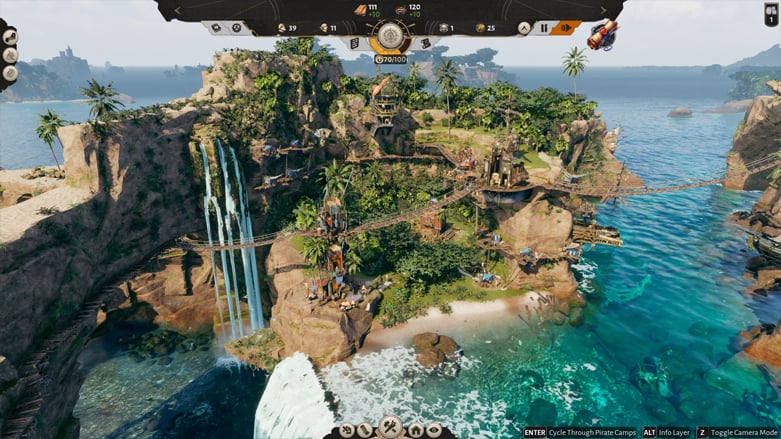
The most interesting aspect of Corsair Cove is that your logistical routes are completed via rope bridges, as the player is challenged to build atop and alongside cliff faces in lieu of buildable ground. If you’re familiar with the lore of League of Legends, Corsair Cove’s approach to city building is highly reminiscent of that of the city of Bilgewater, and that mental comparison is what attracted me to the game in the first place. This is both the most thematically interesting part of the game as well as a fun strategic puzzle.
However, that puzzle isn’t so much of a challenge when the supply chains themselves are pretty simple. It isn’t hard to get building A hooked up to building B, nor is it all that difficult to supply your pirates with everything they need.
That is, of course, when the pathing is functioning as it is supposed to. Some buildings I simply couldn’t connect to at all using the game’s pathing system.
Guano shacks, in particular, didn’t seem to have a connection point that the pathing tool could grab onto, meaning the task of connecting one to a pirate city, a connection you have to make in order to reap the rewards of a harvesting building or even build it in the first place, could not be completed. You can imagine why this might hinder my progression.
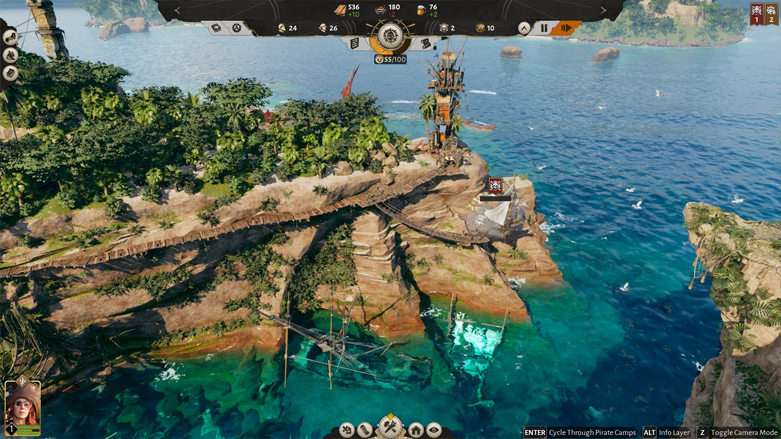
Even when these connections work, they can be rough to look at. Sometimes, the connections or wooden paths made in Corsair Cove just don’t connect well. Planks overlap, and it’s easy to create an impossible path that clips through another and watch as your pirates just walk through it as if it were nothing. While it is understandably hard to make perfect connections at the many angles you’d make them in this cliff-hugging pirate city, it would be nice if the game put a bit more effort into disallowing or correcting these broken paths, as, at the end of the day, looking at the city you made is almost more fun than actually putting it together.
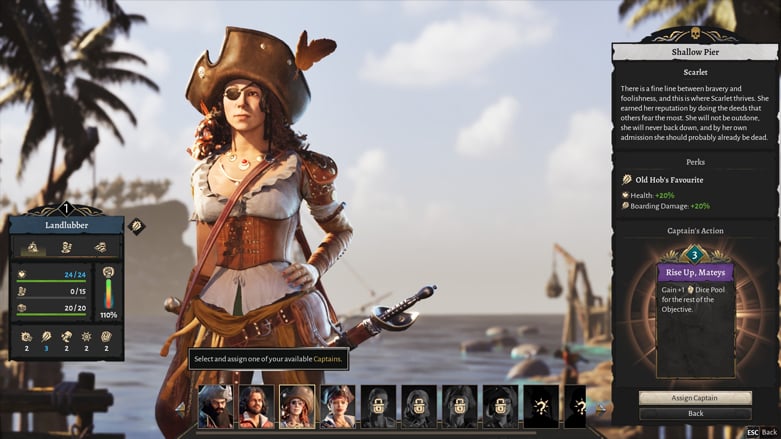
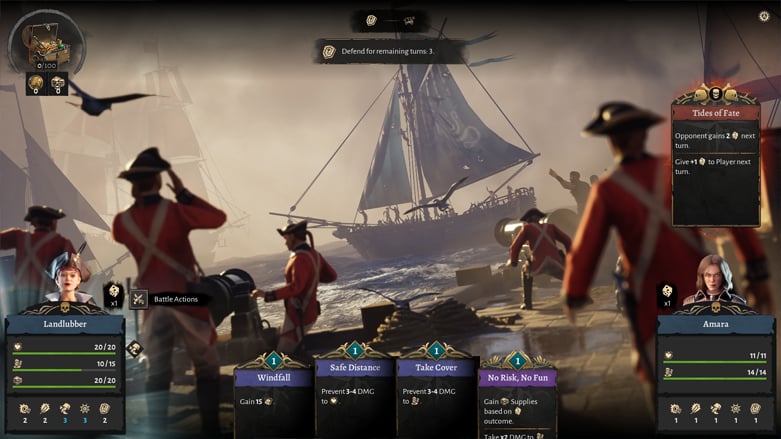
The game contains a main story and a few scenario maps, each of which has its own unique story to pair with its theme, which I greatly appreciated. The stories are engaged with by building outward and exploring the sea. Base building is fun and visually engaging, something that I feel is sometimes underestimated as part of the appeal of city-building games: you want to actually see the results of your building and observe it as it lives and breathes through the day-to-day you’ve designed. The ship combat and exploration, however, are disappointingly basic, coming in the form of text-based resource management decisions and what I can only describe as deckbuilding turn-based combat without the option to actually build your deck. The art and storytelling are fantastic in these exploration events, but in terms of gameplay, they’re understimulating and a bit disappointing.
Though the colony management is relatively straightforward, there are occasional hiccups that occur simply because the game doesn’t do a great job of explaining some of the more minute parts of its mechanics. I seemed to run into an issue when hiring a crew for a ship on my first non-campaign game. Though I had 39 “drifters” waiting to be assigned, the game told me I didn’t have enough of them to meet the ship’s demand of 10 pirates. I resolved this issue by supplying my tavern with ale, I think? Because the problem wasn’t explicitly explained, I’m not sure what actually allowed me to eventually man my ship.
When things work as intended, Corsair Cove is an interesting, albeit not very challenging, city-building game where the fun is watching how your city expands outward, not necessarily in the strategy of managing it. There were occasional bugs in my playthroughs, and for such a crucial element of the game, I would have expected more visual and functional improvements with the game’s path-building. The exploration and ship combat mechanics add some extra flavor to the game, but they are disappointingly underwhelming, and overall quickly take more of a backseat to the city building than they should in a game about seafaring pirate adventurers.
The Final Word
Corsair Cove is a great city-building game for those who like the actual act of building up their town, watching it grow and admiring the shape their labor takes, aided in no small part by its unique pirate theme and how it forces you to build atop and along towering cliffs. Mechanically, however, it can be a bit understimulating, being rather easy for veteran city builders to handle and gravely oversimplifying its ship combat and exploration mechanics.
Try Hard Guides was provided with a Steam code for this PC review of Corsair Cove. Find more detailed looks at popular and upcoming titles on our Game Reviews page! Corsair Cove is available on Steam and Xbox.

Comments