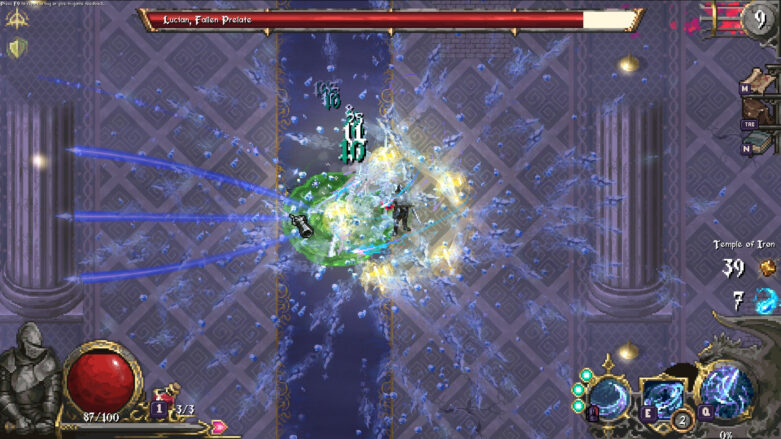
I love roguelikes. I love everything about them, and the genre has become one of my favorites in video gaming as a whole. I’ve had the pleasure of reviewing a lot of them since I started writing for Try Hard Guides, and I’ve seen the genre evolve drastically over the last five years. Because of this, I realize that I have, multiple times, said in my reviews that a title is “my new favorite roguelike.” I really do mean it every time, and I mean it again when I say that Cursemark has taken that throne once again, and has done so effortlessly and in great part because of how it actually subverts a lot of the genre’s staples.
The core of Cursemark is its combat, an exceptional system that hides a shocking level of depth behind its misleading simplicity. On the surface, Cursemark plays like most other beat-’em-up arcade games: you have a basic attack, an offensive spell, a defensive spell, and an ultimate ability. Each of these ability slots, including your basic or main attack, is filled with your choice from a series of elemental skill trees. You can wield a sword from the flaming Draconic tree while using a Celestial “Ward,” and so on and so forth. The actual input requirements for each ability are simple: left-click to attack, right-click to use your spell, and Q and E for the rest. There are no fancy combos or Souls-like micromechanics to complicate the system.
This simplicity allows Cursemark to really shine through where it matters: Its augments and mutations.
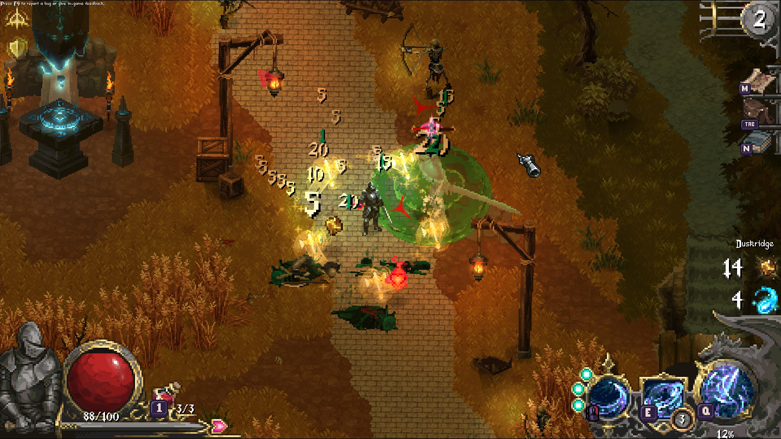
See, each and every one of your spells, your ultimate, and your attack, in addition to being unique depending on which one you actually place into the slot, comes with a series of augmentation slots that allow you to further mutate and enhance the ability. These mutations come in the form of runes, which can be simple effects like increasing the damage by a flat amount or more complicated abilities like summoning spiders when they kill an enemy.
You unlock more slots on each of your four abilities and attack, and there are no restrictions on what kind of runes you can mix. There are also no restrictions on what runes go where: every rune can be applied wherever you want, allowing you to truly build your kit how you see fit. This allows for some really amazing player expression in the game and makes each rune unique. There is a lot of variety in the game’s current state, but chances are you will, after a while, find yourself drifting towards a preferred build path and style, an issue that sort of defeats the purpose, in my opinion, and could be lessened later when the game adds even more runes and spells to the pool.
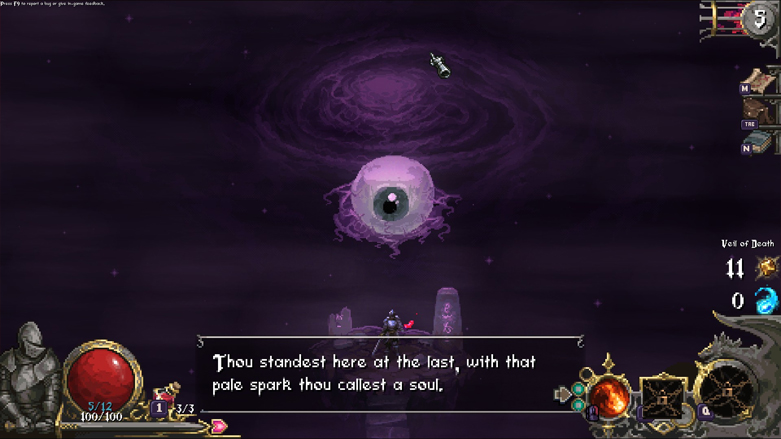
What is equally impressive is how the game’s many elemental types combine in hidden ways. For example, I was surprised to see that my fire spell, which was dropping pools of poisonous fluid, was also igniting said pools, leaving a burning pyre that seriously damaged the enemies within. While these hidden interactions are fun to discover, the game really needs to do a better job of explaining what each elemental effect actually does: as of right now, I’m not actually sure what the difference between applying Burning, Poison, or Lightning to an enemy is, and the game didn’t seem to share any tooltips to help me.
Many roguelike games are afraid to challenge the traditional formula. Cursemark lacks this fear and mixes things up in a few very notable ways.
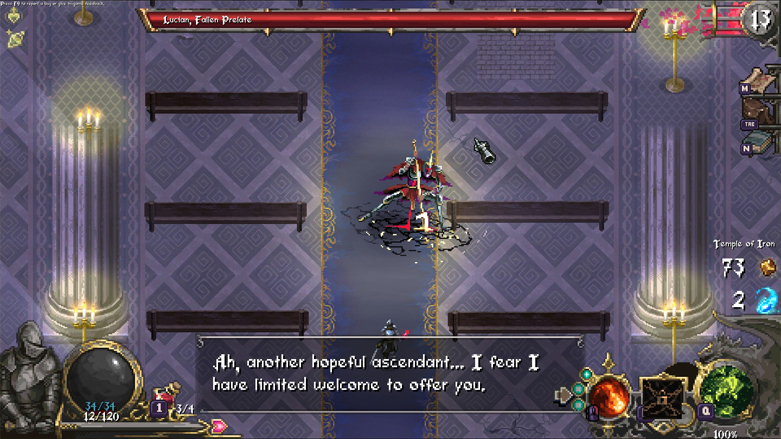
Nearly every roguelike sends you through a series of procedurally generated rooms, each one harder than the last and rewarding you with one of two or three power-ups at the end. Not Cursemark: you will quickly notice that the game’s map is persistent. It follows the same path and spawns the same enemies every time you start a run. It even allows you to backtrack between areas in case there was something you missed in the room before. The game even makes you go out of your way to gather keys and solve riddles in other areas of the map to unlock access to future zones, a world away.
Part of what makes this so unique and the game so much more fun is that everything is persistent. The game encourages you to collect currency between runs to unlock and upgrade boons in rooms you’ve already visited, and to learn the game’s layout to optimize your runs in the future. It also provides shortcuts and secrets that you can unlock to further enhance the map for future visits.
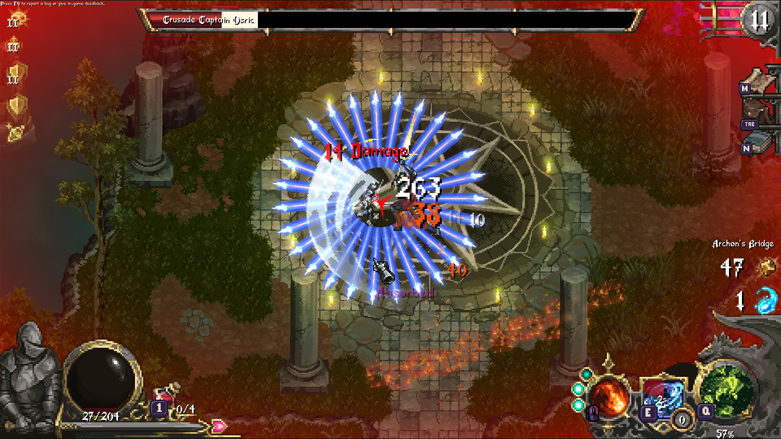
This is paired with a unique difficulty system that increases danger based on how many rooms you’ve cleared, rather than on the location you’re actually in. This creates an incredibly unique strategic game in all of your future runs: do you rush through shortcuts to get to a boss faster and with less of a difficulty spike, or do you backtrack through areas you’ve cleared before to take advantage of shrines, forges, and other boons you unlocked there to make yourself stronger?
I absolutely adore Cursemark. It has become a new favorite of mine, and I’m incredibly excited to see how the game evolves as it develops. Given that it’s in Early Access, there is obviously a lot of content missing: the game’s EA disclaimer promises more areas to explore, more runes and spells to unlock, and an overall increase in content, though there is already a lot to enjoy as it is now.
One area I would love to see the game expanded in is its weapons and spells. Specifically, I would like to see more identity added to the different skill trees. I would love it if each weapon had its own unique appearance, and there was more expansion on how each element operated.
I would also like to see some effort put towards making single-element builds more expressive. While I know the game is all about combining different affinities to make the ultimate build, I, and I know other players will feel this calling as well, was drawn to make a build of just one element. I went for Celestial since it was the most interesting, but was a little disappointed to find that the spells not only had less-than-perfect synergy with each other, but that there was no bonus or effect that came from filling each slot with the same school. Give us something special here; I think it would go a long way towards player satisfaction and identity.
While we’re at it, some new skins for the player character would be really cool, too.
Pros:
- Expressive, deep, and highly customizable combat system without complex mechanics
- Unique mixture of non-linear, persistent-world, and roguelike structure that challenges genre repetition
- Strategic routing and meaningful progression choices
Cons:
- Some game elements are poorly explained or outright not at all
- Base weapon/spell skills could have stronger identities
- Unfinished in the current EA state, though still with a lot of content to enjoy
Try Hard Guides reviewed Cursemark on the PC. Find more detailed looks at popular and upcoming titles on our Game Reviews page!

Comments