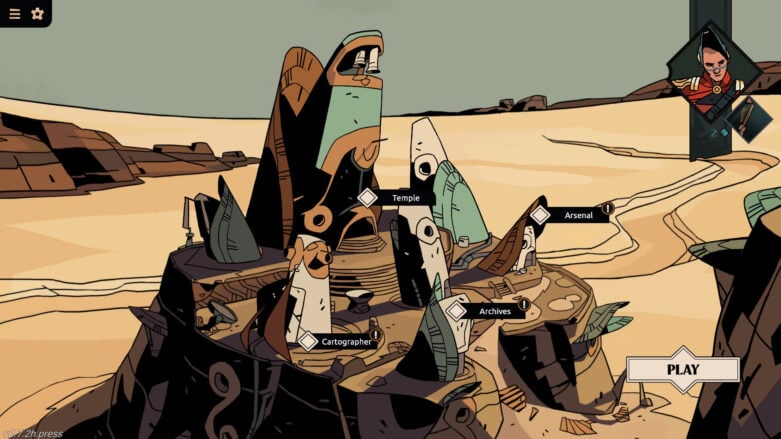
Deified is a turn-based tactical roguelike set in a fantastical desert, where you plunge into ancient tombs and defeat their guardians in search of rare treasures and powerful artifacts. Given the opportunity to play the game’s 1.0 version just before it releases out of Early Access, I can say that fans are in for a solid entry into the genre, albeit one that certainly has its flaws.
Right off the bat, I want to say that I’m not really a big fan of turn-based strategy games. Despite my love for titles like Final Fantasy VII and Darkest Dungeon, I’ll be the first to admit this style usually doesn’t interest me, as I find the slower-paced mechanics often fail to capture my attention. While deckbuilding titles are an exception, I find that I am especially not fond of grid-based, positional-heavy turn-based strategy games, such as XCOM, a mechanical style that is very prevalent in the roguelike genre and in Deified itself.
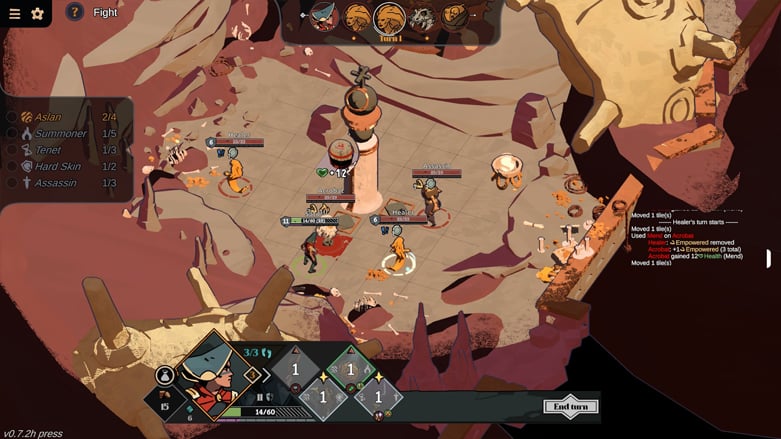
That being said, I actually found Deified’s take on the positional turn-based strategy gameplay to be a lot more engaging, for me personally, than a lot of other titles. I would credit this to the game’s pacing: Deified’s turns play pretty quickly, with you being able to execute your commands in less than 30 seconds when you know what you’re doing, with the enemy AI also playing fairly quickly.
I think a lot of this speed comes from how the game handles its abilities: The player’s only in-battle resource is movement points. Outside of that, you are free to use every ability you have, granted that it is in the proper range and granted that it isn’t on cooldown, with some stronger abilities taking more than a single turn to recover. This means that every turn you can, and should, use everything at your disposal, allowing you to kill enemies much quicker and leaving less time to worry about resource management or positioning. The fast-paced animations also help the game move quicker.
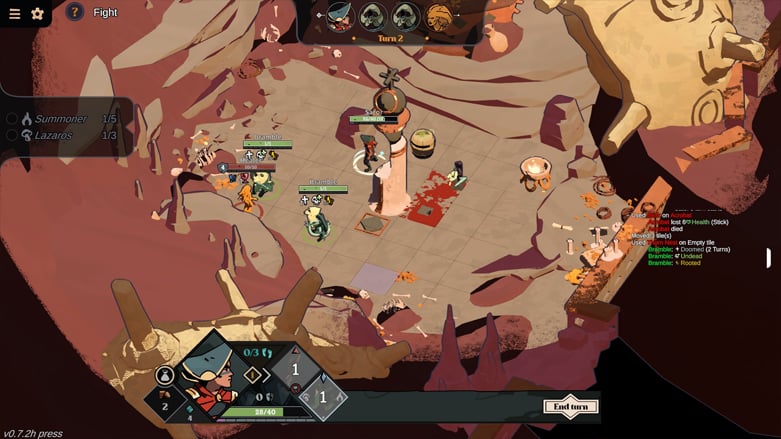
The caveat to the game’s energy-free skill system is that every skill is something you have to physically collect in order to use. Equipping an ability is a two-part process: first, you must buy the skill using gold at specific locations on the roguelike map. Second, you must level up by defeating enemies to unlock a spot to place your skill. You start each run with a blank slot for a skill and a chosen skill in the form of a weapon, essentially starting you with two and letting you build up from there.
The most important part of the game’s strategic challenge, in my opinion, is choosing the right skill slots when you level up. Each additional skill slot you unlock has both a positive and a negative effect. These can range from applying status effects on the positive side to requiring specific types of skills to be equipped there on the negative. This becomes drastically important as it changes what skills you can equip and how you use the skills you do choose to equip. Your build can change dramatically on the fly if you unlock a slot that doesn’t fit the skills you purchased ahead of time.
I got pretty invested in Deified’s combat. It flows quickly and has a surprising amount of strategic depth that makes each run feel unique. However, I was able to notice its flaws.
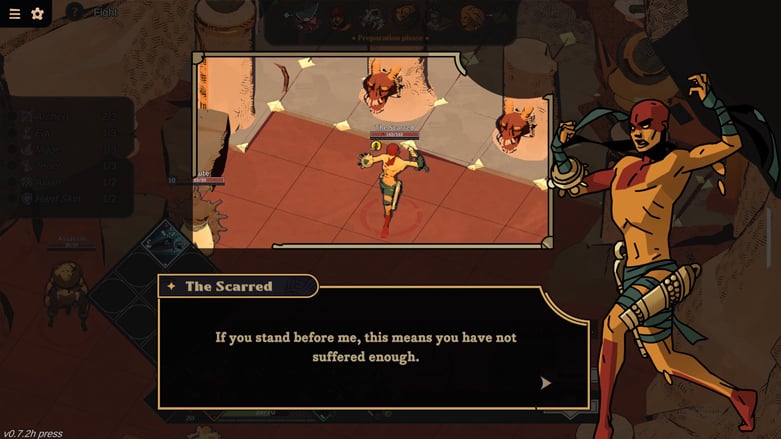
Mainly, the combat can be extremely challenging. That is an invitation to some, sure, but it’s more the way the game goes from trivial to challenging seemingly in an instant that can make it a bit frustrating. One encounter can be fine, and the next you can find yourself instantly killed because you stepped into the wrong tile. The sudden difficulty spike is mostly apparent in boss rooms, where a strong run can instantly feel turned on its head because the boss selected completely counters your build. Unfortunately, as part of the game’s pacing, the player character has very low health and can die incredibly quickly if you make a wrong move.
While the game is fun to play, I can say that in my experience it becomes somewhat of a slog to get through past a certain point. As upgrades become progressively more expensive, the game easily becomes a grind, with your runs taking longer to complete and you needing to do a lot more of them to make tangible progress. With much of the game’s content not available early, it can lead to the game feeling sort of dual-phased, with the first half feeling restrictive because you don’t have many tools to play with, and the second half feeling grindy because you can’t afford to unlock all of the upgrades you need to keep up.
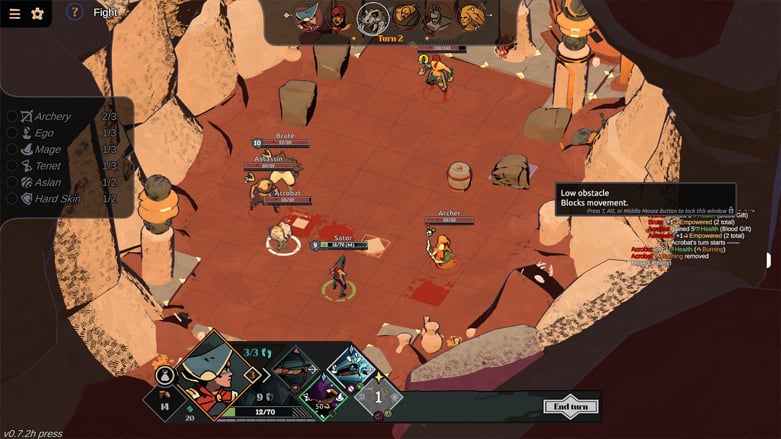
While I have said the pacing of the game’s turn-based combat is quick, I still don’t think it will appeal to people who dislike the genre. If, like me, you find the typical turn-based game a little tedious, Deified is a more enjoyable alternative. However, I don’t believe the game changes the mechanics or the pacing meaningfully enough to say that it would make a fan out of someone who doesn’t like the genre.
I have my criticisms of Deified, but if you haven’t noticed, there aren’t a whole lot of them. Overall, the game is pretty good, and I can see it being very appealing to its target audience: people who like turn-based roguelikes with a grid- and position-based strategy system. To others, the game is fine, but I don’t think it will have much reach outside its intended audience. If it’s caught your interest, you should certainly check it out.
The Final Word
Deified is a solid turn-based combat roguelike that should appeal to fans of the niche with its slightly faster pacing. However, I don’t expect it to change anyone’s mind if they aren’t already fans of similar titles, and the game’s difficulty curve and grindy nature might keep some players from enjoying it to the fullest.
Try Hard Guides was provided with a Steam code for this PC review of Deified. Find more detailed looks at popular and upcoming titles on our Game Reviews page!

Comments