As a professional, full-time game critic, I have dipped my toes into basically every genre gaming has to offer. It sort of comes with the territory. While there are certainly games I try to get my hands on ahead of time, many of the games I review are done so at the request of the developers who made them, which means I’m often going outside of my typical wheelhouse and playing games I otherwise normally would not play in my free time. The soulslike genre isn’t one of those genres. I absolutely adore everything soulslike, and I consider the genre to have some of my favorite progression and combat mechanics across all of gaming.
While the genre is defined by its namesake (I hope, if you’re reading this review, I don’t have to explain to you what Dark Souls is), one of the greatest privileges I have in this job is the ability to review some incredibly charming, interesting, and unique independent soulslike titles. False Hero is one of those, created by a solo developer and perhaps one of the most mechanically interesting soulslike titles I’ve had the pleasure of playing.
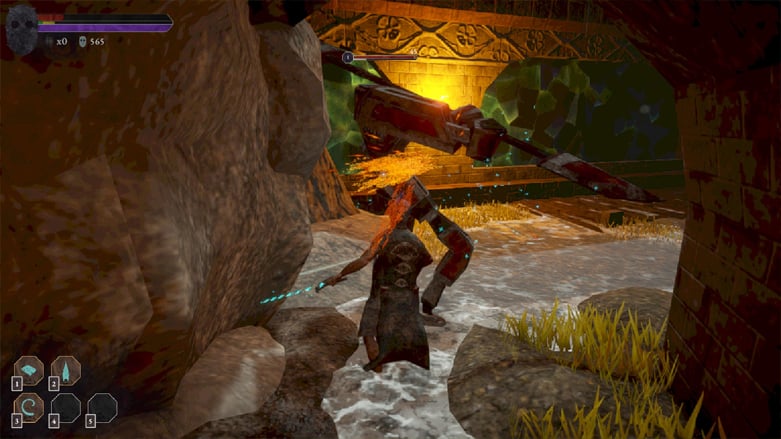
Much of the familiar is there for fans of the genre. The level design harkens back to the classic Souls games rather than the open-world nature of Elden Ring, with very linear momentum and tight pathways packed with visual storytelling. Some of the more nuanced combat mechanics are replaced with a simpler attack, dodge, and ability-casting system. I would say many of the subtler complexities of Dark Souls’ combat mechanics are absent in favor of a more straightforward system in False Hero.
Instead, False Hero really stands out for its unique mechanic that lets players steal enemies’ attack patterns. By defeating bosses or collecting the wisdom of fallen foes, you can equip the same abilities enemies use against you, filling your action bar with a series of powerful attacks. These attacks use their own resource bar and have a variety of effects, hitboxes, and uses. If I had to draw a parallel, I would say they’re most comparable to Elden Ring’s incantations, only you’re using a lot of them at once.
The game makes it blatantly clear that you’re expected to approach combat differently with this system, too. Rather than flat resource costs, these abilities cost a percentage of your resource bar, which you refill with your quote-unquote basic weapon attack. That weapon attack is utterly unreliable as a damage source, and you’re expected to weave your stolen abilities between attacks to maximize damage efficiency. Attack, ability, ability, attack: the game tells you that using a different input after each ability or attack hits the enemy faster than spamming the same one over and over. Long animation times and lockout windows make chaining your best approach to combat.
This might be recency bias, but I can’t recall a soulslike game that loves stunning, staggering, and knockdowns as much as this game does. It didn’t take long to realize I could open up wide windows of advantage against bosses by chaining the right mix of abilities and attacks into a brutal combo that locks the boss into multiple stagger windows. This, of course, didn’t feel like an exploit, as only so many stagger bar triggers could be executed in a row before the boss backed out, but rather felt like a unique way to reward proper ability chaining.
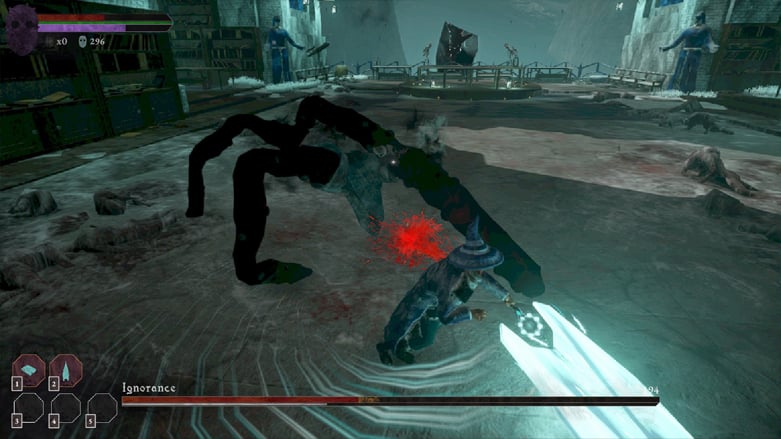
This obsession with staggering goes both ways, though. Again, I’m willing to wager that this could be recency bias (again), but I still can’t remember a soulslike game where I have been backed into a corner or stuck in a chain of knockdowns as I have in False Hero. Whether this is due to the game’s relatively tight level design, the way enemies frequently use combinations of staggering and wide-reaching heavy attacks, or a combination of both, it did get pretty frustrating at times. You can only dodge so many times before a mix of on-screen attacks and off-screen projectiles gets you stuck in a corner. It didn’t help that enemy projectiles seemingly could pass through other enemies with no consequence, which drastically limited the effectiveness of positioning.
There is a lot in False Hero that can be subjectively frustrating or part of the fun, from the aforementioned tight level design that can leave you backed into a corner with poor camera coverage, to a tendency for enemies to get you stuck in stagger or knockdown loops, or some other game design choices that can be argued to be janky or part of the challenge depending on your perspective. However, if I had to make one genuine criticism of False Hero, it would be how the game handles progression.
In False Hero, rather than leveling up attributes at a bonfire, you directly increase the damage of abilities that you collect from killing enemies. In a game like this, it doesn’t really make sense to have a wide array of attributes, since you’re spending the whole game essentially playing like a faith build in, say, Elden Ring. However, a few hiccups in this progression system feel like they undermine the best part of a soulslike system.
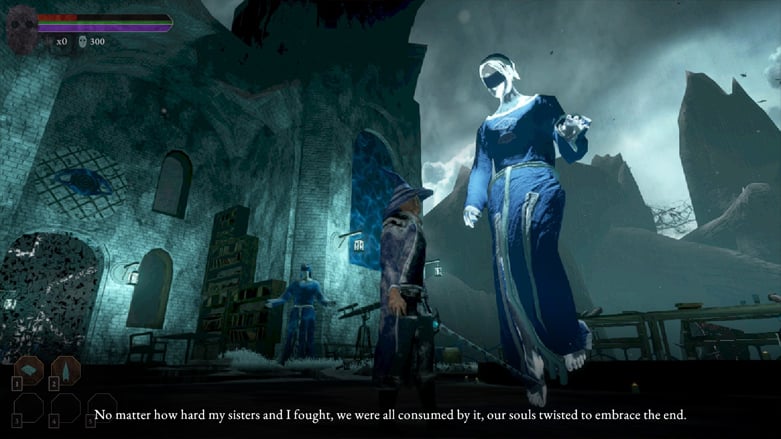
For starters, you can’t gain wisdom, aka the currency needed to learn new abilities, by defeating the same enemy repeatedly. This means only the first instance of an enemy drops wisdom, and respawns do not. While this makes sense, the game pairs it with a need for physical crafting materials in order to actually level up each ability.
Because these materials are limited and found throughout each level, it essentially means that there is little, or at least very limited, tangible reward for having to backtrack through an area. In a soulslike game, you collect currency on every kill and use it to increase your attributes by leveling up. In my opinion, that’s what makes the genre so fun. Your strength and preparedness for the difficult fights ahead are entirely dependent on how much time you want to spend collecting souls. If you’re ever stuck on a boss, you can always leave, kill some enemies, and come back stronger.
While False Hero does use its own system of souls to level up abilities, they are, again, paired with physical resources you have to collect in order to do so. These resources are limited and intentionally left throughout a level, sort of like item placement in other souls games. This makes progression incredibly linear. You are essentially only leveling up as much as the game allows, and only by moving forward. Going back to kill the same enemies because you died to a challenge ahead doesn’t necessarily make you stronger, so it sort of just feels like a punishment for losing rather than an opportunity to improve.
In my opinion, False Hero does what I consider to be the best part of a soulslike wrong, making progression rather linear and reducing the value of backtracking, whether it is something you choose to do or are forced to do because you died. However, it is hard not to praise the game on its other merits: its unique combat system, excellent worldbuilding, fun yet challenging boss fights, and other fan-favorite familiarities that make a Souls game great. If you ask me, the game might not get my favorite part of the formula right, but all of the other ingredients are so good that it’s hard not to appreciate it regardless.
The Final Word
Though I feel like False Hero misses the mark when it comes to what makes progression so fun and rewarding in a soulslike game, the title gets every other piece of the formula down incredibly well. Fans of the genre will appreciate this solo-developed gem, especially its unique approach to combat and interesting original story.
Try Hard Guides was provided with a Steam code for this PC review of False Hero. Find more detailed looks at popular and upcoming titles on our Game Reviews page! False Hero is available on Steam.

Comments