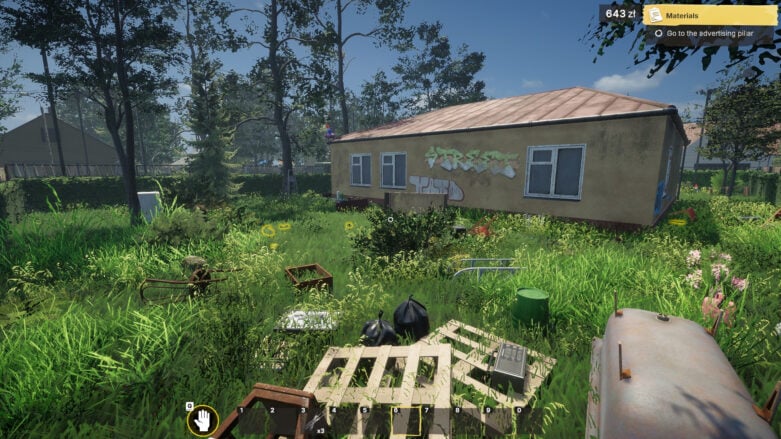
Chances are, most of you reading this review have played, or at least heard of, house renovation games; games that simulate the age-old dream of flipping a derelict junk home into a beautiful shelter of your dreams. More often than not, the games really emphasize a charming fantasy to go along with the experience: you’re often inheriting an old, run-down home and spending your free time helping your neighbors with your renovation skills, earning a little extra cash to put into your own fixer-upper. As someone who has helped family with some home renovations, it is never as easy or stress-free as these games make it out to be.
Enter Low-Budget Repairs, a game where you play as a shady, broke repairman aiming to cut corners anywhere he can to save a buck. The entire game is a genius parody of both the renovation gaming genre and the reality of shady, cheap repairmen willing to just barely get a job done for pay.
I mean, the game even opens with you throwing chairs at a couple of squatters to get them out of your house; a better way to set the tone, I can’t imagine.
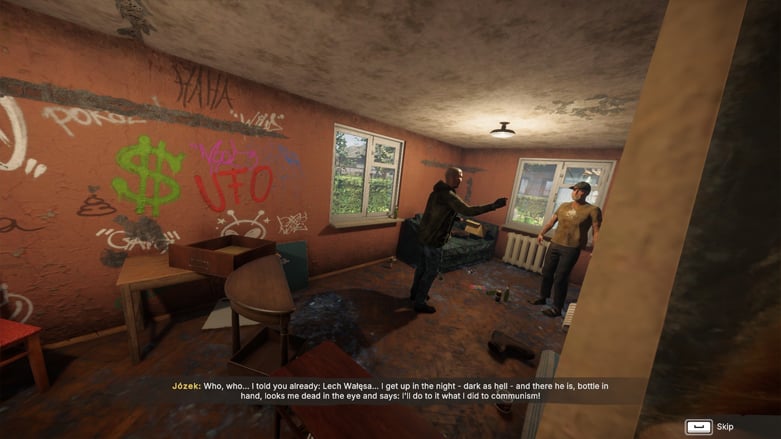
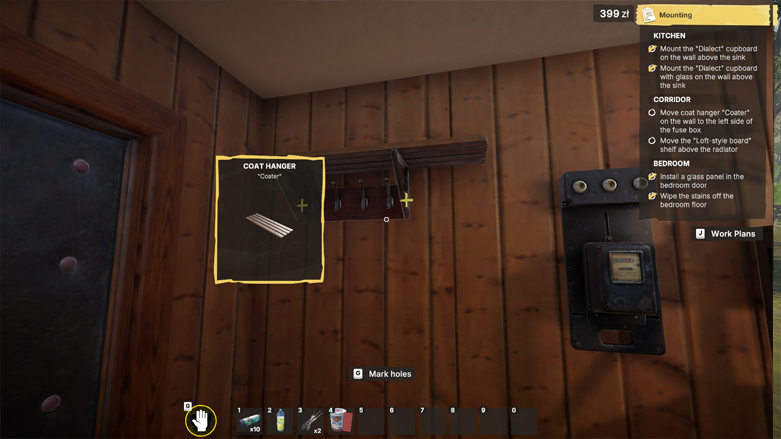
Therefore, the mechanics incentivize doing things half-assed and barely up to snuff. You can miss the mark drilling into walls, you can barely cover up raw drywall with paint, and you can even leave sloppy paint residue all over the floor. Break some windows, toss a couch out of a window, steal leftover materials from the worksite, etc.; in other renovation games, these small mistakes are often forgiven or even covered up by the mechanics. In Low-Budget Repairs, they’re left as is. Sure, you can do a job perfectly for a bonus, but what is 20 bucks compared to all of the time and material you saved?
No small effort was put toward the aforementioned parody, with a great deal of the game being dedicated to comedic dialogue and narrative in addition to the half-hearted repairs you do. Because of this focus on characters, dialogue, and humorous narrative, the game takes a bit more of a linear approach than most other renovation or simulator games would.
You follow in the footsteps of your recently deceased, ghostly Majster as he teaches you everything you need to know to be the world’s cheapest handyman and guides you toward winning a local competition celebrating the best in your craft. Along the way, you gather the materials, knowledge, and funds to renovate your own home, an honestly fantastic little house that I wish I could work on in real life.
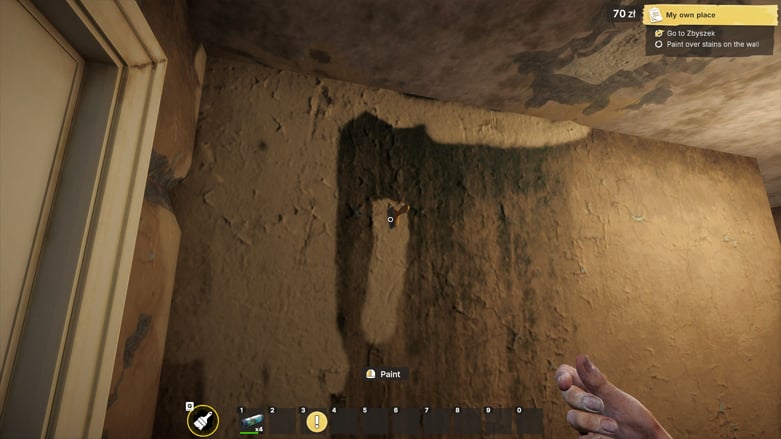
This more linear approach is fun, but can also at times make the game feel a bit more claustrophobic than others. You aren’t given quite as much freedom to take on the jobs you want to take on as you want to take them on. Instead, there is more of a campaign you follow from job to job, especially early on as you are taught the mechanics little by little.
Low-Budget Repairs takes a lot of time to introduce you to its varied mechanics, an honestly astounding amount of different work being made available to the player. Unfortunately, it doesn’t always feel like the game is willing to utilize all of the tools it gives you.
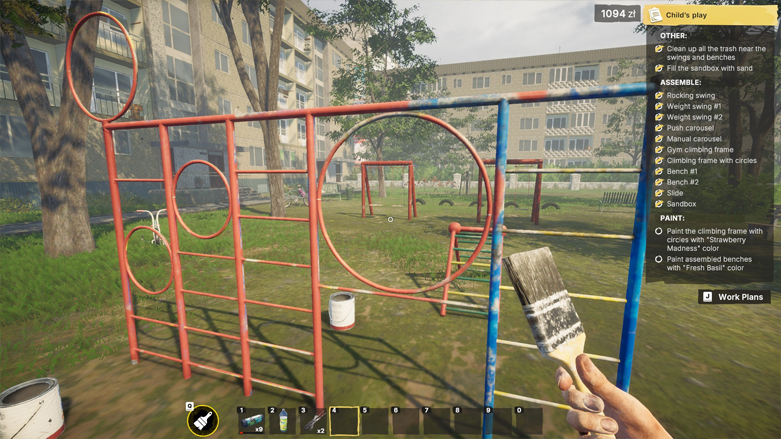
One such level comes to mind, one fairly early in the game, where you have to assemble an entire playground on your own. You might think that assembling playground facilities would require a screwdriver at the very least, but instead, this entire section is completed by simply picking up parts and placing them in a highlighted area. While I feel like these segments were dumbed down to improve pacing, ironically, removing the various mechanics used to simulate real labor makes the experience less immersive and thus more like a chore.
The biggest disappointment I have with Low-Budget Repairs is the game’s seemingly hypocritical stance on the use of generative AI.
From the store page’s AI-generated Content Disclosure:
AI was used for some translations, music, and visual assets. The game does not create AI-generated content during gameplay, and AI was not used to write the game’s code.
The creators seem to take a strong stance on the fact that the gameplay and code, aka the bulk of their workload, were not made through AI. It is 100% human-crafted and the result of good, honest, hard work. So what about the aforementioned music and visual assets? It seems hypocritical to me to put value in your own skill set, coding, and yet outsource the other creative elements of the game to generative AI. It reads like a developer who only values their own creative process but cares very little about others.
I won’t actually deduct any points from the game for this, because I can’t say that it actually affected the quality of the game or the experience. However, I will say that I found the practice to be hypocritical, and the art assets in the game that I could identify as AI-generated could very easily have been made in Photoshop. It felt like the developers had respect for their own craft but not enough respect for the craft of others to simply pay someone to whip together these assets themselves in one afternoon. Again, this didn’t exactly take away from the experience, but I simply dislike the statement a game makes when it chooses to use generative AI.
The Final Word
My gripes aside, I can honestly say that Low-Budget Repairs is one of my favorite new renovation games, if not my downright favorite. It does many mechanics in the genre well while also adding a real, comically dingy and cheap feeling to everything, entertaining beyond the satisfying process by allowing you to be a garbage handyman and accompanying the experience with great dialogue and characters. While I think the game could be a bit more open and make more frequent use of its immersive mechanics, it was still an overall fun game and one I think fans of the genre will really enjoy.
Try Hard Guides was provided with a Steam code for this PC review of Low-Budget Repairs. Find more detailed looks at popular and upcoming titles on our Game Reviews page! Low-Budget Repairs is available on Steam, Xbox, and PlayStation.

Comments