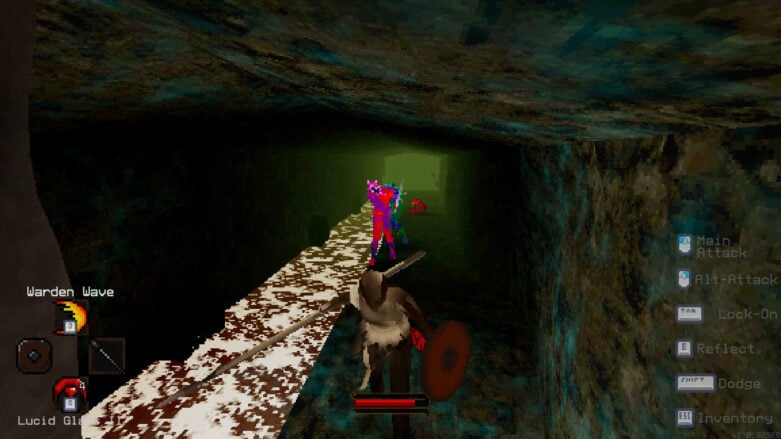
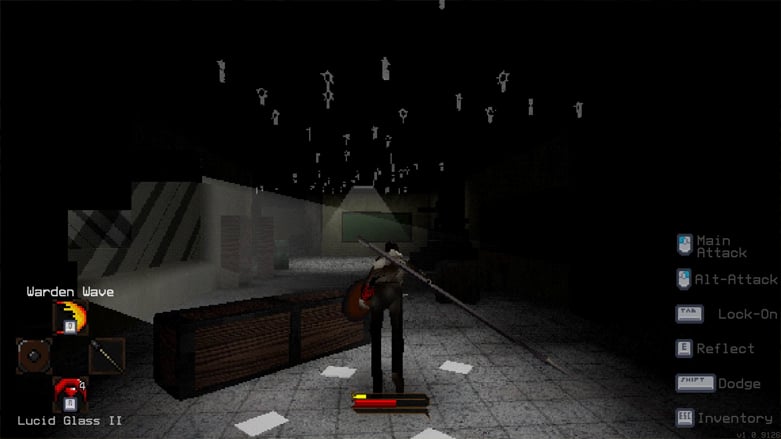
Imagine you boot up your favorite game, Dark Souls, and instead you find yourself in a retro-gaming nightmare. The already dated graphics you were expecting are somehow even more so, looking more as if they belong on the original PlayStation, with the enemies lacking any expression and only barely taking up the silhouettes of humanoids. The levels are different from what you remember, too, being surreal and dreamlike, and the sounds are all incredibly crisp but feel as though they are passing through a distorting filter, almost like they were coming out of an old CRT. Everything feels like… well, a dream, and while everything is peaceful on the surface, something deeper within tells you that you should wake up from this as soon as possible.
What I just described to you is the experience of playing Memoirium, one of the most unique soulslike games I have ever played, and one that takes you on an utterly surreal quest through the dreaming mind, with enemies guarding every path throughout.
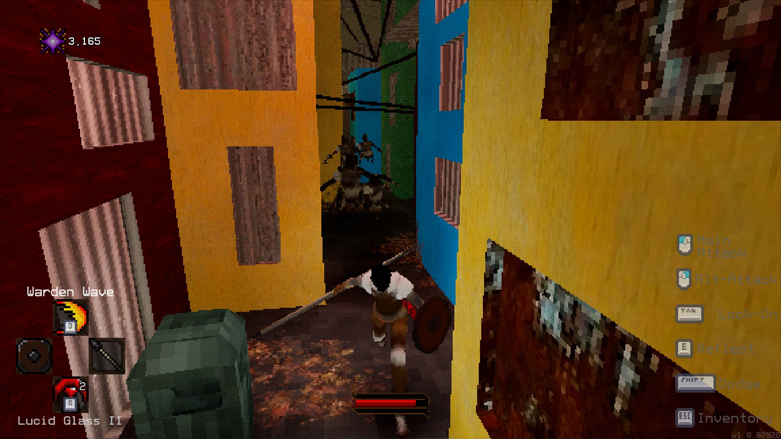
“Surreal,” “Odd,” and “Dreamlike” are some of the best words used to describe Memoirium, and this is on purpose. The theme of dreaming is not nearly as subtle in this game as the plots are in its FromSoftware inspirations: it is made clear from the beginning that the world you explore is one somehow connected by dreams, and that you, the player, are dreaming yourself, which is something you can’t argue with when you leave the space to explore and decorate your room.
This is a perfect excuse for the game to use a lot of level design ideas that might not work in a more “normal” space. Every level is a fever… well… dream, with geometry that doesn’t quite make sense and liminal spaces that would make even a diehard Backrooms fan squeal. These levels do quite a bit of the heavy lifting in the game, as exploring each one and taking in its unique, often slightly disturbing vibes is what really pushed me to keep playing when the game would otherwise become stale.
The combat system introduced to you, the player, is fairly similar to other Dark Souls games, down to the point where I swear some of the animations are exactly the same. Where the game differs, however, is mainly in its attack types: four different types exist for the player to avoid, each one having its own mechanic used to avoid the simple (and much easier) option of getting your ass kicked.
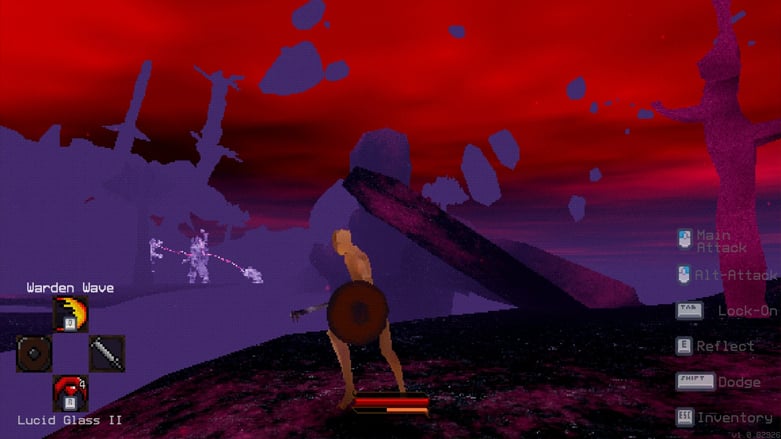
The different attack types, in a vacuum, aren’t too difficult to avoid. Some require you to block, some you must dodge, and others you have to jump over or use a blocking-adjacent mechanic called deflection to overcome. While I can see other players (read: players who are much better than me) having no problem with this system, I often found myself a bit overwhelmed by it in practice. Often, I was forgetting what each attack type was and what the corresponding reaction was supposed to be, which meant that I was dying more often than I should have been.
That being said, I also found that many enemy attacks could be completely avoided by simply stepping backward or to the side, so a lot of the time combat for me felt a lot less like a technical dance and more like me moonwalking, interrupted by the occasional slash from my weapon of choice.
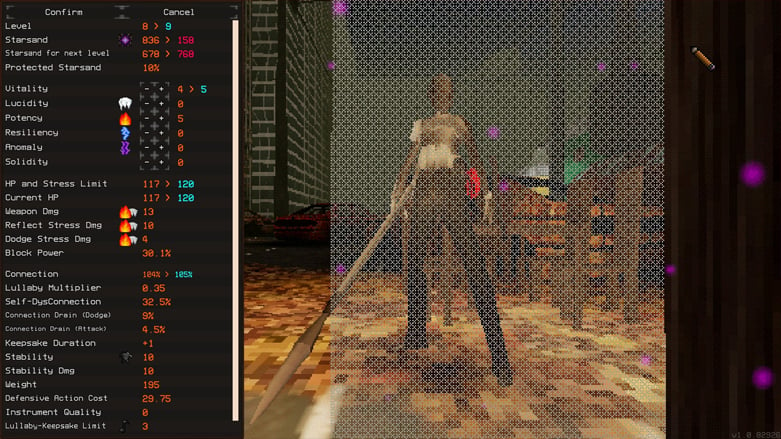
Interestingly, the game also uses what I have come to call a “reverse resource bar” system. In essence, instead of having a stamina or mana bar that ticks down every time you use an ability, you instead have bars that fill with each attack or action you input. When the bar fills up, you’re afflicted with a status ailment that weakens you to the corresponding action type that filled the bar, which often marks an instant, or at least near-instant, death.
I like this system, though I can’t say how mechanically significant it is compared to a traditional resource bar. In practice, it plays essentially the same way: you use your actions sparingly to avoid entering a state of weakness from spamming them. Still, it feels thematically interesting. Something about overindulging, perhaps? I can’t say that I’m smart enough to tell you the developer’s intent behind this one.
If there were one aspect of the game I would complain about, it would be the tedium of some of the later, hazardous levels. The game’s very linear, Dark Souls-like level designs venture into absurd difficulty in areas where hazards like lightning bolts home in on the player’s location, in zones that feel almost purposefully difficult simply to pad time. While I didn’t like these areas, they felt like a bit of tarnish on what was otherwise an exceptional experience, and I was already deeply impressed by the game by the time they came around.
Overall, Memoirium is an impressive indie Soulslike that takes players on a unique, uneasy adventure through a dreamlike world. It is eerie, unsettling, yet warm, feeling much like the odd lucid dreams the game takes its inspiration from. Fans of the original Dark Souls games, as well as anyone looking for a totally unique indie experience, are sure to have a great time with Memoirium, and I hope it stays with you longer than a fleeting dream would.
The Final Word
Memoirium confidently executes the aesthetic of the dreamworld, feeling like a lucid-yet-violent walk through a distant reality accessed only in the late hours of the night. Solid, if occasionally tedious, combat mechanics inspired by the Souls franchise accompany a visually and sensorily vivid world that could only be dreamt up by the maddest of minds. If you’re looking for a truly memorable indie gaming experience, Memoirium is the title for you.
Try Hard Guides was provided with a Steam code for this PC review of Memoirium. Find more detailed looks at popular and upcoming titles on our Game Reviews page! Memoirium is available on Steam.

Comments