I’m a big fan of deckbuilding roguelikes. They combine two of my favorite genres: card games (I spent way too much money on Magic’s Final Fantasy expansion, by the way) and the ever-replayable roguelike game that manages to flood my brain with dopamine in ways other games cannot. While I love many of these games regardless, very few often do anything to deviate from the formula popularized by Slay the Spire: I’ve said multiple times across multiple reviews that, much like Metroidvania titles, the deckbuilding roguelike genre often avoids reinventive gameplay in favor of creating games with incredibly unique art, visuals, and storytelling.
It’s a rare treat, therefore, to find a game that is not only fun to play and carries on the genre’s reputation for incredible and original storytelling and artwork, but also significantly reinvents the deckbuilding roguelike gameplay formula. That rare treat is Moonsigil Atlas.
Moonsigil Atlas follows the tale of three mages beckoned by the stars, and a celestial deity that implores them to defend the moon from the onslaught of titans. This cosmic-horror-adjacent deckbuilder sees you slaying beings that prey upon the stars from the perspective of a mere mortal, casting magical signs into the constellations to fight threats beyond the scope of our imaginations.
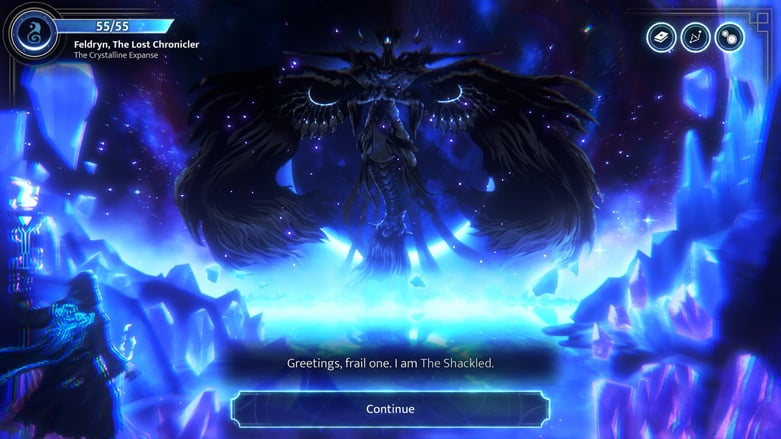
This incredibly unique premise extends not just from the art and storytelling, but also plays a pivotal, thematic role in how you actually play the game.
In most Slay the Spire-inspired deckbuilders, the cards you play in a turn are limited to the amount of points you generate at the start of that turn. Each card has a cost and that cost eats away at a total until you’re left with zero. This is meant to balance how many cards you play in a turn, forcing you to make the decision between going all-in on offensive or defensive cards or striking some kind of cost-efficient balance in between. The meta of these games often revolves around reducing the cost of cards as low as you can to make the most of your turns.
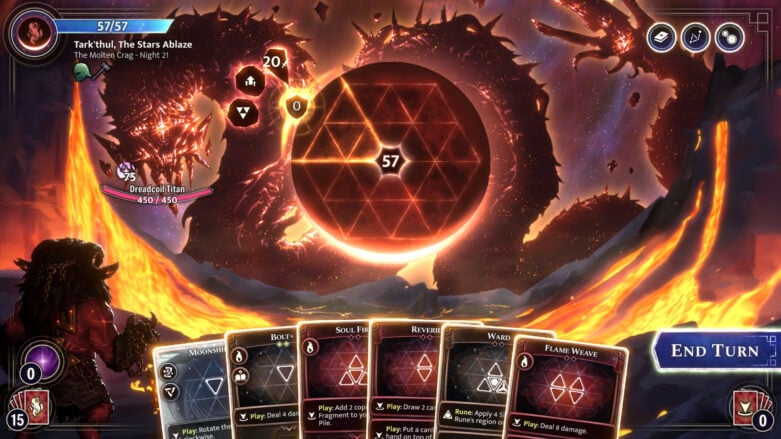
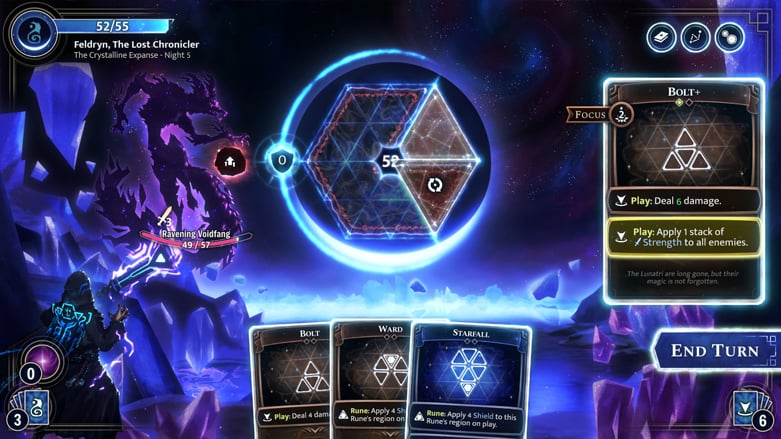
Moonsigil Atlas, however, has no card costs. Instead, the field you play upon is comprised of real space, with each card having its own pattern that fills in those spaces. The only limit to how many cards you can play in a turn is how efficiently you manage to fill the space.
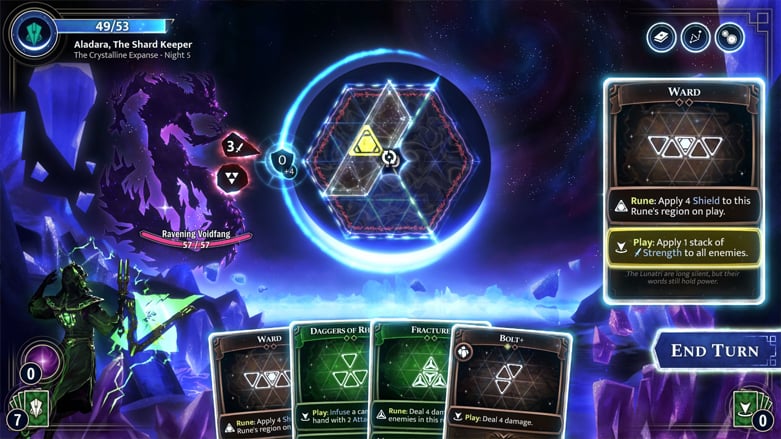
The entire game is cleverly balanced around this mechanic. Enemies, especially bosses, strategically deny or create access to more spaces as you fight, forcing you to play around what’s available. Cards that prevent damage only do so if played in specific spaces correlating to that enemy, and some cards are designed to fill space or become stronger when played over spaces that have been previously used. It’s an incredibly simple concept that opens up a shocking amount of strategic depth, and I quickly fell in love with it.
The thematic alignment between this gameplay mechanic and the game’s premise is strong, too. You are essentially creating constellations in the stars to fight, and I loved every second of it.
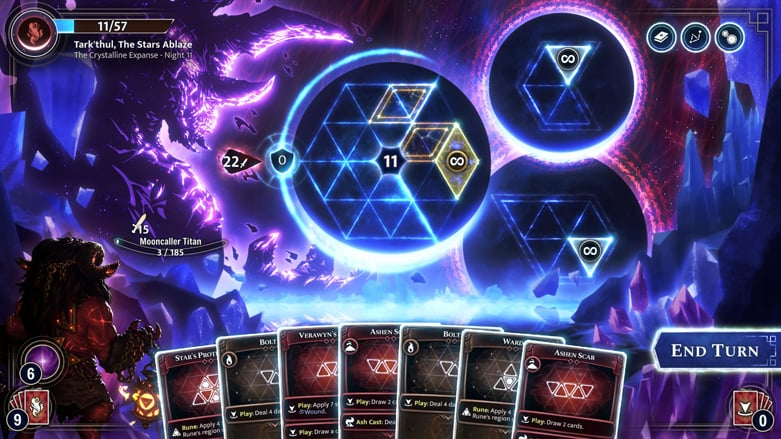
Moonsigil Atlas features three playable characters, each one with their very own unique style of play. I’ll admit that this element of the game left me wanting more: while each character’s unique style was fun to master and there were a lot of cards to unlock by perfecting your mastery with these characters, I simply wanted more options for ways to play the game. All three were quickly unlocked in sequence, and I felt disappointed that there wasn’t a whole lot more to the mystery of who or what came next as I played the game. I hope in future updates to the game they manage to add more playable characters and deck styles.
I will also say that I wasn’t totally in love with the way the game handles roguelike progression. As you unlock mastery on each character, you permanently add to the card pool they can pull from. While this is pretty standard for the genre, I’m simply not a fan. I would prefer that we start the game with the entire card pool unlocked, and that mastering a character comes with passive bonuses that affect how we play the game. Something more akin to Legends of Runeterra’s single-player mode is what I’d like to see in deckbuilding progression, and I think this game would have done some really creative stuff in that direction if it had chosen to go in that direction.
That isn’t to say that all progression in the game is boring or uninspired, with plenty of interesting powerups and mutations available during your runs. Each character’s deck has its own unique ways of feeling strong, and it definitely feels like the developers want your progression to feel more like finally unlocking the full power of each character’s unique strengths, which is fun, but I still think it could have been done in a more exciting way.
It should speak volumes about the quality of Moonsigil Atlas that I have so few complaints, and that one of the most prominent complaints I did have was that I simply wanted more content from the game. I can easily say that Moonsigil Atlas has become one of my new favorite entries into the genre, standing out not only for its incredible art and unique story but for the inventive way it tackles familiar gameplay. I highly recommend this title and only hope to see further additions in the future.
The Final Word
Moonsigil Atlas is an incredible entry into the deckbuilding roguelike genre, reinventing familiar mechanics with a fun twist that fits in with the thematic elements of the game beautifully. It is as fun to play as it is incredible to look at, featuring some great art and unique card mechanics that shine through, even if you may be left wishing the game had a bit more to play with.
Try Hard Guides was provided with a Steam code for this PC review of Moonsigil Atlas. Find more detailed looks at popular and upcoming titles on our Game Reviews page! Moonsigil Atlas is available on Steam.

Comments