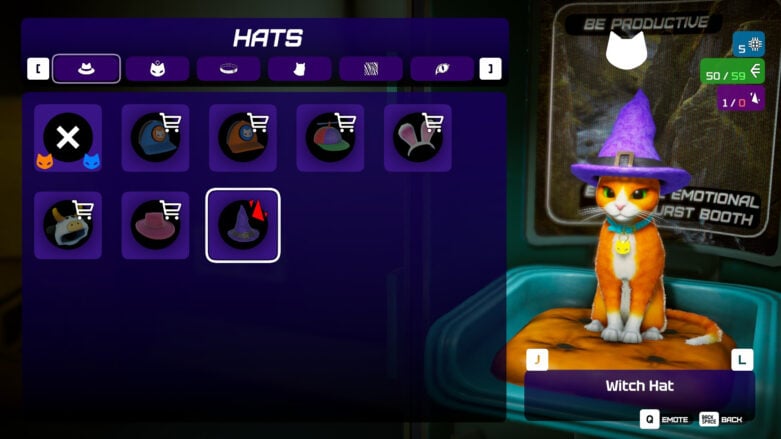
What would you do if you could be in two places at once? Would you use your clone as an alibi to commit some sort of lucrative crime, get twice as much work done, or even avoid work altogether, spending more time with your loved ones and hobbies while simultaneously making that hard-earned buck? This seemingly simple superpower has a near-endless number of possible utilities in your day-to-day life, making it a deceptively life-changing ability that anyone would benefit from. Now take all of those possibilities you imagined and pretend you’re a cat instead.
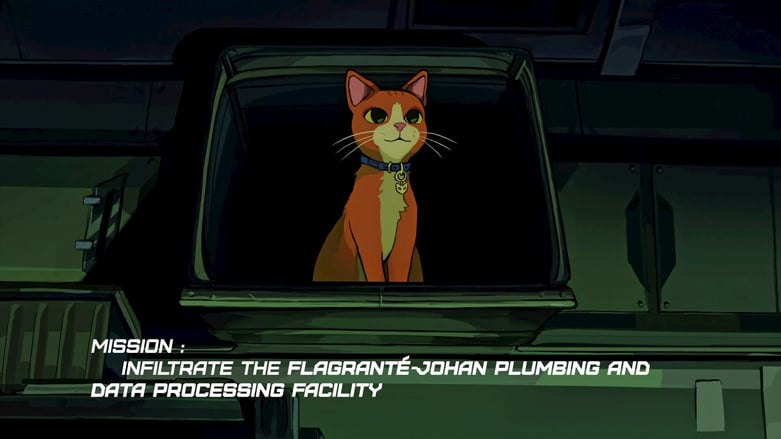
Schrodinger’s Cat Burglar is a game that follows Whiskers, the world’s greatest cat burglar, who also happens to be a literal cat. If you go into the game, like I did, with no prior knowledge of anything else about it, it might not give the best first impression.
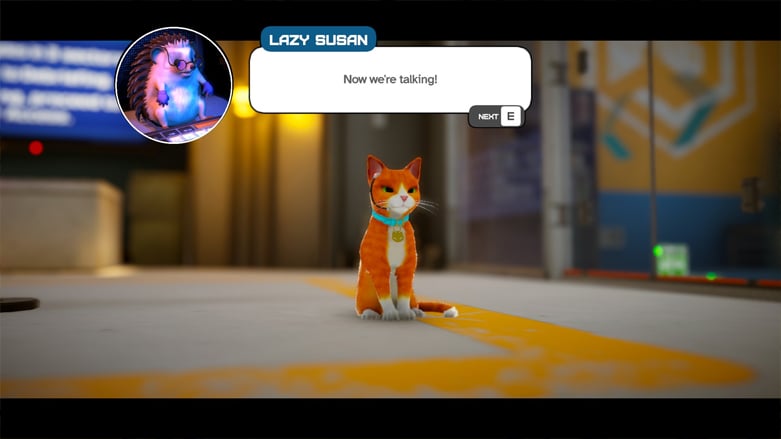
The game you open into presents itself as a platformer-lite from a cat’s perspective. Using a sort of auto-jump system, you can scale great heights with feline finesse, making a daring escape from a twisted underground laboratory in a way only a cat could. The game at this point cleverly designs its mechanics around the fact that you’re playing a cat: robotic mice can be jumped down upon to slay them, Roombas make for convenient travel apparatuses, and you can, and will, knock objects over as you traverse human furniture. Oh, and of course, you can hack computers by mashing your little bean pads against them.
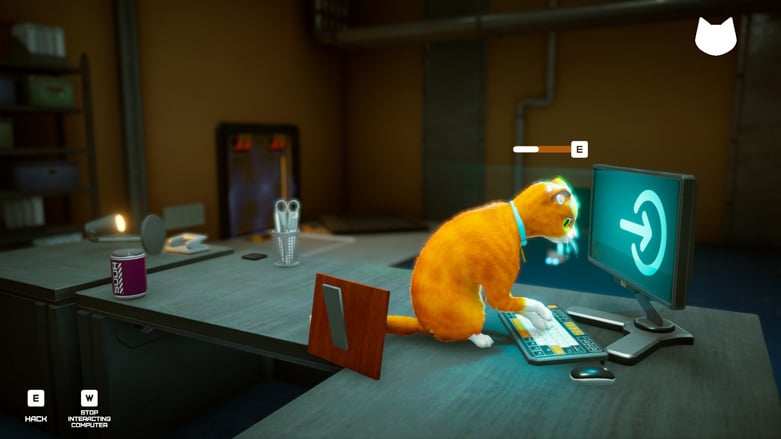
This is a cute take on the platforming genre, but if this were all the game had to offer, I wouldn’t be very impressed.
Thankfully, what felt like a tutorial for the entire game was actually just a tutorial for a small aspect of it, as this fifteen-or-so-minute level (probably shorter if you do less exploring than I did) ends with our protagonist entering the dreaded machine and gaining the ability to split in two.
What Schrodinger’s Cat Burglar becomes from this point on is essentially Portal 2 with cats, a comparison that the game actually uses in its marketing. With the ability to polarize himself into two separate entities, it’s up to Mittens to use this new power to solve a series of puzzles, all of which are cleverly designed around the ability to multiply and then divide oneself at will.
The most interesting part about the puzzle-solving gameplay of Schrodinger’s Cat Burglar is that the game can be played entirely single-player. Sure, the game has multiplayer functionality, but I almost found it more interesting to play solo than online. Rather than turning your second controllable character into a bot controlled by the AI, Schrodinger’s Cat Burglar instead gives you the power to control both. Puzzle-solving becomes all the more difficult and interesting as you have to think and then control two bodies at once, often challenging your spatial awareness as much as it challenges your logical thinking.
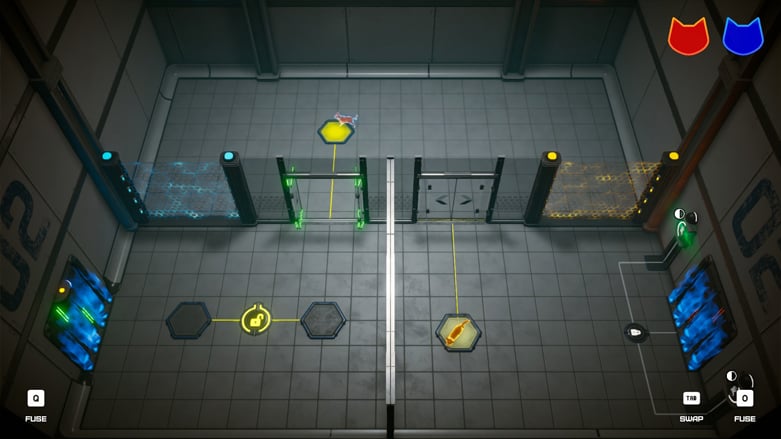
Something that I particularly enjoy about Schrodinger’s Cat Burglar is that the puzzles are challenging but not overly so, and the game gives you ample yet unobtrusive introductions to its mechanics. That extended introduction I spoke about earlier is simply how the game chooses to teach you its information: it gives you enough time to learn its mechanics and concepts one at a time without being overbearing with tutorials or pop-up pages. It even presents you with an utterly optional obstacle course to learn how to control both characters at once, which you can choose to skip when you feel like you’ve got the hang of things.
Once everything clicks into place, Schrodinger’s Cat Burglar simultaneously becomes a Portal fan’s dream and an excellent introduction to puzzle games for the puzzle-averse. Its mechanics are simultaneously easy to understand and logically challenging, making for some excellent brain-teaser puzzles that aren’t so overbearing as to make you feel stupid for not getting them. All of it is paired with the quirky talking-cat-secret-agent theme of the game, which just comes together to make a fun, charming indie game, and one that, in my opinion, is criminally undercharged.
That’s right, Schrodinger’s Cat Burglar sits at a measly twenty dollars on the Steam store, or even less if you pick it up before June 4. While there are definitely indie games out there that don’t quite punch up to their cost of entry, Schrodinger’s Cat Burglar is not one of them, and I would absolutely recommend the game at this price for both die-hard Portal fans looking for their new fix or those simply looking to try out a fun, quirky puzzle game, even if you don’t think you’re very good at them.
Schrodinger’s Cat Burglar is great. It offers a lot, between its fun concept, its engaging puzzles, and the unique way in which it handles its split-up mechanics. While the game is fun to play with two, I really recommend you give it a try in single-player, as controlling two cats at the same time is a unique experience that I think elevates the game a lot. If the title has caught your interest at all, I definitely recommend you jump in, because there are certainly many worse things you could spend twenty bucks on.
The Final Word
Schrodinger’s Cat Burglar combines a unique and quirky concept with Portal-like puzzle solving, creating brain teasers that are simultaneously challenging and yet unusually forgiving to new players. The game can be played with two players, but it is a completely different experience when you play alone, enticing your brain not only with cooperative puzzles but with the challenge of controlling two cats at the same time.
Try Hard Guides was provided with a Steam code for this PC review of Schrodinger’s Cat Burglar. Find more detailed looks at popular and upcoming titles on our Game Reviews page! Schrodinger’s Cat Burglar is available on Steam.

Comments