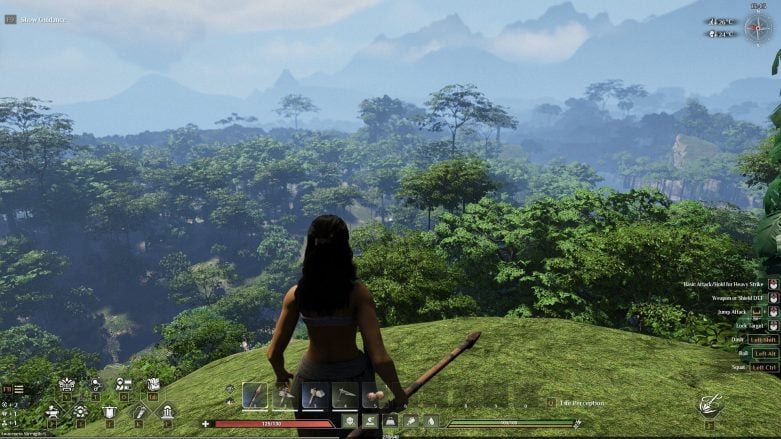
Soulmask is an ambitious new survival-crafting game that just entered Early Access. When I say the game is ambitious, I mean it, as Soulmask packs in a wealth of inspired design choices and features that easily separate it from other games in the genre. While the game certainly has potential and currently has positive reviews on Steam, I can safely say it has a bit of work to get done before it leaves early access.
Immediately, Soulmask stands out from other games in the genre with its setting; Soulmask takes place in an incredibly unique Meso-American Fantasy setting the likes of which I haven’t seen in other games, with others that come close choosing to focus more on the aesthetic of European explorers.
While the game currently doesn’t give too much story, what is presented is that you, the player, have recently escaped an attempted human sacrifice ritual. Finding the titular Soul Mask, you are given the power to enforce your will over your enemies and set out to build your own civilization in the resource-rich jungle.
The combat in Soulmask is also fairly impressive for its genre. Each weapon has a unique move set, including light attacks, heavy attacks (which function more like special moves), and abilities such as a bey-blade-esque spinning sword attack.

The combat reminds me a lot of Dark Souls, actually, both in the weight of attacks, the damage you receive, the heavy use of blocks and dodging, and the slightly stunted, weighty-feeling animations and attack sounds.
Soulmask’s main mechanical loop seems to be gathering, subduing, and putting your enemies to work to build a massive, automated base. It’s something I’ve seen done in other survival craft titles; Conan Exiles is where I was introduced to the concept, with that game allowing you to place captured workers on crafting benches for a production boost or setting them up as guards. Sons of the Forest expands on it a bit by giving you an AI companion so you can give a range of limited commands, allowing him to gather your more basic resources for crafting.

Soulmask, however, takes the idea to what could possibly be the apex and allows you to assign your workers to every aspect of the game’s gathering and crafting. Its issuing order system allows you to send a worker to far-off regions of the map, gather resources, operate crafting tables, and maintain your base, allowing them to do everything in a cycle. It’s fairly impressive, and while some micro-managing is involved, you can more or less offload the game’s menial tasks to your servants so that you can go off and fry bigger fish.
When you start a game, Soulmask likes to throw a lot of tutorials your way. And I mean, a lot; It is perhaps the most hand-holdy tutorial sequence I have ever seen, and it continues several hours into the game. Not only are you given lengthy quest objectives that go so far as to specify that you have to look at a container to open it, but you are constantly prompted to open up a deeper, encyclopedia-style tutorial page for further information. Thankfully, this can be shut off, but if you are trying to learn the game, the tutorial can be a frustrating one to get through.
The game struggles to communicate many of its ideals due almost entirely to its poor localization. Sentences will run on and use phrases that are unclear even in context. For example, your level is called “Awareness Strength,” a confusing statistic I thought applied to my Strength stat in the character screen.
For a survival craft title like Soulmask, where base building plays such an important part in the game, you really need to make sure that the mechanic for doing so is fluid and easy to use. As it is currently implemented in Soulmask, base building is kind of a frustrating prospect. The system for snapping one piece to another is very glitchy and can make rotating a piece a herculean task. The simple task of filling in a hole in my first building’s roof was a chore that took upwards of five minutes to get the piece to align properly.

The base building also makes some really strange choices. For example, you have to place your bonfire, which is a giant, flaming… well, a bonfire that clearly belongs outside, beneath a highly flammable thatch roof. Otherwise, the rain will put the fire out and remove your respawn point.
Soulmask’s UI and HUD are pretty, with thin lines and a modern sort of look, but that doesn’t help distract from how busy and awkward to navigate the whole thing can be. Endless menus plague the game’s navigation, requiring you to jump back and forth from multiple sections and memorize the game’s quick keys to get through them in a timely manner. The crafting section of the hud has poor organization; you have to right-click to open further menus to navigate with most of the options in said hud. It’s hard to explain exactly how sluggish and tedious the UI in Soulmask feels, but by experiencing it yourself, you’ll certainly catch on to what I mean.
On top of this, there’s just constantly too much information on the screen. I mean, just look at this screenshot and tell me it doesn’t give you a mild headache.

Overall, I think Soulmask has some good ideas but needs more work, especially on the non-mechanical side of things. The UI, menu navigation, building, and localization need some improvement before this game can shine as the ambitious survival craft the developers want it to be.
Pros:
- Ambitious mechanics with an advanced follower system that allows you to offload gathering and construction to your workers
- Pretty good combat, especially for the genre
- A great, unique setting that feels truthful to its inspirations
Cons:
- Lackluster base building mechanics
- Poor Localization
- A clunky, hard-to-navigate UI that floods you with too much information.

Comments